
Brief Context
In News A National Campaign on Entrepreneurship was launched to strengthen non-farm livelihoods for rural women under Deendayal Antyodaya Yojana – National Rural Livelihoods Mission (DAY-NRLM). Importance of Rural Entrepreneurship Reducing Overdependence on Agriculture: Agriculture still employs 45% of India’s workforce but contributes only 18% to GDP. Non-farm rural enterprises help absorb surplus labour.
Source Content
Syllabus: GS2/ Governance, Rural Development
In News
- A National Campaign on Entrepreneurship was launched to strengthen non-farm livelihoods for rural women under Deendayal Antyodaya Yojana – National Rural Livelihoods Mission (DAY-NRLM).
- The campaign aims to train 50,000 Community Resource Persons (CRPs) on enterprise promotion and impart Entrepreneurship Development Programme (EDP) training to 50 lakh SHG members.
Importance of Rural Entrepreneurship
- Reducing Overdependence on Agriculture: Agriculture still employs 45% of India’s workforce but contributes only 18% to GDP. Non-farm rural enterprises help absorb surplus labour.
- Employment and Income Generation: MSMEs contribute 30% of India’s GDP and 45% of exports. Rural enterprises expand MSME base beyond urban centres.
- Women-Led Development: SHG-based enterprises improve female labour force participation, which remains around 25%. Income control by women improves nutrition, health, and education outcomes.
- Migration Reduction: Local enterprises reduce seasonal and distress migration to urban areas.
Government Steps To Foster Rural Entrepreneurship
- Pradhan Mantri Employment Generation Programme (PMEGP): Implemented by KVIC, it provides subsidies up to 35% on project costs (higher in rural areas) for new micro-enterprises in manufacturing and services, targeting unemployed youth and artisans with loans up to Rs. 25 lakh.
- ASPIRE Scheme: Launched by MSME, it funds Livelihood Business Incubators (LBIs) in rural areas with up to Rs. 1 crore for infrastructure, skill programs, and innovation support to nurture agro-rural startups.
- Lakhpati Didi Initiative: “Lakhpati Didi” designates SHG women achieving ₹1 lakh+ annual household income (₹10,000+ monthly) over four seasons/cycles via farm/non-farm activities.
- NABARD’s Role: NABARD supports rural non-farm sectors via refinancing, infrastructure (e.g., rural haats), capacity-building for SHGs/FPOs, and programs like MEDPs/LEDPs.
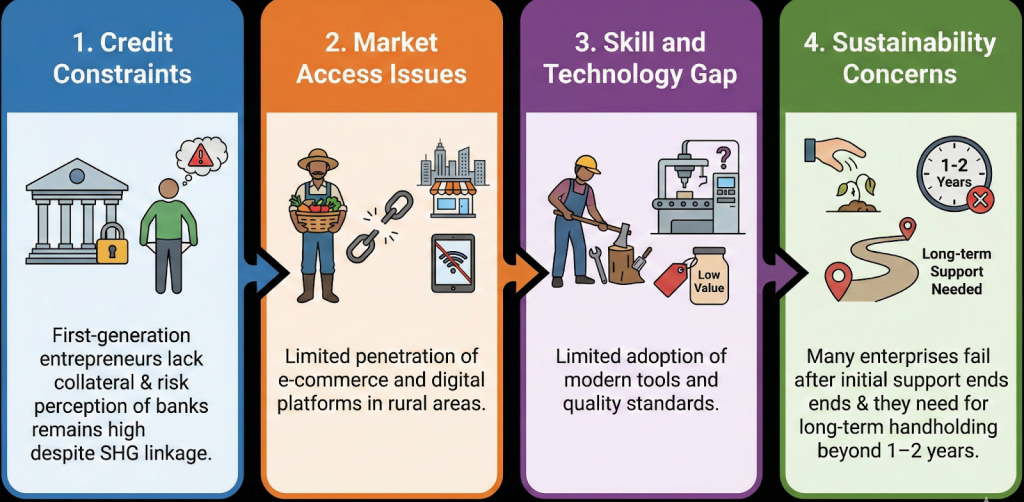
Challenges in Rural Entrepreneurship
| About DAY-NRLM
– Launch: 2011 (restructured from Swarnajayanti Gram Swarojgar Yojana (SGSY)). NRLM was renamed as DAY-NRLM in 2016. |
Source: PIB