
Brief Context
Context The early onset of the southwest monsoon over Kerala this year has caught the attention of meteorologists. What is Madden-Julian Oscillation (MJO) The MJO is a moving system of winds, clouds, and pressure that brings rain as it circles around the equator. It was discovered in 1971 by Roland Madden and Paul Julian.
Source Content
Syllabus: GS1/ Geography
Context
- The early onset of the southwest monsoon over Kerala this year has caught the attention of meteorologists.
- According to the India Meteorological Department (IMD), the Madden-Julian Oscillation (MJO) played a significant role in this development.
What is Madden-Julian Oscillation (MJO)
- The MJO is a moving system of winds, clouds, and pressure that brings rain as it circles around the equator.
- It was discovered in 1971 by Roland Madden and Paul Julian.
- The system travels eastward at 4–8 m/s and circles the globe typically every 30–60 days, though it can take up to 90 days.
- As it moves, strong MJO activity often splits the planet into two parts — one in which the MJO is in active phase and brings rainfall, and the other in which it suppresses rainfall.
Geographical Influence
- The effect of the MJO is witnessed mainly in the tropical region, in the band between 30 degrees North and 30 degrees South of the equator, even though the mid-latitude regions in both hemispheres also feel its impact.
- It also includes India, making it a crucial player in the South Asian monsoon system.
- During an active MJO phase, regions within its influence experience above-average rainfall, often due to increased cloud formation, convection, and cyclonic activity.
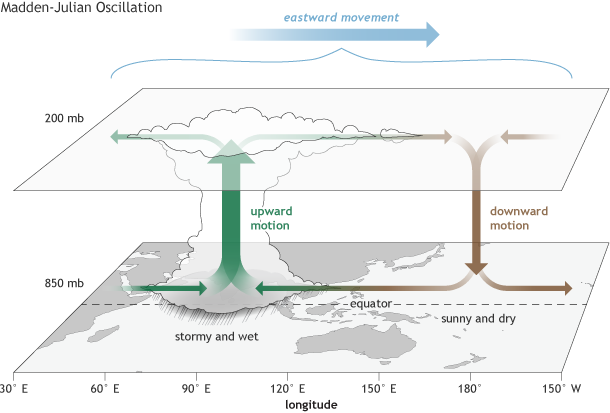
Contribution of MJO to the Early Monsoon
- This year, the MJO was observed in Phase 4 with an amplitude greater than 1 around May 22, originating in the Indian Ocean.
- Phase 4 with strong amplitude is indicative of intense rainfall and storm systems, conducive for monsoon initiation.
- This setup contributed to frequent cyclonic activity and cloud build-up over the Bay of Bengal, helping trigger the early arrival of the monsoon over Kerala.
Other reasons for Early Monsoon
- Transition to La Niña: In early 2025, global climate models indicated El Niño weakening and possible La Niña development — a pattern historically associated with stronger and earlier monsoon seasons in India.
- Stronger-than-usual cross-equatorial winds: During May, winds from the southern hemisphere begin to blow across the equator and enter the Arabian Sea.
- When these winds are stronger and more organised, they push moisture-laden air toward the Indian coast more quickly, hastening the monsoon’s arrival.
- Above-normal sea surface temperatures: Warmer-than-usual waters in the Arabian Sea and Bay of Bengal fuel intense convection, which helps develop cloud bands and low-pressure systems needed for monsoon formation.
- In 2025, sea surface temperatures in the region were higher than average, aiding early cloud development.
Concluding remarks
- While the early onset of the monsoon offers critical advantages for agriculture and water resource management, it also intensifies climate-related vulnerabilities.
- As monsoon patterns become increasingly erratic under climate change, strengthening early warning systems and forecasting models remains essential for safeguarding lives, livelihoods, and ecosystems.
Source: IE