
Brief Context
Context The Mahanadi Water Disputes Tribunal has given a final opportunity to Odisha and Chhattisgarh to arrive at a mutual settlement on water sharing before proceeding with its own adjudication. About Inter-state river disputes arise when multiple states contest the use, control, or allocation of shared river waters, reflecting the tension between state autonomy and collective resource management. With nearly 80% of freshwater used in agriculture, rising population, industrial demand, and urba
Source Content
Syllabus: GS2/ Polity & Governance
Context
- The Mahanadi Water Disputes Tribunal has given a final opportunity to Odisha and Chhattisgarh to arrive at a mutual settlement on water sharing before proceeding with its own adjudication.
About
- Inter-state river disputes arise when multiple states contest the use, control, or allocation of shared river waters, reflecting the tension between state autonomy and collective resource management.
- With nearly 80% of freshwater used in agriculture, rising population, industrial demand, and urbanisation have intensified pressure on river systems, making water a strategic and political resource.
Causes of Inter-State Water Disputes
- Asymmetric river geography allows upstream states to exercise greater control over water flows, often affecting downstream availability during critical seasons.
- State boundaries not aligned with river basins disrupt integrated planning, as rivers flow across multiple administrative units with differing priorities.
- Rising demand for water due to agriculture, urbanisation, and industry has created intense competition over limited resources, particularly in water-stressed regions.
- Unilateral infrastructure development, such as dams and barrages, often occurs without consensus, triggering disputes and mistrust among states.
- Lack of transparent data sharing undermines scientific allocation, as states rely on differing estimates of water availability.
- Climate variability, including erratic monsoons and droughts, increases uncertainty and complicates long-term water-sharing arrangements.
- Politicisation of water issues transforms technical disputes into identity-driven conflicts, delaying rational resolution.
Legal and Institutional Framework
- Article 262 of the Constitution empowers Parliament to legislate on inter-state river disputes and restricts judicial intervention once a tribunal is constituted.
- The Inter-State River Water Disputes Act, 1956 provides for the establishment of tribunals to adjudicate disputes, ensuring a quasi-judicial resolution mechanism.
- The River Boards Act, 1956 envisages basin-level management institutions, although it has remained largely ineffective in practice.
- Recent reforms, including the Inter-State River Water Disputes Amendment Bill, 2019, propose a permanent tribunal system and a central data repository to improve efficiency and transparency.
Challenges in Resolving Water Disputes
- Delays in tribunal processes often extend beyond mandated timelines, reducing the credibility and effectiveness of dispute resolution.
- Weak enforcement mechanisms allow states to delay or partial compliance.
- Fragmented institutional structures prevent coordinated basin-level management, as multiple agencies operate without integration.
- Limited multidisciplinary expertise in tribunals restricts the incorporation of hydrological, environmental, and climate perspectives.
- Judicial interventions and political pressures further complicate and prolong dispute resolution processes.
- Environmental degradation and over-extraction reduce available water, intensifying competition among states.
Way Forward
- To resolve water disputes, India should strengthen cooperative federalism through permanent tribunals and river basin authorities.
- Establishing a centralised data bank with satellite monitoring ensures transparent, objective decision-making.
- Additionally, promoting micro-irrigation, climate-resilient frameworks, and ecological flows will ensure long-term sustainability and efficient resource management across administrative boundaries.
Mahanadi River and Dispute
- The Mahanadi River, spanning about 851 kilometres, originates from the Amarkantak plateau in Chhattisgarh and flows extensively through Odisha before draining into the Bay of Bengal. Its basin supports agriculture, industry, and dense human settlements.
- The central issue revolves around assessment of annual water availability, which forms the basis of any sharing formula. The absence of reliable and mutually accepted hydrological data has stalled progress.
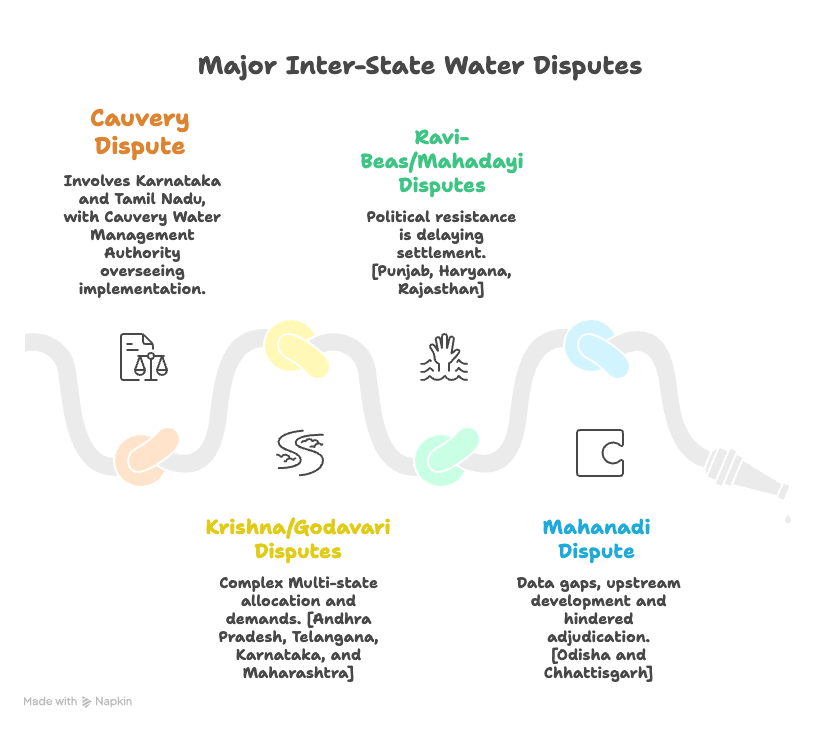
- Odisha alleges that extensive upstream infrastructure, including over 500 anicuts and multiple barrages, has altered river flow, while Chhattisgarh argues its developmental and irrigation needs justify water utilisation.
- The dispute is compounded by the absence of a formal water-sharing agreement, making the tribunal’s decision critical for future allocation and governance.
- Odisha approached the Union Government in 2016, leading to the constitution of the Mahanadi Water Disputes Tribunal in 2018 under the Inter-State River Water Disputes Act, 1956, after negotiations failed to yield results.
Source: TH