
Brief Context
Context Post-harvest losses remain a significant challenge in India, particularly for perishable commodities and there is a need for integrated cold chain and value addition infrastructure. Scale of Post Harvest Loss India ranks second in global agriculture production, but its share in global agricultural exports is only 2.4%, placing it eighth in the world. India’s post-harvest losses amount to approximately ₹1,52,790 crore annually, according to a Ministry of Food Processing Industries 2022 st
Source Content
Syllabus: GS3/Infrastructure
Context
- Post-harvest losses remain a significant challenge in India, particularly for perishable commodities and there is a need for integrated cold chain and value addition infrastructure.
Scale of Post Harvest Loss
- India ranks second in global agriculture production, but its share in global agricultural exports is only 2.4%, placing it eighth in the world.
- India’s post-harvest losses amount to approximately ₹1,52,790 crore annually, according to a Ministry of Food Processing Industries 2022 study.
- The biggest loss is from perishable commodities, which include livestock produce such as eggs, fish and meat (22%), fruits (19%) and vegetables (18%).
Reasons for the Post Harvest Loss
- Harvesting Inefficiencies: Premature or delayed harvesting leads to the quality & quantity loss.
- Mechanisation Gaps: Limited access to harvest machinery causes damage & spillage.
- Inadequate Market Access & Price Support: Small farmers often sell produce immediately after harvest due to liquidity constraints and lack of warehouse receipts.
- Leads to distress sales and discourages investment in proper storage or post-harvest handling.
- Pest & Disease Attacks: Inadequate pest control leads to crop spoilage.
- Inadequate Infrastructure: Shortage of cold chains, warehouses, moisture-proof silos leads to the rotting/decay of the food items.
- Transport Bottlenecks: The road infrastructure is not robust and there is a lack of refrigerated transport support.
Concerns
- Direct GDP Loss: In India, food loss is estimated at ₹1.5 trillion annually of GDP loss which can be avoided through more efficient and resilient food systems.
- Farmer Incomes: It leads to reduced profitability due to spoilage and wastage of produce.
- Green House Gas Emissions: Even modest percentage losses in cereals, particularly paddy, translate into more than 10 million tonnes of carbon dioxide (CO2)-equivalent emissions annually, owing to the high methane intensity of rice.
- Losses of livestock products are equally damaging because of their heavy resource footprint.
- Burden on government schemes: The food wastage also has a cascading impact on the government food security schemes such as Public Distribution System, nutrition missions.
- Loss of Resources: The production of these food crops is a cumulative result of proper water supply, energy, fertilizer, land and labour.
- The food lost is equivalent to the wasted water, energy, fertilizer, and land etc.
Government Initiatives
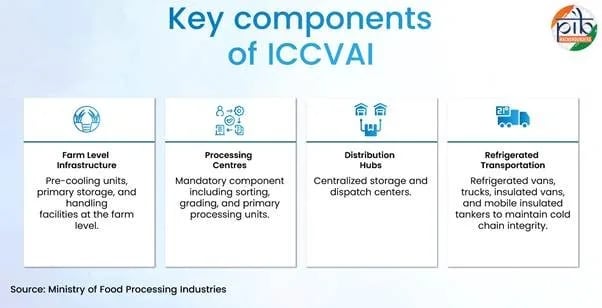
- Integrated Cold Chain and Value Addition Infrastructure Scheme (ICCVAI): The Ministry of Food Processing Industries (MoFPI) runs the ICCVAI Scheme, as part of the Pradhan Mantri Kisan Sampada Yojana (PMKSY).
- The scheme encompasses multiple sectors, including horticulture, dairy, meat, poultry, and marine or fish products, thereby addressing a broad spectrum of perishable commodities crucial to agriculture and allied industries.
- Mission for Integrated Development of Horticulture (MIDH): Under the MIDH, financial assistance is provided for a range of horticulture activities, including the construction, expansion, and modernization of cold storages with a capacity of up to 5,000 MT across the country.
- These projects are implemented based on Annual Action Plans submitted by States and Union Territories.
- Operation Greens Scheme: It is a central Sector Scheme being implemented by MoFPI under Pradhan Mantri Kisan SAMPADA Yojana from 2018-19, with the objective of enhancing the value realisation of farmers and minimizing post-harvest losses.
- Agriculture Infrastructure Funds (AIF): The Fund aims to facilitate the creation of post-harvest management and community farming assets, including cold storages, warehouses and processing units.
- All the eligible beneficiaries can avail collateral-free term loans of up to₹2 crore along with an interest subvention of 3% per annum on the term loan.
- Enhanced Budgetary Allocation under PMKSY (2025): The Union Cabinet in 2025 approved an additional outlay of₹1,920 crore for the PMKSY, raising the total allocation to ₹6,520 crore for the 15th Finance Commission cycle.
- This significant increase reflects the government’s strong commitment to expand the impact of cold chain infrastructure.
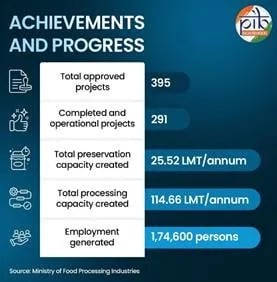
Achievements and Progress
Conclusion
- The evolution of the scheme demonstrates adaptive governance.
- The 2025 budget increase underscores the government’s focus on strengthening and expanding the impact of cold chain infrastructure.
- Strengthening linkages with agricultural marketing reforms can further amplify benefits for farmers including Doubling Farmer’s Income (DFI).
Source: PIB