
Brief Context
Context India has retained its position as the world’s second-largest steel producer since 2018, reinforcing its position as a competitive and expanding global player. About Steel Steel is an alloy primarily composed of iron, carbon ( There are different forms of steel and iron which are vital for the steel sector. Some of them are: Crude steel: First solid steel product formed upon solidification of liquid steel.
Source Content
Syllabus: GS3/ Economy
Context
- India has retained its position as the world’s second-largest steel producer since 2018, reinforcing its position as a competitive and expanding global player.
About Steel
- Steel is an alloy primarily composed of iron, carbon (< 2%) and manganese (1%), along with small quantities of silicon, phosphorus, sulphur and oxygen.
- There are different forms of steel and iron which are vital for the steel sector. Some of them are:
- Crude steel: First solid steel product formed upon solidification of liquid steel.
- Finished steel: Product obtained upon hot rolling/forging of Semi-finished steel.
- Hot metal, pig iron and sponge iron: Key forms of iron that constitute important categories within the steel industry.
India’s Global Position in Steel Sector
- India’s share in global crude steel production increased from 5.2% in 2014 to 7.9% in 2024, reflecting its growing global competitiveness.
- According to the World Steel Association, India is also the world’s second-largest consumer of finished steel.
- Finished steel consumption in India increased from 77 million tonnes (MT) in 2014–15 to 163.7 MT in 2025–26.
- Top destinations for India’s finished steel exports in March 2026 were Vietnam, Belgium and Taiwan, comprising more than 50% of India’s total finished steel exports.
- India aims to achieve 500 MT steel production capacity by 2047 as part of the long-term industrial growth strategy.
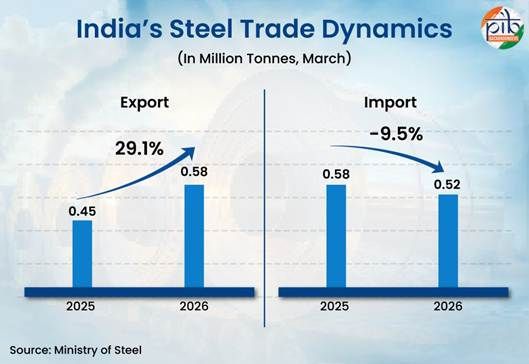
Importance of the Steel Sector for India
- Backbone of Industrial Development: Steel supports core sectors such as infrastructure, housing, transportation, power, capital goods, and heavy industries, while contributing roughly 2% to India’s GDP.
- Employment Growth: The steel industry generates large-scale direct and indirect employment across mining, manufacturing, logistics, and ancillary industries.
- National Security Importance: A strong domestic steel base is crucial for defence manufacturing, shipbuilding, railways, and strategic infrastructure.
Government Reforms Supporting Steel Sector
- National Steel Policy: The National Steel Policy 2017 envisions expanding crude steel capacity to 300 MTPA and production to 255 MTPA by 2030–31.
- Additionally, raising per-capita finished steel consumption to 158 kg from the current 61 kg.
- Production Linked Incentive (PLI) Scheme for Specialty Steel: It aims to strengthen India’s manufacturing capabilities by offering financial incentives to eligible companies based on their incremental sales.
- The scheme offers incentives for 5 years (FY 2024-25 – FY 2030-31) to companies that meet specified investment and production targets.
- Specialty steel is a value-added steel product manufactured through advanced processing techniques to provide superior strength, durability, corrosion resistance, and performance.
- Identification of Steel Zones: The Government is fast-tracking key logistics and infrastructure projects across 12 major steel zones.
- Priority rail, road and port expansions are underway to ease bottlenecks and develop world-class multimodal connectivity supporting the sector’s growth.
- The Steel Scrap Recycling Policy (2019) has been notified to boost the availability of domestic scrap.
- In April 2025, the Government imposed a 12% safeguard duty on select non-alloy and alloy steel flat products. This protects domestic manufacturers from import surges and maintains fair market competition.
Decarbonisation of India’s Steel Sector
- India is pursuing decarbonisation of the steel sector to achieve its net-zero emission intensity target by 2070 through energy efficiency, renewable energy adoption, green hydrogen, scrap recycling, and Carbon Capture, Utilisation and Storage (CCUS) technologies.
- In 2024, India became the first country to introduce an official Green Steel Taxonomy, defining green steel as steel produced with emission intensity below 2.2 tonnes of CO₂ equivalent per tonne of finished steel.
- By March 2026, 89 steel units had received green steel certification covering 12.34 MT production.
Way Ahead
- India’s steel sector has emerged as a major driver of industrial growth, infrastructure development, and economic self-reliance.
- With rising production capacity, expanding exports, focus on specialty steel, and commitment towards green steel and decarbonisation, the sector is poised to play a crucial role in India’s vision of becoming a developed and sustainable economy by 2047.
Source: AIR