
Brief Context
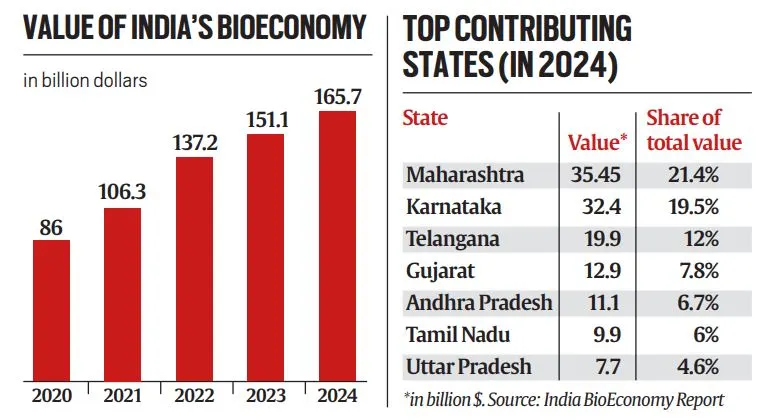
India BioEconomy Report has pegged the value of India’s bioeconomy in 2024 at more than $165 billion, accounting for over 4.2% of the country’s GDP.
Source Content
Syllabus: GS3/ Economy, Environment
In News
- India BioEconomy Report has pegged the value of India’s bioeconomy in 2024 at more than $165 billion, accounting for over 4.2% of the country’s GDP.
- The report highlighted ample opportunity for this sector to grow to about $300 billion by 2030, and to $1 trillion by 2047.
What is Bioeconomy?
- Bioeconomy refers to the industrial use of biological resources (plants, animals, and microorganisms), and the replication of natural biological processes in the production of goods and services.
- Bioresources like plants or microorganisms are renewable, relatively cheap, and locally available, while natural processes are more sustainable and eco-friendly.
- A prime example of this is the growing use of ethanol, which is produced through fermentation of crops like sugarcane or corn by microorganisms, as a biological alternative to fuels traditionally derived from hydrocarbons.
Why Bioeconomy Matters for India?
- Economic Growth & Jobs:
- Expected to contribute $1 trillion by 2047.
- The number of companies in the bioeconomy has increased by almost 90% in the last three years.
- Nearly half the value of the bioeconomy (roughly $78 billion) was generated in the industrial sector, for the development and use of biofuels and bioplastics.
- Food & Agriculture Security:
- GM technologies improve yields by 21%.
- Biofertilizers enhance soil health.
- Innovations like golden rice combat micronutrient deficiencies.
- Healthcare Access:
- Affordable drug and vaccine production (e.g., CERVAVAC – HPV vaccine).
- Gene therapy advancements (e.g., Hemophilia A trial).
- India supplies 25% of WHO’s total vaccine volume.
- Environmental Benefits:
- Promotes circular economy via waste-to-energy technologies.
- Reduces reliance on fossil fuels with biogas and ethanol.
- Supports biodiversity conservation and eco-restoration (e.g., TERI’s Oilzapper).
- Climate Action:
- Helps achieve India’s net-zero target by 2070.
- Reduces emissions through bio-based alternatives.
BioE3 Push For India’s Bioeconomy
- To catalyze this growth, the government launched the BioE3 policy in 2024—Biotechnology for Economy, Environment, and Employment.
- The policy promotes:
- Establishment of Bio-AI Hubs, Bio-Foundries, and Bio-Enabler Hubs
- Focus on advanced technologies, sustainable biomanufacturing, and pan-India implementation
- Assam became the first state to formally adopt the BioE3 framework, setting the stage for widespread national rollout.
Other Initiatives
- BioSaarthi Mentorship Initiative (2025): BioSaarthi is designed as a six-month cohort facilitating structured mentor-mentee engagements, offering personalized guidance to emerging entrepreneurs in the biotech sector.
- Draft National Biotechnology Development Strategy (2020–25): Targets $150 billion bioeconomy by 2025, focusing on R&D innovation, Industry competitiveness & startup growth.
- Biotechnology Industry Research Assistance Council (BIRAC): Public sector interface to Fund biotech startups.
- National Biopharma Mission: Supports clinical trials, biosimilars, biotherapeutics, and vaccine development.
- PM-JIVAN Yojana: Focus on bioethanol and compressed biogas from agri-waste.
- SATAT & GOBARdhan Schemes: Promotes bio-CNG plants and waste-to-energy models, aligned with rural bioeconomy goals.
- Global Biofuel Alliance (2023): Led by India, USA, and Brazil to strengthen biofuel supply chains and reduce fossil fuel dependence.
- IP Guidelines (2023): Encourages commercialization of public-funded research.
Challenges to Address
- Despite progress, India’s bioeconomy faces several hurdles:
- Fragmented Regulation: Overlaps between agencies delay biotech approvals.
- Limited Investment: High risk and long return on investment deter private capital.
- IP & Bio-piracy Issues: Weak enforcement hampers innovation and indigenous protection.
- Weak Industry-Academia Linkages: Limits commercial translation of research.
- Import Dependence: On high-end equipment and biotech inputs.
- Skill Shortages: Need for trained professionals in genomics, bioinformatics, etc.
- Public Perception: Skepticism around GMOs and lab-grown food remains high.
- Environmental Risks: Overexploitation of biological resources could harm biodiversity and land use.
Way Ahead
- Strengthen Policy Implementation & Coordination: Ensure effective rollout of the BIO-E3 Policy across all states.
- Establish a National Bioeconomy Mission to provide centralized coordination.
- Promote state-level policies aligned with national bioeconomy goals (as Assam has done).
- Boost Investment & Public-Private Partnerships: Create dedicated Bioeconomy Investment Funds.
- Offer tax incentives and risk-sharing models to attract private capital in high-risk biotech ventures.
- Scale PPP models in R&D, manufacturing, and skill development.
- Accelerate Regulatory Reforms:
- Streamline regulatory frameworks through a single-window system (expand BioRRAP).
- Harmonize biotech approvals across agencies (DBT, FSSAI, GEAC, etc.).
- Build capacity in biosafety and ethics review boards for faster innovation deployment.
- Foster Research, IP & Innovation Ecosystem: Fast-track IP approvals and set up specialized IP courts for biotech.
- Strengthen academia-industry linkages through co-development platforms.
- Encourage applied research in synthetic biology, gene therapy, bioinformatics, etc.
- Expand Biotech Infrastructure & Hubs:
- Set up Bio-AI Hubs, Biofoundries, and bio-incubation centers in Tier 2/3 cities.
- Invest in shared testing labs, pilot-scale facilities, and data repositories.
- Support precision farming zones and bio-industrial parks.
- Empower Startups & Entrepreneurs:
- Scale initiatives like BioSaarthi for mentorship and global exposure.
- Strengthen BIRAC schemes for funding, incubation, and early-stage scale-up.
- Encourage grassroots bio-entrepreneurship and women-led biotech ventures.
- Invest in Skilling & Education: Integrate bioeconomy curricula in universities and skill development missions.
- Establish Centers of Excellence in genomics, molecular biology, and bio-manufacturing.
- Enhance Global Collaboration: Forge R&D partnerships with biotech leaders like the EU, Japan, USA.
- Lead international forums like the Global Biofuel Alliance and One Health platforms.
Source: IE