
Brief Context
In News Indias aviation sector is undergoing major infrastructure expansion and regional connectivity enhancement. Indias aviation sector It is growing and includes scheduled air transport (domestic and international airlines), non-scheduled services (charter and air taxis), and air cargo (cargo and mail transport). It is witnessing rapid growth, driven by rising demand and strong government support through strategic policies.
Source Content
Syllabus: GS 3/Economy
In News
- India’s aviation sector is undergoing major infrastructure expansion and regional connectivity enhancement.
India’s aviation sector
- It is growing and includes scheduled air transport (domestic and international airlines), non-scheduled services (charter and air taxis), and air cargo (cargo and mail transport).
- It is witnessing rapid growth, driven by rising demand and strong government support through strategic policies.
- It has transformed into a vibrant and competitive market, making India the third-largest domestic aviation market globally, after the USA and China.
- India’s domestic air passenger traffic reached a historic milestone, surpassing 5 lakh passengers in a single day in 2024.
- Over the past decade, domestic air passenger traffic has grown 10-12% annually.
- India boasts 13–18% of women pilots, which ranks among the highest globally.
- The Directorate General of Civil Aviation (DGCA) targets 25% representation of women in all aviation roles by 2025.
Related Steps
- Parliament passed the Protection of Interest in Aircraft Objects Bill, 2025, aligning India’s aviation leasing laws with global standards to reduce leasing costs.
- The Bharatiya Vayuyan Adhiniyam 2024 modernized India’s aviation sector, replacing the colonial-era Aircraft Act from 1934.
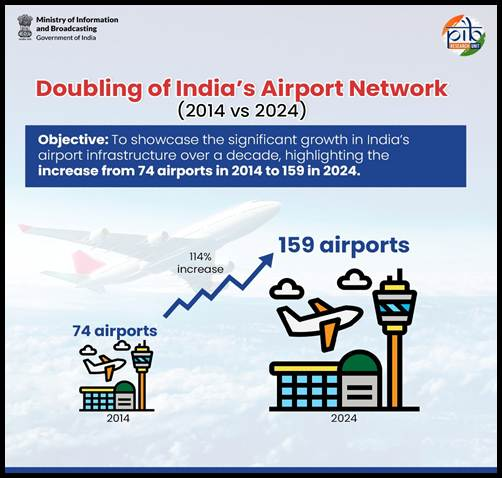
- Foundations for new terminals have been laid in cities like Varanasi, Agra, Darbhanga, and Bagdogra.
- Greenfield Airports: Since 2014, 12 out of 21 approved Greenfield Airports have become operational, including Durgapur, Shirdi, Kannur, Kushinagar, Itanagar, and others.
- Projects at Noida (Jewar) and Navi Mumbai are progressing, with completion targeted by FY 2025-26.
- The government plans to develop 50 more airports and connect 120 new destinations in the next 10 years.
- Capital Investment: Over ₹91,000 crore has been allocated under the National Infrastructure Pipeline (NIP), with ₹82,600 crore already spent by November 2024.
- RCS–UDAN: Expanding Regional Connectivity Since 2016, the UDAN scheme has operationalised 619 routes and connected 88 airports, making air travel more accessible and affordable.
- In 2024, 102 new routes were launched, including 20 in the North East.
Challenges
- India’s aviation industry is growing rapidly but experts warn of challenges, including overdependence on imports and a shortage of skilled talent.
- Despite global supply chain diversification, India’s share in aviation exports remains low.
- Current arbitration frameworks are insufficient to handle complex aviation disputes, leading to cases being resolved in global hubs like Singapore, London, and Paris.
Conclusion and Way Forward
- India’s aviation sector is undergoing a major transformation, marked by infrastructure development, improved regional connectivity, and a focus on sustainability.
- Initiatives like RCS-UDAN have expanded air travel access, boosting economic growth in underserved areas.
- With rising domestic and international passenger numbers, India is set to become a global aviation hub.
- But there’s a need to increase indigenisation and value-added production to strengthen the ecosystem.
- India must focus on neutrality, transparency, and institutional strength to align with global best practices in aviation arbitration.
- The industry stakeholders should engage and collaborate with policymakers to implement efficient and rational decisions that would boost India’s civil aviation industry.
Source :PIB