
Brief Context
Context The Minister of Communications announced at the India Mobile Congress (IMC) 2025 that India’s Internet user base is set to touch 1 billion by the end of FY26. Challenges Last-Mile Connectivity: Difficult terrain, low affordability, and lack of digital skills still limit access in remote areas. Data Privacy and Cybersecurity: India needs stronger laws and greater public awareness to protect user data.
Source Content
Syllabus: GS2/ E-governance
Context
- The Minister of Communications announced at the India Mobile Congress (IMC) 2025 that India’s Internet user base is set to touch 1 billion by the end of FY26.
- The theme of the IMC 2025 is “Innovate to Transform”.
Growth of India’s Telecom and Internet Sector
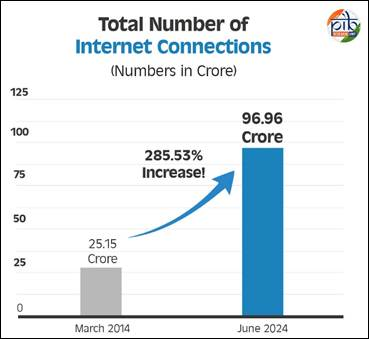
- Internet Penetration Surge: Internet users in India have risen from 250 million (2014) to 974 million, a nearly fourfold increase in a decade.
- Broadband Subscribers: Subscribers with speeds >2 Mbps rose from 66 million in 2014 to 940 million.
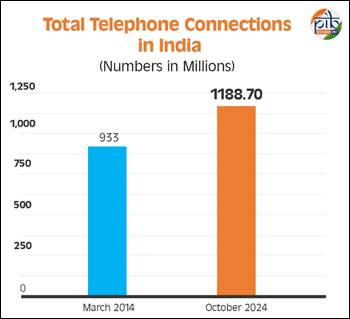
- Mobile Market: The telecom subscriber base increased from 1 billion to 1.2 billion.
- Affordability: Call rates reduced from ₹0.50/minute to ₹0.003/minute.
- Data prices in India have dropped dramatically—from ₹287 per GB to just ₹9 per GB—making it one of the cheapest globally at just 11 cents per GB, compared to the global average of $2.49.
Key Policy Initiatives of GOI
- Prime Minister’s WiFi Access Network Interface (PM-WANI) was launched by the Department of Telecommunication in 2020.
- The scheme aims to enhance the proliferation of public WiFi hotspots to create robust digital communications infrastructure in the country, especially in rural areas.
- BharatNet Project:
- Phase I: Connected 2.14 lakh Gram Panchayats with 7 lakh km of optical fibre.
- Phase II: Target to connect remaining 2.64 lakh Gram Panchayats, totaling connectivity for 3.8 lakh villages.
- Investment: ₹1.39 lakh crore ($16.9 billion) – world’s largest public-sector connectivity program.
- Technology Upgrades in BharatNet II: Use of MPLS routers (better redundancy) instead of GPON.
- Shift from linear to ring topology for uninterrupted service.
- Mandating 10-year maintenance by implementation agencies.
- Setting up a central Network Operating Centre.
- Telecom Manufacturing and Export: From 80% mobile imports to exporting ₹1.75 lakh crore worth of phones.
- The transformation has been driven by the Production-Linked Incentive (PLI) Scheme, which has attracted over ₹4,000 crore in investments, facilitated exports worth ₹16,000 crore, and created around 25,000 jobs.
- Bharat 6G Alliance: It is a collaboration between India’s domestic industry, academia, research institutions, and standards organisations.
- The alliance aims to build a national action plan for 6G, ensuring that India remains at the forefront of technological innovation in the coming decades.
Significance
- Digital Governance Backbone: Enables delivery of digital services like e-governance, telemedicine, and online education to rural areas.
- Inclusive Growth: Empowers the digitally underserved, especially rural and remote regions.
- Global Leadership: India’s telecom affordability and scale, position it as a model for developing nations.
- Economic Multiplier: Internet and telecom expansion enhances productivity, innovation, and investment.
Challenges
- Last-Mile Connectivity: Difficult terrain, low affordability, and lack of digital skills still limit access in remote areas.
- Data Privacy and Cybersecurity: India needs stronger laws and greater public awareness to protect user data.
- Quality of Service: Internet speed and reliability remain uneven despite wide network coverage.
- Skilling: Increased digital access must be supported by basic digital literacy and training programs.
Concluding remarks
- India’s near-billion Internet users mark a paradigm shift in digital empowerment.
- With supportive policies like BharatNet and PLI, the country is not just connecting its people, but also aspiring to lead the global digital future.
Source: TH