
Brief Context
Context The 8th High-Level Meeting (HLM) between the Indian Coast Guard (ICG) and Sri Lanka Coast Guard (SLCG) was held in New Delhi. About The discussions centered on strengthening cooperative engagements in the fields of marine pollution response, maritime search rescue, and maritime law enforcement, along with enhanced capacity building technical assistance initiatives. Both sides reaffirmed their commitment to work closely in addressing contemporary maritime challenges, ensuring safety, secu
Source Content
Syllabus: GS3/Internal Security
Context
- The 8th High-Level Meeting (HLM) between the Indian Coast Guard (ICG) and Sri Lanka Coast Guard (SLCG) was held in New Delhi.
About
- The discussions centered on strengthening cooperative engagements in the fields of marine pollution response, maritime search & rescue, and maritime law enforcement, along with enhanced capacity building & technical assistance initiatives.
- Both sides reaffirmed their commitment to work closely in addressing contemporary maritime challenges, ensuring safety, security, and environmental stewardship in the shared maritime domain.
| Indian Coast Guard (ICG) – ICG is a maritime law enforcement and search and rescue agency of India with jurisdiction over its territorial waters including its contiguous zone and exclusive economic zone. – Established in 1977 by the Coast Guard Act, 1978 of the Parliament of India. – Parent Agency: Ministry of Defence. – Headquarters: New Delhi. – Head: Director General Indian Coast Guard (DGICG). |
India’s Maritime Zone
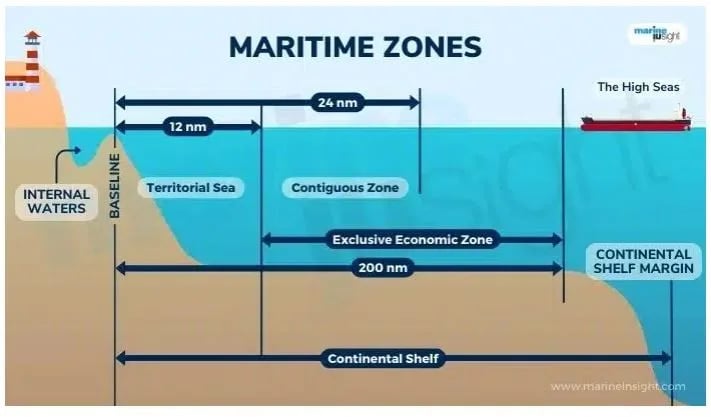
- India’s maritime zone refers to the maritime boundaries and areas under its jurisdiction in the surrounding seas and oceans.
- India has a coastline of 7,517 Km including island territories.
- Territorial Waters (12 Nautical Miles): Within this zone, India exercises full sovereignty, and it includes the country’s coastal areas and ports.
- Contiguous Zone (24 Nautical Miles): In this zone, India can take action to prevent or punish infringements on customs, fiscal, immigration, or sanitary laws within its territory or territorial sea.
- Exclusive Economic Zone (EEZ): The EEZ extends up to 200 nautical miles from the baseline.
- Within this zone, India has the exclusive rights for exploring, exploiting, conserving, and managing natural resources, such as fisheries and hydrocarbons.
Maritime Security
- It involves protecting the nation’s sovereignty from threats arising from the oceans and seas.
- Threats include protecting coastal areas, safeguarding the available ocean resources such as fish, offshore oil and gas wells, port facilities, etc.
- It also means maintaining freedom at sea for movement of our ships and facilitating and protecting trade.
- Following are the elements of maritime security:
- International and national peace and security;
- Protection of sea lanes of communication Sovereignty, territorial integrity and political independence;
- Protection from crime at sea;
- Access and security to the resources at sea;
- Security of seafarers and fishermen;
- Environmental protection.
Need to Strengthen Maritime Security in IOR
- Trade & energy lifelines: More than 80 % of the world’s seaborne oil trade goes through the Indian Ocean choke points – 40 % passes through the Strait of Hormuz, 35 % through the Strait of Malacca and 8 % through the Bab el-Mandab Strait.
- Disruptions here could severely impact India’s economy.
- Geopolitical contestation: Major-power activity (notably China’s expanding presence and infrastructure investments) alters the strategic balance.
- Fragmented maritime governance: Many littoral states lack capacity for surveillance, law enforcement, and HADR (humanitarian & disaster response).
- Diverse asymmetric threats: Illegal, unregulated and unreported (IUU) fishing, trafficking, piracy resurgence and attacks on commercial shipping complicate security.
- Blue Economy Potential: The IOR offers opportunities in fisheries, seabed minerals, renewable energy, and tourism—requiring secure seas for sustainable exploitation.
Conclusion
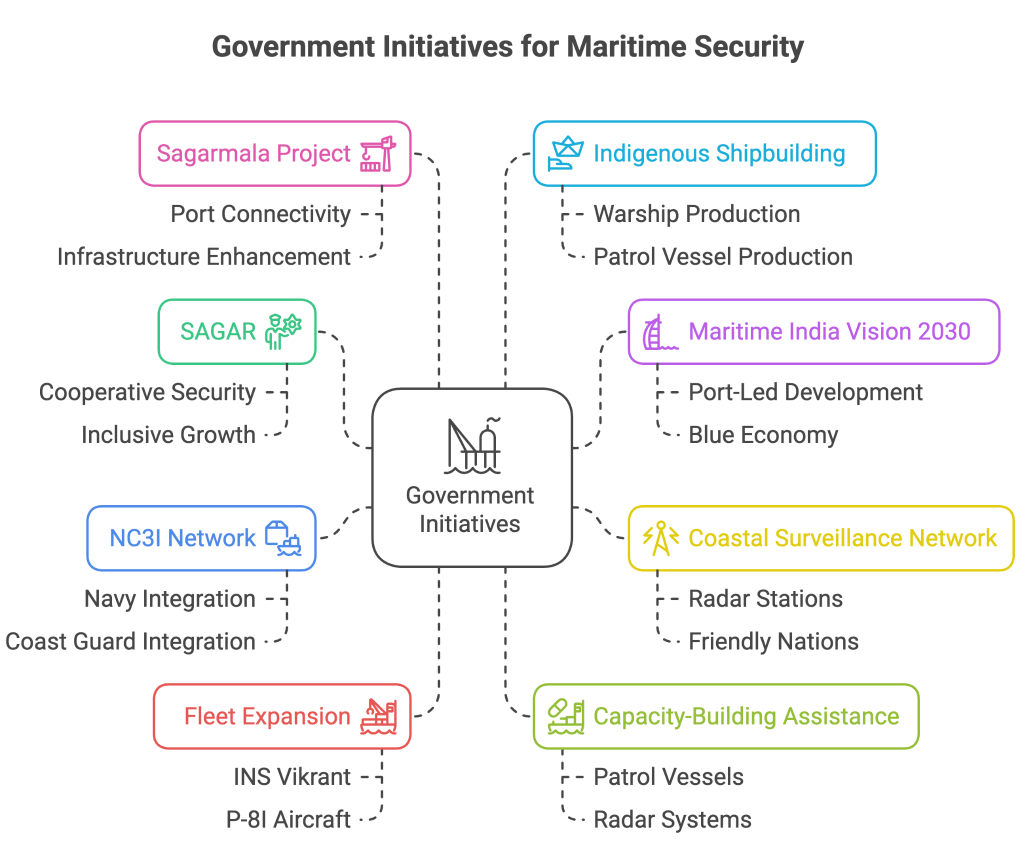
- India’s maritime security initiatives reflect a blend of military capability, infrastructure readiness, regional partnerships, and legal-institutional frameworks.
- As maritime threats evolve, India’s approach—anchored in SAGAR—aims to secure sea lanes, protect coastal communities, and maintain a rules-based order in the IOR.
Source: PIB