
Brief Context
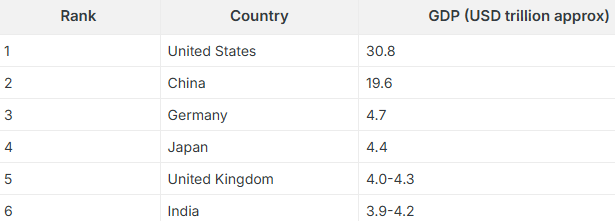
Context According to the latest World Economic Outlook (WEO) released by the International Monetary Fund (IMF), India has slipped to the 6th-largest economy in the world in nominal GDP terms. How Global GDP Rankings Are Calculated The IMF ranks economies based on nominal GDP in US dollar terms. It depends on GDP measured in local currency, and exchange rate vis-à-vis the US dollar.
Source Content
Syllabus: GS3/ Economy
Context
- According to the latest World Economic Outlook (WEO) released by the International Monetary Fund (IMF), India has slipped to the 6th-largest economy in the world in nominal GDP terms.
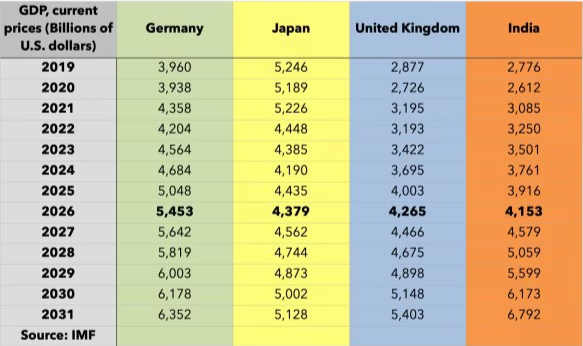
- India’s GDP is estimated at $4.15 trillion in 2026, behind the United Kingdom and Japan.
How Global GDP Rankings Are Calculated
- The IMF ranks economies based on nominal GDP in US dollar terms.
- It depends on GDP measured in local currency, and exchange rate vis-à-vis the US dollar.
- Any adverse movement in these variables can affect rankings even if real growth remains strong.
Reasons for India’s Decline in Ranking
- Revision of GDP Estimates: India revised its GDP series with a new base year in 2026.
- Nominal GDP for 2025–26 was reduced from ₹357 lakh crore to ₹345 lakh crore, indicating earlier overestimation.
- This revision lowered India’s GDP in dollar terms from around $4.1 trillion to $3.9 trillion.
- Depreciation of the Indian Rupee: The Indian rupee depreciated significantly against the US dollar in the past year.
- Since GDP rankings are calculated in dollar terms, currency depreciation reduces India’s relative economic size.
- Exchange Rate Asymmetry: The British pound and Japanese yen strengthened relative to the rupee, widening the gap between India and economies such as the United Kingdom and Japan.
- This led to both countries overtaking India despite modest or even declining growth in their own economies.
- Close Clustering of Major Economies: After the United States and China, the next four economies are closely clustered around the $4 trillion mark. Small changes in data or exchange rates can easily alter rankings within this group.
Implications of the Ranking Shift
- Limited Impact on Economic Fundamentals: The decline in global ranking does not indicate any structural weakness in the Indian economy.
- India’s growth trajectory remains strong, as reflected in its real GDP growth projections of 7.4% in FY26 (domestic estimates) and 6.5% for FY27 as projected by the International Monetary Fund,
- Impact on Perception and Global Positioning: Global GDP rankings play an important role in shaping investor sentiment and international confidence.
- A lower ranking may create a temporary perception of relative economic slowdown, even when fundamentals are stable.
- Delay in Strategic Economic Milestones: India’s transition to becoming one of the top three global economies may take longer than previously anticipated.
- India is projected to overtake Germany by 2031, thereby becoming the third-largest economy in the world.
Key Economic Concepts
Gross Domestic Product (GDP)
- GDP is the total monetary value of all final goods and services produced within a country’s domestic territory during a specific period (usually a quarter or a year).
- Current base year used 2022-23 (Updated in 2026; earlier 2011–12)
- Released By: National Statistical Office (NSO), Ministry of Statistics and Programme Implementation (MoSPI).
Nominal Vs Real GDP
- Nominal GDP measures a country’s economic output at current market prices, thereby incorporating the effects of inflation and making it useful for assessing the economy’s size in present-value terms.
- Real GDP adjusts for inflation by valuing output at constant base-year prices, providing a more accurate measure of actual growth in production over time.
What is Base Year?
- A base year is a benchmark year used for comparison in economic and statistical calculations.
- It provides a reference point against which current values of indicators like GDP, CPI, and IIP are measured to track real changes over time.
- Significance:
- It allows us to remove the effect of inflation and see real growth.
- Ensures that the data reflects the current structure of the economy, consumption patterns, and prices.
Source: IE