
Brief Context
Context The Union Minister for Road Transport and Highways has announced that India has emerged as the third-largest automobile industry globally, with a market size of about ₹22 lakh crore. About the Automobile Industry Global Scenario: The United States has the largest automobile industry in the world, valued at ₹78 lakh crore. China ranks second with an industry size of ₹49 lakh crore.
Source Content
Syllabus: GS3/ Economy
Context
- The Union Minister for Road Transport and Highways has announced that India has emerged as the third-largest automobile industry globally, with a market size of about ₹22 lakh crore.
About the Automobile Industry
- Global Scenario: The United States has the largest automobile industry in the world, valued at ₹78 lakh crore.
- China ranks second with an industry size of ₹49 lakh crore.
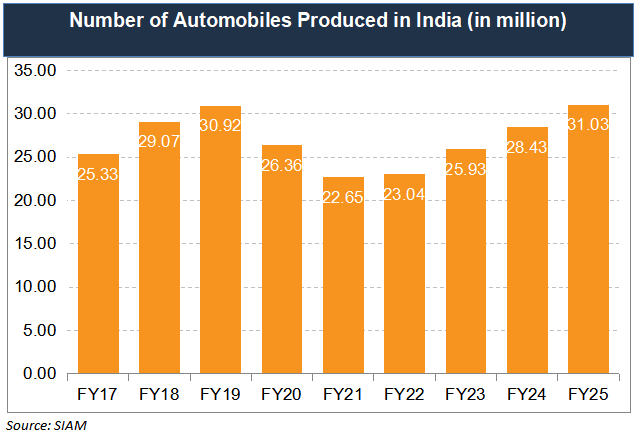
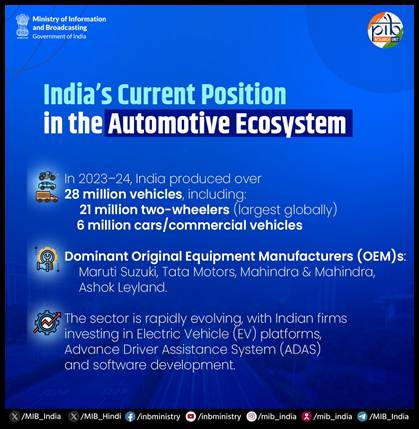
- Indian Scenario: India’s automotive industry is a cornerstone of the nation’s manufacturing and economic growth, contributing around 7.1% to India’s Gross Domestic Product (GDP) and 49% to manufacturing GDP.
- Two-wheelers and passenger vehicles dominate the domestic market.
- In FY25, two-wheelers accounted for 76.57% of total market share, while passenger cars accounted for 16.80%.
Government Initiatives Driving Growth
- Production Linked Incentive (PLI) Scheme for Auto and ACC Batteries: With a total allocation of ₹44,038 crore the initiative aims to boost the domestic manufacturing of advanced automotive technologies, including EVs, hydrogen fuel cell vehicles, and advanced battery storage solutions.
- FAME-II Scheme: The scheme provides subsidies for electric and hybrid vehicles and charging infrastructure, supporting the adoption of eco-friendly vehicles and contributing to cleaner transportation.
- Vehicle Scrappage Policy: Targets phasing out vehicles older than 15 years to cut emissions and stimulate replacement demand.
- Make in India and FDI Policy: The policies, particularly the 100% FDI allowance in the auto sector, have attracted significant investments from both global and domestic players, boosting manufacturing and employment.
What are the Challenges?
- Heavy dependence on imports for high-value components such as semiconductors and EV batteries.
- Limited share of only about 3% in the globally traded auto components market, with low penetration in high-precision segments.
- Inadequate infrastructure for EV charging and hydrogen refuelling stations.
- Environmental Challenges: Rising vehicle numbers leading to increased carbon emissions and environmental concerns.
Way Ahead
- Increase localisation in high-technology automotive components to reduce import dependence.
- Expand investments in EV charging networks and hydrogen fuel infrastructure.
- Enhance research and development and provide skill training for advanced manufacturing capabilities.
- Promote recycling, emission control measures, and adoption of green mobility solutions for sustainable growth.
Source: AIR