
Brief Context
Context Hydraulic systems convert power into smooth, flexible mechanical movement, making heavy lifting and precision tasks possible. About the Hydraulic Systems Hydraulic systems are essential in modern engineering, enabling powerful and precise movement in various industries. They offer advantages such as smooth operation, high power-to-weight ratio, precise control, and efficient heat dissipation.
Source Content
Syllabus: GS3/General Science
Context
- Hydraulic systems convert power into smooth, flexible mechanical movement, making heavy lifting and precision tasks possible.
About the Hydraulic Systems
- Hydraulic systems are essential in modern engineering, enabling powerful and precise movement in various industries.
- They offer advantages such as smooth operation, high power-to-weight ratio, precise control, and efficient heat dissipation.
- Worldwide, hydraulics constitute a $45-50 billion market and is growing steadily.
Working of Hydraulic Systems
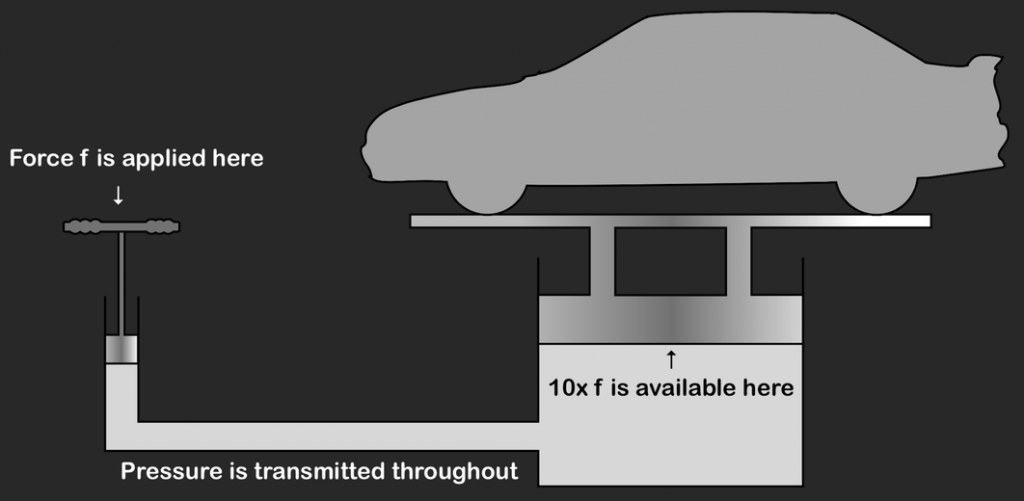
- Hydraulic systems use incompressible fluids to transmit force efficiently, making them ideal for heavy-duty applications, based on Pascal’s Law.
- Pascal’s law states that when there is an increase in pressure at any point in a confined fluid, there is an equal increase at every other point in the container.
- Pneumatic systems use compressible fluid, such as air, in their operation.
- Pascal’s law states that when there is an increase in pressure at any point in a confined fluid, there is an equal increase at every other point in the container.
- It allows a small force applied over a small area to generate a much larger force over a larger area.
- They operate by applying pressure to a fluid, which then transmits force evenly in all directions.
- In this system, forces perpendicular everywhere to the surface; force per unit area (pressure) same everywhere.
- Key Components:
- Pumps: Convert mechanical energy into fluid pressure
- Valves: Control the flow and direction of the fluid
- Actuators: Deliver mechanical output, either linear or rotary.
- Pipes and Tanks: Store and transport hydraulic fluid.
- Sensors and Switches: Ensure operational safety and control.
Applications of Hydraulic Systems
- Construction Equipment: Cranes, excavators, and bulldozers rely on hydraulic power for lifting and movement.
- Aviation: Aircraft landing gear and control surfaces use hydraulic mechanisms.
- Manufacturing: Press machines and robotic arms operate using hydraulic force.
- Automotive Industry: Braking systems in vehicles function through hydraulic pressure.
| Read this in Hindi: हाइड्रोलिक सिस्टम: कार्यप्रणाली और अनुप्रयोग |