
Brief Context
In News The Lok Sabha is currently debating the Constitution (131st Amendment) Bill, 2026, which proposes changes to increase the size and composition of the Lok Sabha and State Legislative Assemblies. About Constitution Amendment It is a legislative proposal introduced in Parliament to modify, add, or repeal provisions of the Constitution of India. Constitution Amendment Bill can be introduced in either House of Parliament (Lok Sabha or Rajya Sabha).
Source Content
Syllabus: GS2/Governance
In News
- The Lok Sabha is currently debating the Constitution (131st Amendment) Bill, 2026, which proposes changes to increase the size and composition of the Lok Sabha and State Legislative Assemblies.
About Constitution Amendment
- It is a legislative proposal introduced in Parliament to modify, add, or repeal provisions of the Constitution of India.
- Constitution Amendment Bill can be introduced in either House of Parliament (Lok Sabha or Rajya Sabha).
- Only Parliament has the power to initiate (States cannot introduce such Bills).
Types of Constitutional Amendments
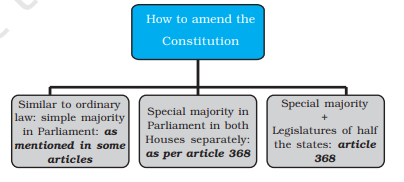
- The Constitution of India provides for three types of amendment procedures depending on the nature of the provision being amended:
- Simple Majority (Outside the scope of Article 368): Amended by a simple majority of Parliament (more than 50% of members present and voting) — like ordinary legislation. Example: Changes related to creation of new states, boundary changes, etc. (e.g., Article 4).
- Special Majority (Main procedure under Article 368): Most constitutional amendments require Majority of total membership of each House, and At least 2/3rd of members present and voting.
- This is the most commonly used amendment route and forms the backbone of Article 368.
- Special Majority + State Ratification (Under Article 368): Some important federal provisions require Special majority in Parliament and Approval by at least half of the State Legislatures.
- These relate to the federal structure (e.g., powers of states, judiciary, representation).
Importance of Constitutional Amendments
- Democratic Adaptation: It keeps the Constitution relevant to changing socio-political realities.
- Federal Balance: It ensures representation aligns with population shifts (e.g., delimitation based on latest Census).
- Social Justice: It Enables reforms like reservation for women in legislatures.
- National Integration: It Facilitates initiatives such as “One Nation, One Election” for synchronized polls.
- Institutional Strengthening: It Provides mechanisms to expand Parliament and Assemblies to reflect India’s demographic growth.
Challenges in the Amendment Process
- Political Consensus: Sometimes Securing two-thirds majority is difficult in a fragmented polity.
- Federal Sensitivities: States may resist amendments perceived as centralizing power.
- Risk of Overuse: Frequent amendments could dilute constitutional stability.
- Judicial Scrutiny: Amendments must respect the basic structure doctrine upheld by the Supreme Court.
- Population-Based Representation: Delimitation may create regional imbalances, with populous states gaining more seats at the expense of smaller ones.
Conclusion and Way Ahead
- Constitutional amendments should be guided by consensus building, where dialogue with the opposition and state governments ensures broad-based support.
- The process should involve transparent deliberation through public consultations and meaningful parliamentary debate to strengthen legitimacy.
- At the same time, amendments must safeguard federalism by promoting cooperative relations between the Centre and states rather than weakening them.
- There should also be a provision for periodic review of constitutional provisions to keep pace with social and technological changes.
- The reforms must strike a balance between modernization of governance and the preservation of constitutional stability and core values.
Source :TH