
Brief Context
Context The US National Oceanic and Atmospheric Administration in partnership with the International Coral Reef Initiative, confirmed that the world is witnessing its fourth global bleaching event. About The bleaching-level heat stress has impacted 83.7% of the planet’s coral reef area and mass coral bleaching has been recorded in at least 83 countries and territories. The ongoing global coral bleaching event is the biggest to date.
Source Content
Syllabus: GS3/ Biodiversity and Conservation
Context
- The US National Oceanic and Atmospheric Administration in partnership with the International Coral Reef Initiative, confirmed that the world is witnessing its fourth global bleaching event.
About
- The bleaching-level heat stress has impacted 83.7% of the planet’s coral reef area and mass coral bleaching has been recorded in at least 83 countries and territories.
- The ongoing global coral bleaching event is the biggest to date.
- Previous Bleaching:
- The 1st and 2nd global coral bleaching events occurred in 1998 and 2010, respectively.
- The 3rd global coral bleaching event, which occurred from 2014-2017, when 68.2% of the world’s reef area experienced bleaching-level heat stress.
- Future Projections: Climate models predict that by 2040-2050, nearly every coral reef worldwide will face annual bleaching events.
- Great Barrier Reef Status: Currently undergoing a sixth mass bleaching event.
- Second consecutive bleaching episode after 2016-17.
- Caused by prolonged marine heatwaves, especially in Far Northern and Northern regions.
- Bleaching History in Australia: Mass coral bleaching events recorded in 1998, 2002, 2016, 2017, 2020, 2022, and 2024.
What are Corals?
- Corals are invertebrates that belong to a large group of animals called Cnidaria.
- Corals are formed by multiple small, soft organisms known as polyps.
- They secrete a rocky chalk-like (calcium carbonate) exoskeleton around themselves for protection.
- Coral reefs are therefore created by millions of tiny polyps forming large carbonate structures.
- Appearance: Corals range in colour from red to purple and even blue, but are most commonly shades of brown and green.
- Coral are bright and colorful because of microscopic algae called zooxanthellae.
- There are three types of coral reefs – fringing reefs, barrier reefs and atolls.
- Fringing reefs form along shorelines, barrier reefs form in open water and atolls are circular reefs that have formed around sunken volcanoes.
Coral Bleaching
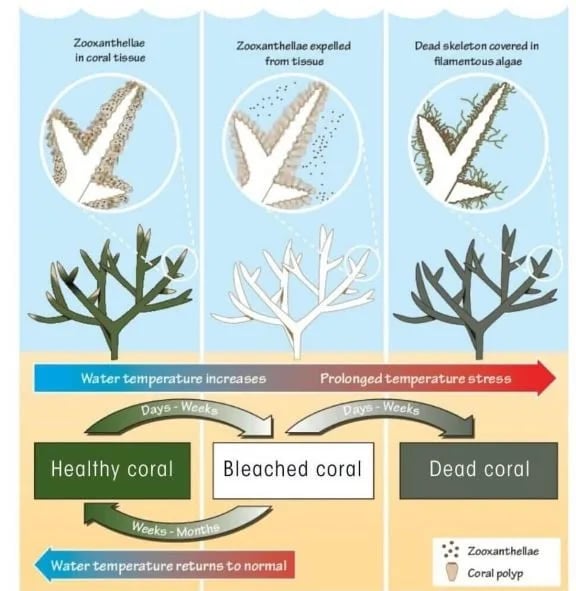
- Coral bleaching occurs when corals expel the colourful algae living in their tissues.
- Without these helpful algae, the corals become pale and are vulnerable to starvation and disease.
- A bleached coral is not dead, but ocean temperatures need to cool off for any hope of recovery.
- At least 14% of the world’s remaining corals were estimated to have died in the previous two global bleaching events.
What triggers Coral Bleaching?
- The leading cause of coral bleaching is climate change.
- A warming planet means a warming ocean, and a change in water temperature—as little as 2 degrees Fahrenheit—can cause coral to drive out algae.
- Coral also bleaches for other reasons, like extremely low tides, pollution, or too much sunlight.
Concerns
- Coral bleaching matters because once these corals die, reefs rarely come back.
- With few corals surviving, they struggle to reproduce, and entire reef ecosystems, on which people and wildlife depend, deteriorate.
- This would have dire implications for ocean health, subsistence fisheries and tourism.
Impact of Coral Bleaching
- Wildlife: Thousands of marine animals depend on coral reefs for survival.
- Coral reefs provide shelter, spawning grounds, and protection from predators.
- They also support organisms at the base of ocean food chains.
- As reef ecosystems collapse, already at-risk species may face extinction.
- Humans: Coral reefs are natural barriers that absorb the force of waves and storm surges, keeping coastal communities safe.
- Every year, reefs provide about $2.7 trillion in goods and services, according to a 2020 estimate by the Global Coral Reef Monitoring Network.
- Bleached coral also compounds the overfishing crisis by removing links in the food web and depriving some fish of a place to spawn and develop.
- Reef tourism brings in billions of dollars each year and supports thousands of jobs.
Can corals recover from bleaching?
- Corals can recover if conditions improve, but recovery can take years or even a decade, depending on the extent of the damage.
- Corals can recover only if temperatures drop and conditions return to normal.
- When this happens, the algae returns and the corals gradually regain their health.
Way Ahead
- Strengthening Marine Protected Areas (MPAs).
- Implementing coral restoration techniques, such as coral gardening and breeding resilient coral species, to enhance recovery after bleaching events.
- Advocating for global efforts to reduce greenhouse gas emissions to limit temperature increases and ocean acidification.
- Increasing investment in research to better understand coral resilience, bleaching triggers, and recovery processes, alongside developing advanced monitoring technologies.
Source: DTE