
Brief Context
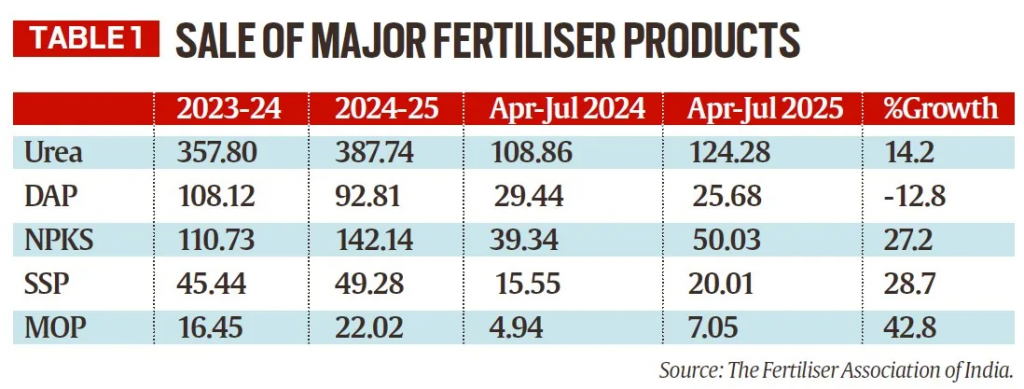
Context A well-distributed southwest monsoon in 2025, has boosted kharif sowing along with triggering an unprecedented surge in fertilizer demand. Fertiliser Sale Impact A good monsoon ensures soil moisture, reservoir filling, and groundwater recharge, encouraging higher sowing and proportionately higher fertilizer use. Fertilisers supply key nutrients like nitrogen (N), phosphorus (P), potassium (K), and sulphur (S), that are indispensable for crop growth.
Source Content
Syllabus: GS3/ Economy
Context
- A well-distributed southwest monsoon in 2025, has boosted kharif sowing along with triggering an unprecedented surge in fertilizer demand.
Fertiliser Sale Impact
- A good monsoon ensures soil moisture, reservoir filling, and groundwater recharge, encouraging higher sowing and proportionately higher fertilizer use.
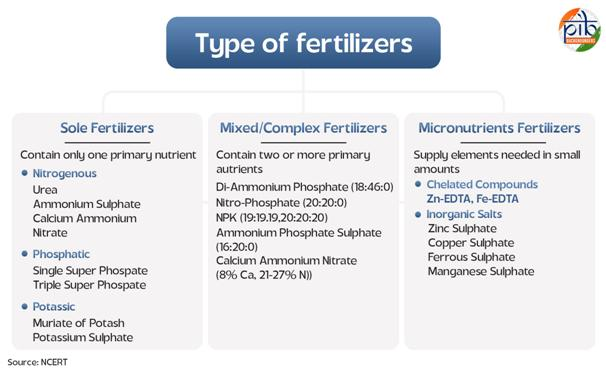
- Fertilisers supply key nutrients like nitrogen (N), phosphorus (P), potassium (K), and sulphur (S), that are indispensable for crop growth.
- India stands as the second-largest user and the third-largest producer of fertilizers globally
- Supply-Side Constraints:
- While demand surged, supply failed to keep pace.
- Domestic production of urea fell from 102.1 lakh tonnes in April–July 2024 to 93.6 lakh tonnes in April–July 2025, while DAP production remained stagnant at 13.7 lakh tonnes.
- Imports have also declined, largely due to supply restrictions from China, which has been a major exporter of fertilisers to India.
Subsidy Framework & Pricing Dynamics of fertilizers
- Urea Subsidy Scheme: Under the scheme, urea is provided to farmers at a statutorily notified maximum retail price (MRP).
- The MRP of 45 kg bag of urea is ₹242 per bag (exclusive of charges towards neem coating and taxes as applicable) while the actual cost is around ₹3,000 for 45 kg bag.
- Nutrient-based subsidy policy: It aims to promote the balanced use of fertilizers by linking subsidies to the nutrient content (nitrogen, phosphorus, potash, and sulfur) rather than the final product.
- Under this scheme, the government sets a fixed subsidy amount per kilogram for each nutrient in P&K fertilizers.
- In the broader budget for FY2025–26, the urea subsidy stands at ₹1.19 lakh crore, while the NPK subsidy is budgeted at approximately ₹0.49 lakh crore, reflecting the government’s massive fiscal commitment.
Government’s Initiatives in the Fertilizer Sector
- The Government introduced the Nutrient Based Subsidy (NBS) scheme in 2010 for phosphatic and potassic fertilizers.
- Under this scheme, a fixed subsidy is provided for subsidised P and K Fertilizers, including di-ammonium phosphate, based on their nutrient content.
- The One Nation One Fertilizer scheme was introduced to bring uniformity in branding and ensure transparency in the Fertilizer sector.
- PM PRANAM scheme: PM Programme for Restoration, Awareness Generation, Nourishment and Amelioration of Mother – Earth (PMPRANAM)” was launched to incentivize States/ Union Territories to promote alternate fertilizers and balanced use of chemical fertilizers.
Way Ahead
- Advance Demand Forecasting: Fertiliser allocation must be synchronised with crop acreage patterns to prevent shortages in years of good monsoon.
- Diversified Imports: Over-reliance on China for DAP and urea creates vulnerability; long-term contracts with multiple suppliers are needed.
- Capacity Expansion: Speeding up commissioning of domestic urea plants under “Atmanirbhar Bharat” will reduce import reliance.
- Sustainable Practices: Wider adoption of nano-urea, bio-fertilisers, and soil health cards can reduce chemical fertiliser intensity over time.
Source: IE