
Brief Context
Context Recently, the Union Government has expanded the scope and timeline of the Pradhan Mantri Jaiv Indhan–Vatavaran Anukool Fasal Awashesh Nivaran (JI-VAN) Yojana, reaffirming its commitment to sustainable development and energy security. About PM JI-VAN Its 2024 Upgrades It was launched in 2019 under the Ministry of Petroleum and Natural Gas (MoPNG). It is implemented by the Centre for High Technology (CHT) that operated under the MoPNG.
Source Content
Syllabus: GS2/Govt Policy & Intervention; GS3/Environment
Context
- Recently, the Union Government has expanded the scope and timeline of the Pradhan Mantri Jaiv Indhan–Vatavaran Anukool Fasal Awashesh Nivaran (JI-VAN) Yojana, reaffirming its commitment to sustainable development and energy security.
About PM JI-VAN & Its 2024 Upgrades
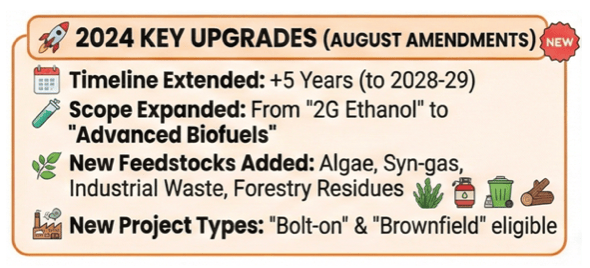
- It was launched in 2019 under the Ministry of Petroleum and Natural Gas (MoP&NG).
- It is implemented by the Centre for High Technology (CHT) that operated under the MoP&NG.
- Financial Outlay: ₹1,950 crore (Total Allocation)
- ₹1,800 crore for 12 commercial-scale projects
- ₹150 crore for 10 demonstration-scale projects
- Support Mechanism: Viability gap funding and capital assistance to make projects commercially viable.
Objectives of the Scheme
- Establishment of commercial and demonstration-scale advanced biofuel projects using lignocellulosic biomass and other renewable feedstocks.
- Providing remunerative income to farmers for agricultural residues that would otherwise go to waste.
- Creating employment opportunities in rural and urban areas.
- Addressing air pollution caused by stubble burning and reducing soil and water pollution from municipal solid waste.
- Contributing to the Swachh Bharat Mission and supporting the Ethanol Blended Petrol (EBP) Programme.
- Reducing India’s dependency on crude oil imports and supporting the nation’s climate goals.
Key Biofuel Projects Under PM JI-VAN
- Second Generation (2G) Bio-Ethanol Projects: Indian Oil Corporation Ltd. (IOCL) has set up a 2G paddy straw-based feedstock bio-ethanol project at Panipat, Haryana.
- A 2G bamboo-based biorefinery has been established at Numaligarh, Assam by Numaligarh Refinery Ltd., through Assam Bio-Ethanol Private Limited (ABEPL).
- Third Generation (3G) Ethanol Project: IOCL has commissioned a 3G ethanol plant at Panipat, utilizing refinery off-gas as feedstock — marking a leap towards innovative carbon utilization.
Policy Framework Supporting Biofuel Expansion
- The National Policy on Biofuels (Amended 2022) promotes the use of diverse feedstocks such as:
- Damaged and surplus food grains (broken rice, maize, cassava, rotten potatoes).
- Agricultural residues (rice straw, corn cobs, cotton stalk, sawdust, bagasse).
- Sugarcane juice and molasses, regulated through the National Biofuel Coordination Committee (NBCC) to avoid food security conflicts.
- Feedstock utilization is calibrated annually based on availability, cost, market demand, and sustainability considerations.
Impact on Sugar and Maize Sectors
- Sugar Sector: In Sugar Season (SS) 2024–25, sugar production reached 340 LMT, with 34 LMT diverted for ethanol production.
- Domestic sugar demand stood at 281 LMT, and ethanol production helped stabilize sugar inventories and ensure timely payments to sugarcane farmers.
- Maize Production Growth: Maize output increased by nearly 30%, from 337.30 LMT in 2021–22 to 443 LMT in 2024–25, driven by government encouragement for crop diversification from water-intensive crops like rice and sugarcane.
Achievements of the Ethanol Blended Petrol (EBP) Programme
- Since Ethanol Supply Year (ESY) 2014–15 up to October 2025, the EBP Programme has achieved:
- Payments to farmers exceeding ₹1,36,300 crores.
- Foreign exchange savings of more than ₹1,55,000 crores.
- Net CO₂ reduction of approximately 790 lakh metric tonnes.
- Substitution of over 260 LMT of crude oil imports.
Conclusion
- The Pradhan Mantri JI-VAN Yojana represents a cornerstone of India’s clean energy and circular economy vision.
- It paves the way for a sustainable and self-reliant biofuel ecosystem by linking farmers’ livelihoods, waste management, and energy security.
- The initiative strengthens India’s journey toward a low-carbon, energy-secure future together with supportive policies and technological innovations.