
Brief Context
Elon Musk’s brain-chip startup Neuralink has announced ambitious plans to begin human trials of its visual prosthesis device, “Blindsight” by the end of 2025.
Source Content
Syllabus: GS3/ S&T
In News
- Elon Musk’s brain-chip startup Neuralink has announced ambitious plans to begin human trials of its visual prosthesis device, “Blindsight” by the end of 2025.
- This brain-computer interface (BCI) aims to restore vision in people who are completely blind.
What is Blindsight?
- Blindsight is an experimental artificial vision device that:
- Uses a microelectrode array implanted in the visual cortex of the brain.
- Bypasses the eyes and optic nerves entirely.
- Processes visual data from a camera feed and stimulates neurons in the brain’s visual center, enabling perception of images.
About Brain-Computer Interfaces (BCIs)
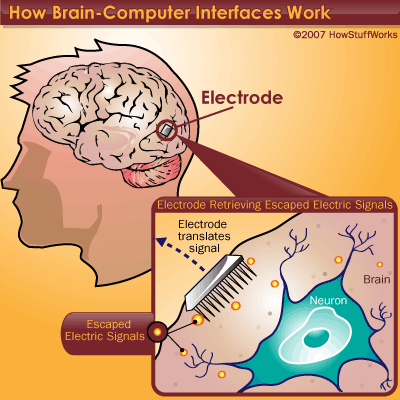
- A Brain-Computer Interface (BCI) is a computer-based system that:
- Acquires brain signals
- Analyzes them
- Translates them into commands
- Sends those commands to external devices to carry out a desired action
- Unlike traditional motor control (e.g., flipping a light switch), BCIs enable users to control devices directly using brain activity, bypassing the body’s muscles and peripheral nerves.
- BCIs can be broadly categorized as:
- Invasive: Electrodes are surgically implanted directly into the brain. These offer high signal quality but carry risks associated with surgery.
- Non-invasive: Sensors are placed on the scalp (e.g., EEG headsets). These are safer but have lower signal quality.
- Partially invasive: Electrodes are placed inside the skull but outside the brain tissue.
Applications & Challenges of BCIs
| Category | Applications | Challenges |
| Medical & Rehab | Assistive technology for paralysis, ALS, etc.; Stroke & spinal injury rehab; Communication aids | Signal noise in non-invasive methods; Biocompatibility issues with implants |
| Mental Health & Cognitive | Neurofeedback for ADHD, PTSD, etc.; Memory & attention enhancement | Requires brain training; Ethical issues in cognitive manipulation |
| Education | Monitor engagement & cognitive load; Adaptive learning systems | Data privacy in learning settings; Standardization of tools |
| Military & Defense | Thought-controlled drones & devices; Cognitive monitoring of soldiers | Ethical use in combat; Risk of misuse or surveillance |
| Smart Home & IoT | Control devices using brain signals | Latency and reliability issues; Cost and integration complexity |
| Neuroscience Research | Brain mapping; Understanding cognition and neural links | Requires high-precision data; Long development cycles |
| General | Enhancement of brain functions and overall efficiency in functionality. | High costs; Lack of trained experts; Regulatory and legal uncertainty; Brain data security |
Source: IE