
Brief Context
Context The Delhi Cabinet approved a Rs 3.21-crore project for conducting five cloud-seeding trials across the National Capital Region (NCR) amid the fight against pollution. What is Cloud Seeding? Cloud seeding is a weather modification technique aimed at enhancing precipitation from clouds by introducing substances that act as cloud condensation or ice nuclei.
Source Content
Syllabus: GS3/Science and Technology, Environment
Context
- The Delhi Cabinet approved a Rs 3.21-crore project for conducting five cloud-seeding trials across the National Capital Region (NCR) amid the fight against pollution.
What is Cloud Seeding?
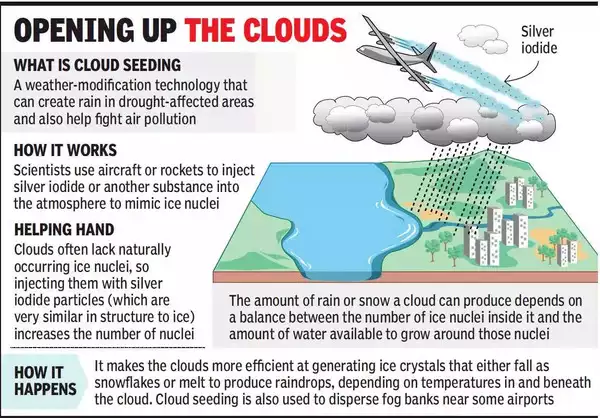
- Cloud seeding is a weather modification technique aimed at enhancing precipitation from clouds by introducing substances that act as cloud condensation or ice nuclei.
- Method: Aircraft or rockets disperse seeding agents like silver iodide, potassium iodide, or dry ice (solid carbon dioxide), or liquid propane into the atmosphere.
- Purpose: Stimulate rainfall, reduce dust, suppress hailstorms, and improve air quality by settling particulates.
Suitable Conditions for Cloud Seeding
- Cloud seeding requires existing clouds; it will not produce rain out of thin air.
- Not all types of clouds are suitable for seeding. Clouds must be deep enough and of a suitable temperature (between -10 and -12 degrees Celsius) to be seeded effectively.
- The wind must be below a certain speed. These conditions are most common in mountainous areas.
Concerns with Cloud Seeding
- Use of Chemicals: Some chemicals are potentially harmful to the natural environment. There is concern about soil and water contamination, especially affecting plants and crops that rely on rainwater for nourishment.
- Redistribution of Rainfall: Artificially inducing rainfall in one area may deprive adjacent areas of their natural precipitation, potentially triggering drought-like conditions elsewhere.
- High Cost: Cloud seeding requires specialized aircraft, meteorological expertise, and precision timing, making it a cost-intensive initiative.
Concluding remarks
- Cloud seeding offers a technological solution to mitigate the immediate impact of air pollution in NCR, especially during critical months.
- However, it should be part of a multi-pronged approach involving emissions control, green infrastructure, and public health measures.
Source: TH