
Brief Context
Context The Ministry of Tribal Affairs (MoTA) has written to the Registrar General and Census Commissioner, urging that particularly vulnerable tribal groups (PVTGs) be separately enumerated in the upcoming census. Why the Census Matters? Better Resource Allocation: Helps the government to channel resources effectively for infrastructure, healthcare, and education.
Source Content
Syllabus: GS1/Tribal Groups
Context
- The Ministry of Tribal Affairs (MoTA) has written to the Registrar General and Census Commissioner, urging that particularly vulnerable tribal groups (PVTGs) be separately enumerated in the upcoming census.
- While data on Scheduled Tribes was collected during the 2011 Census, data separately for PVTGs was not collected.
Who are Particularly Vulnerable Tribal Groups (PVTGs)?
- In 1973, the Dhebar Commission set up a separate category for Primitive Tribal Groups (PTGs).
- In 1975, the Union identified 52 tribal groups as PTGs.
- In 1993, 23 more groups were added to the list. Later, in 2006, these groups were named PVTGs.
- PVTGs are a more vulnerable group among tribal groups in India.
- These groups have primitive traits, geographical isolation, low literacy, zero to negative population growth rate, and backwardness.
- Moreover, they are largely dependent upon hunting for food and a pre-agriculture level of technology.
- Out of more than 700 tribal communities, there are 75 tribal communities identified as PVTGs residing in 18 States and the Union Territory of Andaman and Nicobar Islands.
- As per the Ministry of Tribal Affairs, the PVTG population is estimated to be 45.56 lakh.
- Madhya Pradesh, Maharashtra, and Andhra Pradesh are the top three in terms of PVTG population.
Challenges Faced by the PVTGs
- Marginalisation: Due to their isolation, small population size, and distinct socio-economic and cultural traits.
- Limited Access to Services: Poor access to healthcare, education, and other basic facilities.
- Discrimination and Vulnerability: Subject to social discrimination and displacement from development projects and natural disasters.
- Lack of Political Representation: Minimal role in decision-making due to low political visibility.
Why the Census Matters?
- Better Resource Allocation: Helps the government to channel resources effectively for infrastructure, healthcare, and education.
- Targeted Welfare Schemes: It will enable the design and delivery of focused development programmes.
- Improved Planning: Provides data for long-term development strategies and policy decisions.
- Support for Research and Governance: Offers reliable information for the judiciary, policymakers, and scholars to study trends in migration, urbanisation, employment, and fertility.
Government Initiatives
- PM-JANMAN Scheme: It was launched on the occasion of Janjatiya Gaurav Divas in 2023 in Jharkhand, targeting 75 PVTGs communities.
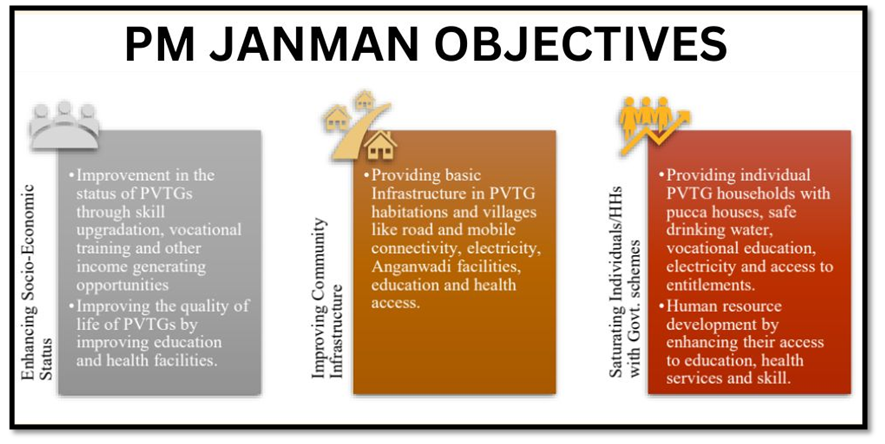
- Particularly Vulnerable Tribal Groups (PVTGs) Development Program: The PVTG program targets the most vulnerable tribal communities, focusing on improving access to healthcare, education, clean water, and electricity.
- Around 7 lakh PVTG families across 22,000 habitations in 200 districts benefit from comprehensive development plans under this initiative.
Conclusion
- PVTGs are one of the most marginalized and socio-economically backward vulnerable sections of the population. Thus, it was imperative to have a “consolidated database” on their population and socio-economic indicators.
- The precise enumeration of PVTGs will help the implementation of targeted welfare schemes.
Source: TH