
Brief Context
In a recent address at the Financial Action Task Force (FATF) Private Sector Collaborative Forum, the Governor of RBI emphasized the need for a balanced approach in combating money laundering and terrorist financing.
Source Content
Syllabus: GS3/Internal Security; Money-laundering & Its Prevention
Context
- In a recent address at the Financial Action Task Force (FATF) Private Sector Collaborative Forum, the Governor of RBI emphasized the need for a balanced approach in combating money laundering and terrorist financing.
| Key Highlights of RBI Governer’s Address – Balanced Regulations: The Governor emphasized the importance of regulations that effectively target illicit activities without stifling legitimate investments or financial inclusion. – Potential of Advanced Technologies: Use of AI, machine learning and blockchain to enhance transaction monitoring and risk assessment. – Public-Private Collaboration: Need for strong partnerships between government agencies, financial institutions, and civil society to safeguard the financial system. |
Understanding Money Laundering
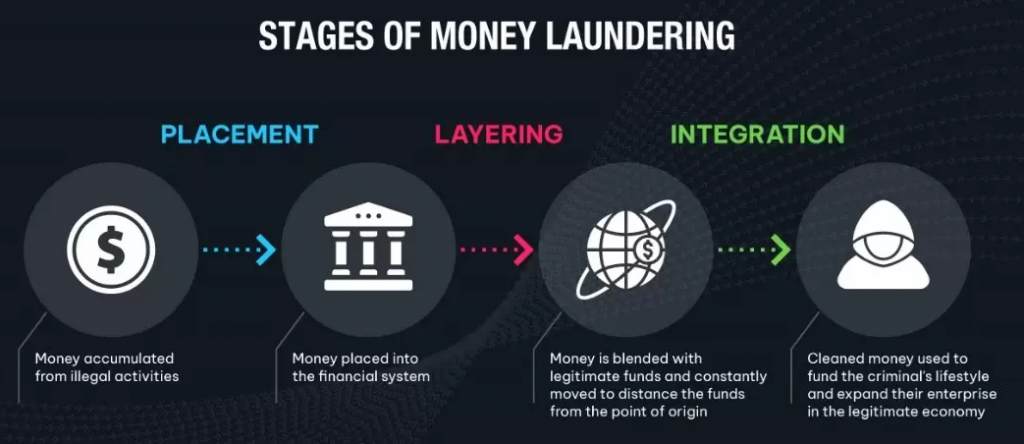
- It is the process of making illegally acquired money appear legitimate. It generally occurs in three stages:
- Placement: Introducing illegal funds into the financial system.
- Layering: Conducting multiple transactions to obscure the source.
- Integration: Reintegrating the laundered money into the economy as seemingly legitimate wealth.
- Common techniques include shell companies, offshore accounts, real estate purchases, trade-based laundering, and digital currency transactions.
Terrorist Financing
- It often involves relatively small but crucial amounts of money channeled for operational costs, recruitment, and propaganda.
- These funds may originate from legal sources such as donations or charities, or illegal means like drug trafficking and smuggling.
- Key Methods of Terrorist Financing:
- Hawala transactions (informal value transfer systems);
- Charitable organizations and NGOs misused for fundraising;
- Cryptocurrencies and digital wallets;
- Fake business enterprises and shell companies;
- Smuggling of cash and high-value goods.
Challenges in Combating Money Laundering and Terrorist Financing
- Evolving digital payment methods like cryptocurrencies.
- Hawala networks that bypass formal banking channels.
- Cross-border financial flows make tracking difficult.
- Complex corporate structures used to obscure illicit funds.
- Delay in judicial proceedings leading to slow convictions.
India’s Legal and Institutional Framework
- India has adopted several laws and enforcement measures to tackle money laundering and terrorist financing, aligned with global standards set by the Financial Action Task Force (FATF).
- Prevention of Money Laundering Act (PMLA), 2002: It is India’s primary anti-money laundering law.
- It mandates financial institutions to report suspicious transactions and empowers authorities to seize illicit assets.
- The Enforcement Directorate (ED) is the primary agency enforcing PMLA provisions.
- Unlawful Activities (Prevention) Act (UAPA), 1967: It criminalizes terrorist financing and provides strict penalties for funding or supporting extremist groups.
- Financial Intelligence Unit – India (FIU-IND): It, under the Ministry of Finance, collects and analyzes financial data to detect money laundering and terror financing.
- Reserve Bank of India (RBI) Guidelines: RBI mandates Know Your Customer (KYC), Anti-Money Laundering (AML) and Counter-terrorism Financing (CFT) Frameworks and norms for banks and financial institutions to curb illicit financial flows.
- Foreign Contribution (Regulation) Act (FCRA), 2010: FCRA monitors foreign funding received by NGOs and associations, ensuring they are not used for illegal activities.
Recent Developments
- India has ramped up its efforts to combat financial crimes, particularly in light of FATF reviews and growing digital financial transactions. Key measures include:
- Crackdown on shell companies to prevent money laundering.
- Regulation of cryptocurrency transactions for AML compliance.
- Strengthening inter-agency coordination between the ED, FIU, RBI, and Intelligence agencies.
Source: IE