
Brief Context
Context The recently concluded India AI Impact Summit 2026 showcased how AI is rapidly transforming India’s legal ecosystem with AI-powered research tools. Use of AI in India’s Justice System In the Supreme Court, High Courts, National Informatics Centre (NIC) AI tools are now assisting various functions such as: Transcription of oral arguments, Translation of judgments, Read More
Source Content
Syllabus: GS2/Governance; GS3/Science and Technology
Context
- The recently concluded India AI Impact Summit 2026 showcased how AI is rapidly transforming India’s legal ecosystem with AI-powered research tools.
Use of AI in India’s Justice System
- In the Supreme Court, High Courts, National Informatics Centre (NIC) AI tools are now assisting various functions such as:
- Transcription of oral arguments,
- Translation of judgments,
- Identification of defects in e-filing,
- Legal research, and
- Metadata extraction.
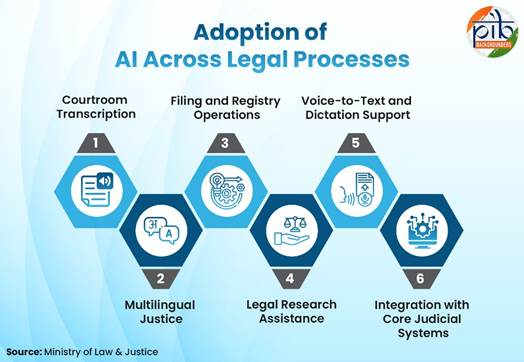
- Over the past decade, courts have moved from basic computerisation to nationwide digital platforms, real-time data systems, virtual courts and multilingual judgment access.
- Latest technologies like AI and its subsets Machine Learning (ML), Optical Character Recognition (OCR), Natural Language Processing (NLP) are being used in the e-Courts software applications developed under the eCourts Project.
Use of AI in India’s Criminal Justice System
- e-Courts Project: Initiated by the Supreme Court of India to modernize judicial functions through digital innovation.
- Phase III: Integrates advanced AI solutions to improve case management and administrative efficiency in courts.
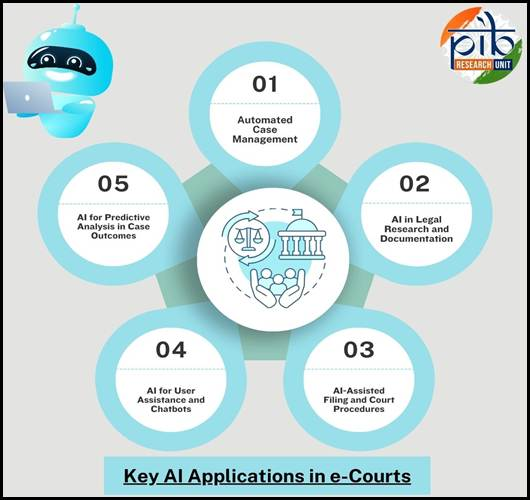
- AI for Legal Translation and Language Accessibility: India’s judicial system operates primarily in English, creating barriers for non-English-speaking litigants.
- AI-driven legal translation tools are being deployed to make legal documents and judgments accessible.
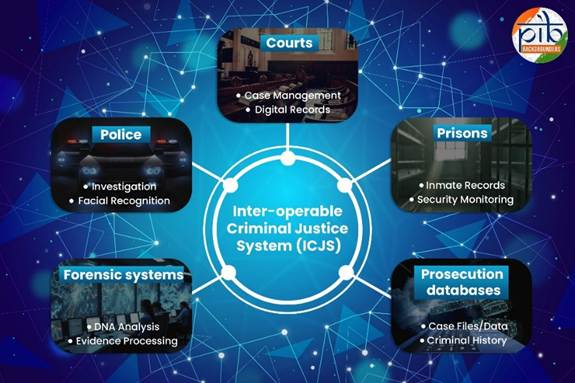
- AI in Law Enforcement and Crime Prevention: To enhance crime detection, surveillance, and criminal investigations.
- Automated drones for crime scene monitoring and suspect tracking.
- Facial recognition systems integrated with national criminal databases.
- AI-powered forensic analysis to examine evidence and digital crime trails.
- AI-driven speech-to-text tools assist in real-time FIR filing and case documentation.
- AI is improving witness testimony analysis and courtroom evidence evaluation.
Significance of Use of AI in CJS in India
- Backlog of Cases: India’s judicial system faces a backlog cases, undermining public trust in timely justice.
- AI can streamline case management, reduce backlog, and speed up judicial processes.
- Overcrowding in Prisons: Indian prisons have been housing more inmates than their capacity for decades now, AI can streamline the complaint registration process, track investigations, flag necessary actions, and assess investigation quality.
- Predictive Models for Operations: AI can analyze crime location data, patrolling patterns, and offender routes to guide police operations effectively.
- Resource Optimization: AI can handle administrative tasks, freeing up police personnel for more public-facing work, such as investigations, law enforcement, and traffic management.
- Enhanced Accuracy: AI can prevent neglect of crucial evidence and ensure a more meticulous and reliable criminal justice process.
Concerns/Challenges
- Privacy Concerns: AI could lead to surveillance overreach and violations of individual privacy rights.
- Bias and Discrimination: AI systems may perpetuate biases in decision-making, affecting marginalized communities unfairly.
- Lack of Transparency: AI algorithms are often opaque, making it difficult to understand how decisions are made, potentially undermining accountability.
- Dependence on Technology: Over-reliance on AI could lead to the erosion of human judgment and discretion in the criminal justice system.
- Data Security: Storing and processing sensitive criminal justice data using AI raises risks of data breaches and misuse.
- Ethical Concerns: The use of AI in sensitive areas like sentencing and parole decisions raises moral and ethical questions about fairness and justice.
- The opaqueness can go against the principles of open justice, due process and the rule of law.
- Exclusion of Human Insight: AI may overlook nuanced factors in cases that require human empathy and judgment.
Way Ahead
- A balanced approach must be taken to ensure AI tools respect privacy, civil liberties, and ethical standards, while preventing misuse.
- By leveraging AI, India’s criminal justice system can become more efficient, accessible, and just, while ensuring safeguards are in place to address any challenges.
Source: AIR