
Brief Context
Context The food subsidy is likely to touch Rs 2.25 trillion and the fertiliser subsidy may go up to Rs 2 trillion, in a total budget of around Rs 51 trillion. Agricultural Subsidies in India Agricultural subsidies refer to financial support and incentives provided by the government to farmers to reduce production costs, stabilise farm incomes, ensure food security, and promote adoption of modern inputs and sustainable practices. Price Support: Government supports farmers by setting Minimum Supp
Source Content
Syllabus: GS3/Agriculture
Context
- The food subsidy is likely to touch Rs 2.25 trillion and the fertiliser subsidy may go up to Rs 2 trillion, in a total budget of around Rs 51 trillion.
- Together, these are about 8 to 8.5 per cent of the budget. Both are operating at a sub-optimal level.
Agricultural Subsidies in India
- Agricultural subsidies refer to financial support and incentives provided by the government to farmers to reduce production costs, stabilise farm incomes, ensure food security, and promote adoption of modern inputs and sustainable practices.
- Price Support: Government supports farmers by setting Minimum Support Prices (MSPs) for certain crops.
- MSP is basically a guaranteed floor price: if market prices crash, the government will buy farmers’ crops at the MSP.
- This policy started in 1965, MSPs are announced for 25 crops, including major staples (rice, wheat, maize), pulses (like lentils), oilseeds (like soybeans), and even commercial crops like cotton.
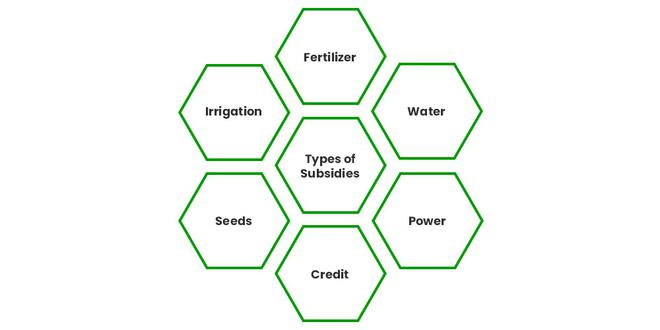
- Input Subsidies: Beyond price guarantees, the government also subsidizes many inputs that farmers need – things like fertilizer, electricity for pumping water, irrigation infrastructure, seeds, credit, and crop insurance.
Importance of Subsidies in Indian Agriculture
- Ensures Food Security: Subsidies lower production costs and sustain foodgrain output, enabling India to meet the food needs of a large population and maintain price stability.
- Supports Small and Marginal Farmers: With most farmers having low income and limited risk-bearing capacity, subsidies make farming economically viable and protect them from input price shocks.
- Stabilises Farm Incomes: Price support (MSP) and income support (PM-KISAN) act as safety nets against market volatility and crop failures, reducing agrarian distress.
- Promotes Productivity and Technology Adoption: Subsidised fertilisers, seeds, irrigation and mechanisation encourage adoption of modern practices, enhancing agricultural productivity.
- Sustains Rural Livelihoods and Employment: By keeping agriculture viable, subsidies support rural employment, allied activities, and prevent distress migration.
Arguments Against
- Heavy Fiscal Burden: Large subsidies on fertiliser, food and power strain public finances and reduce fiscal space for investment in infrastructure, research and education.
- Inequitable Distribution of Benefits: Subsidies disproportionately benefit large and better-off farmers, while small and marginal farmers often receive limited or indirect gains.
- Resource Misuse and Environmental Degradation: Cheap fertilisers, free power and underpriced water encourage overuse, leading to soil degradation, groundwater depletion and environmental damage.
- Distorted Cropping Patterns: MSP- and input-linked subsidies incentivise water-intensive crops like rice and sugarcane in ecologically unsuitable regions, undermining sustainability.
- Market Distortions and Inefficiency: Subsidies weaken market signals, discourage crop diversification, and reduce farmers’ responsiveness to demand and price discovery.
- Disincentive to Reforms and Innovation: Excessive reliance on subsidies discourages structural reforms, private investment, and adoption of climate-smart agricultural practices.
Way Ahead
- Shift from Input-Based to Income-Based Support: Gradually replace input subsidies with direct income support to give farmers flexibility and reduce resource misuse.
- Reform Price Support and Procurement Systems: Decentralise procurement, expand MSP coverage beyond rice and wheat, and promote market-based price discovery via e-NAM and farmer producer organisations (FPOs).
- Major committees like the Shanta Kumar Committee, Kelkar Committee, NITI Aayog and Economic Survey have emphasised rationalisation of agricultural subsidies.
- They recommend shifting from input- and price-based subsidies to targeted DBT and income support, while linking subsidies with efficiency, sustainability and fiscal prudence.
Source: IE