
Brief Context
has decided to set up a fund of $1 billion for the country’s creative economy.
Source Content
Syllabus: GS3/ Economy
In Context
- The Govt. has decided to set up a fund of $1 billion for the country’s creative economy.
- And, the first Indian Institute of Creative Technology (IICT) is being established in Mumbai with funds of about 400 crore.
What is the Creative Economy?
- Also known as the orange economy, the creative economy refers to a knowledge-driven economic system where creativity and intellectual capital fuel economic activities. It includes:
- Creation, production, and distribution of goods and services based on creativity.
- Monetization of intellectual property in industries such as film, music, fashion, gaming, software development, and advertising.
- Key Characteristics:
- Knowledge-Based Economic Activity: Creativity is developed through education, training, or inherited traditional skills.
- Originality & Intellectual Property: Monetization of ideas through copyrights, patents, and trademarks.
- Adaptability to Technology: Continuous evolution with AI, automation, and digital platforms.
- Cultural and Economic Value Chain: Ideas are transformed into commercial products and services.
Significance of Creative Economy
- Economic Contributions:
- Global Revenue & Job Creation: Goldman Sachs predicts the global market will surge from $250 billion in 2023 to a staggering $480 billion by 2027 & and employ nearly 50 million people worldwide
- Export Potential: Indian creative sectors, including Bollywood, IT services, fashion, and handicrafts, have huge export markets.
- Spillover Effects: Boosts hospitality, tourism, and retail sectors.
- Social & Cultural Impact:
- Youth & Women Empowerment: 23% of creative economy jobs are held by youth aged 15-29, and women hold 45% of creative occupations.
- Cultural Diplomacy & Soft Power: Indian cinema, cuisine, yoga, and literature enhance global influence.
- Sustainability & Green Economy: Creativity relies on intellectual resources rather than natural exploitation.
- Role in Innovation & Technology:
- Promotes Startups & Digital Entrepreneurship: Growth of YouTubers, content creators, and AI-driven art.
- Supports Technological Advancements: AI and virtual reality (VR) redefine art, gaming, and immersive experiences.
Challenges
- Digital & Infrastructure Gaps:
- Limited Rural Digital Access: Only 41% of rural India has internet connectivity, restricting digital content creation.
- Cybersecurity Risks: Threats to digital assets, NFTs, and online platforms.
- Economic & Policy Barriers:
- Weak Intellectual Property Rights (IPR): Patent processing in India takes 58 months, compared to 20 months in China.
- Market Fragmentation: Lack of organized industry structure and distribution platforms for creative products.
- Limited Access to Finance: Few MSMEs and startups in the creative sector receive formal credit or investment.
- Societal & Career Constraints:
- Traditional Career Preferences: Creative fields are perceived as unstable compared to medicine or engineering.
- Lack of Awareness & Recognition: Limited global branding of India’s cultural and creative industries.
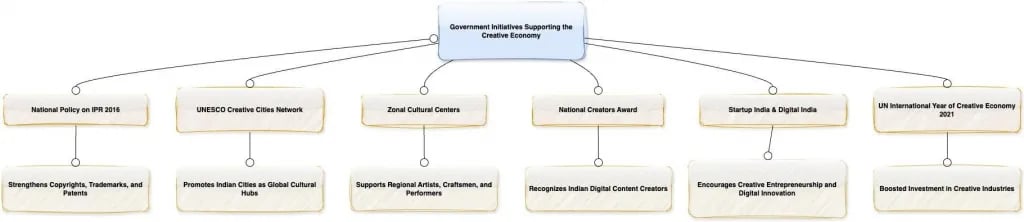
Way Forward: Strengthening India’s Creative Economy
- Expanding Indian Culture Globally: Promote Indian Films, Arts & Fashion in International Markets through trade fairs and cultural festivals.
- Boost Exports of Handicrafts, Digital Art, and Animation.
- Financial & Policy Support: Launch Credit Guarantee & Crowdfunding Portals for creative MSMEs.
- Provide Startup Incentives for Digital Content Creators & Game Developers.
- Strengthening Intellectual Property Protection: Faster Patent & Copyright Processing to protect creative works.
- Establishing Creative Hubs & Districts: Develop Creative Districts in Tier-2 & Tier-3 Cities to support local artists and startups.
- Skill Development & Digital Education: Integrate Digital Design, AI, and Digital Marketing Courses into higher education.
- AI & Emerging Technology Governance: Develop AI-based copyright policies for digital art, music, and content. Use Blockchain for Securing Digital Creations & NFTs.
Source: IE