
Tags: GS Paper 3 – Science and Technology: Space; Security
For Prelims: NavIC, IRNSS, NVS-01/02/03, GSLV, rubidium atomic clock, L1/L5/S bands, GPS, GLONASS, Galileo, BeiDou, QZSS
For Mains: Strategic importance of indigenous satellite navigation, ISRO’s launch reliability
Why in News?
ISRO successfully launched NVS-03 on board the GSLV-F18 from Sriharikota on 30 October 2026. The satellite later reached its intended orbit and was declared fully healthy. The launch is expected to restore base-level functioning of NavIC, India’s own navigation system.
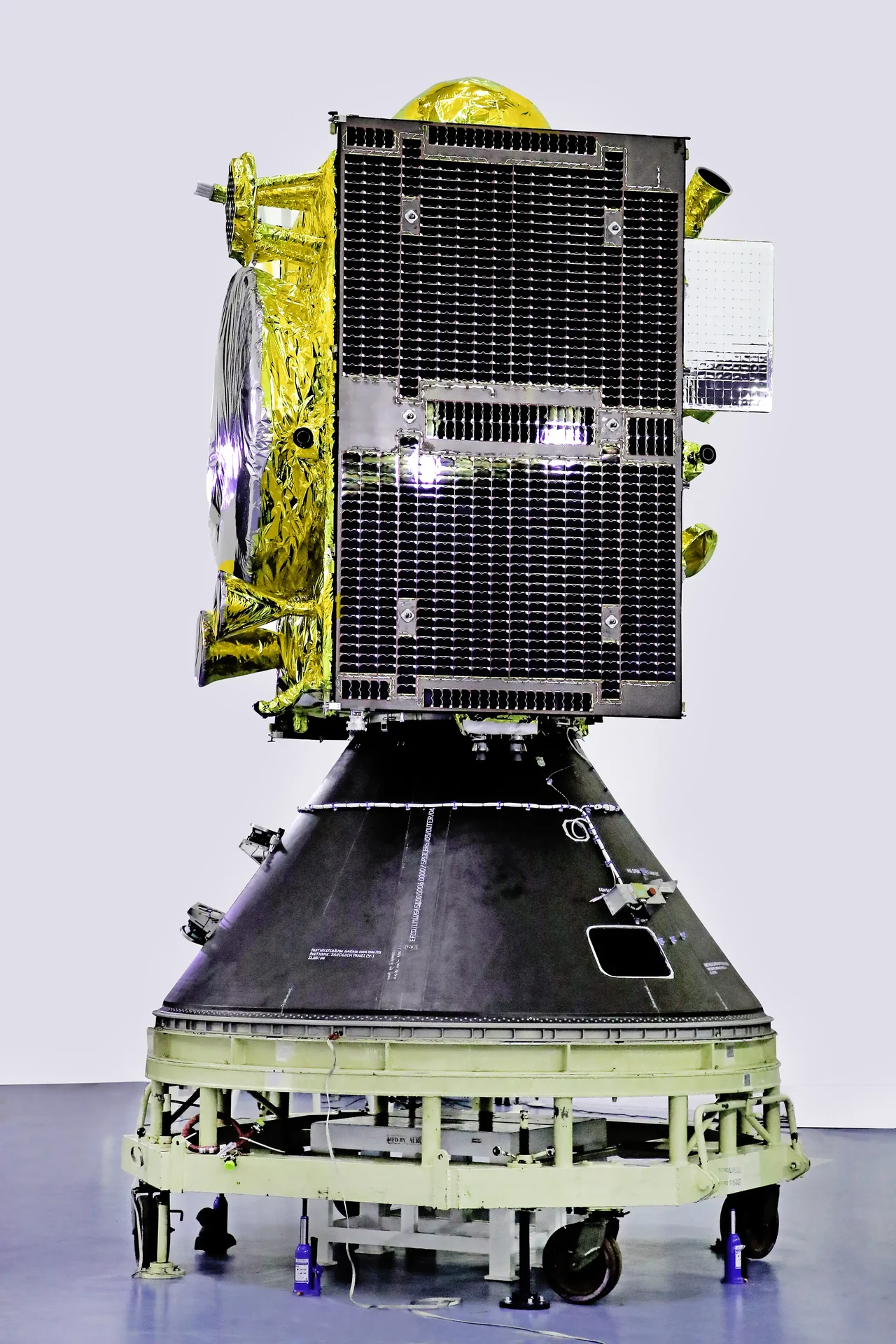
What is NavIC?
- Navigation with Indian Constellation, earlier called the IRNSS. It is a regional satellite navigation system providing positioning, navigation and timing (PNT) services.
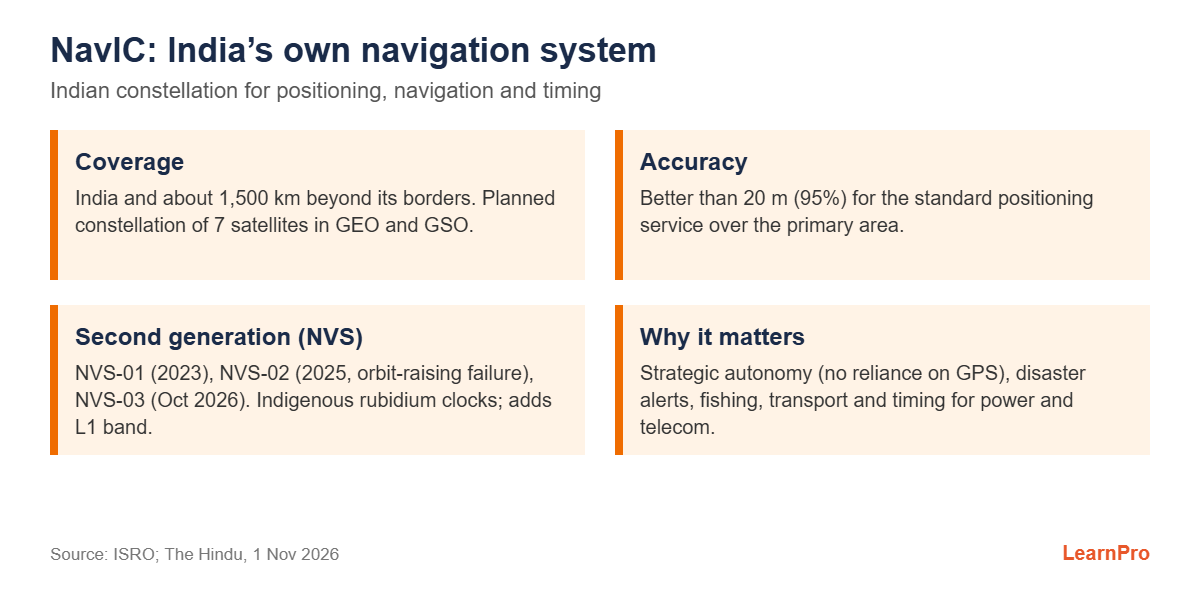
- Coverage: India and about 1,500 km around it.
- Services: A Standard Positioning Service for civilians and an encrypted Restricted Service for strategic users.
- First generation: IRNSS-1A to 1I (2013–18). Several satellites’ imported atomic clocks failed, which reduced the system’s capability.
The NVS Series (Second Generation)
- Each satellite carries at least one indigenous rubidium atomic clock, developed by ISRO’s Space Applications Centre, replacing imported clocks.
- Adds the L1 band (also used by GPS), which makes NavIC easier to support in consumer devices, along with the L5 and S bands.
- NVS-01 (May 2023): Successful. NVS-02 (January 2025): Could not reach its final orbit because of a thruster valve failure. NVS-03 (October 2026): Successful.
Why Atomic Clocks Matter
A receiver works out its position from the time signals take to travel from several satellites. An error of one nanosecond equals about 30 cm in position, so very stable clocks are essential.
Global Navigation Systems (Prelims Snapshot)
| System | Country | Type |
|---|---|---|
| GPS | USA | Global |
| GLONASS | Russia | Global |
| Galileo | European Union | Global |
| BeiDou | China | Global |
| NavIC | India | Regional |
| QZSS | Japan | Regional |
Significance
- Strategic autonomy: The Kargil conflict (1999), when India was denied GPS data, showed the need for an indigenous system.
- Civil uses: Fisheries alerts, disaster warnings, vehicle tracking (AIS 140), railways, surveying and timing for power grids and telecom.
- Self-reliance: Indigenous clocks reduce dependence on foreign suppliers.
Frequently Asked Questions (FAQs)
1. What area does NavIC cover?
India and about 1,500 km beyond its borders.
2. What new frequency band does the NVS series add?
The L1 band.
3. Which NVS satellite failed to reach its final orbit?
NVS-02 (January 2025).
Sources and further reading
- Indian Space Research Organisationcommons.wikimedia.org