
Brief Context
As India accelerates its digital transformation journey and digital public infrastructure emerges as a cornerstone of inclusive growth, innovation, and governance, there is a need to unlock the full potential of data exchanges and make them integral to the ecosystem.
Source Content
Syllabus: GS2/Governance; GS3/Infrastructure
Context
- As India accelerates its digital transformation journey and digital public infrastructure emerges as a cornerstone of inclusive growth, innovation, and governance, there is a need to unlock the full potential of data exchanges and make them integral to the ecosystem.
What Are Data Exchanges?
- They are secure, policy-driven, and consent-based platforms that enable structured, trusted, and interoperable sharing of data across sectors — government, private, civil society and research.
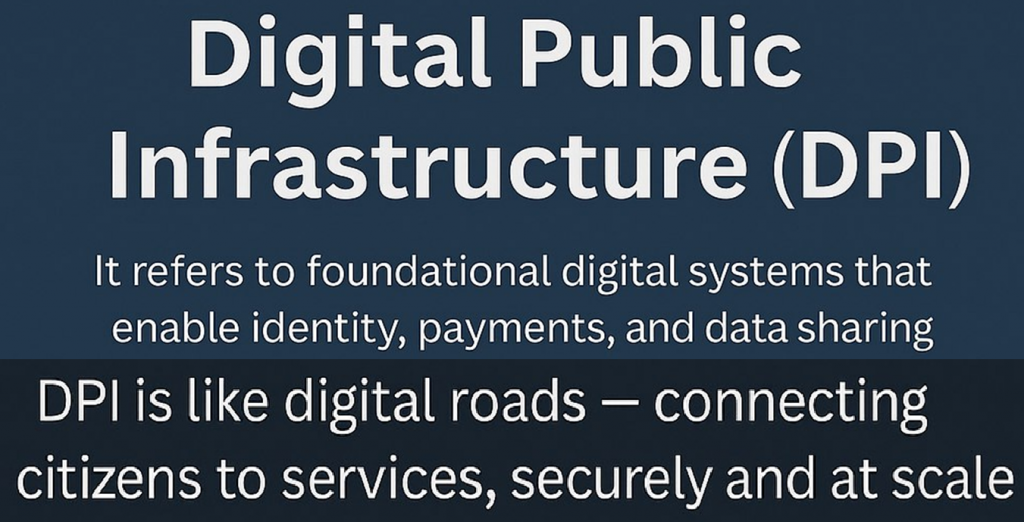
- They promote standardization, discoverability, and accountability, ensuring that data flows where it’s needed most, without compromising privacy.
Key Benefits of Data Exchanges
- Improved Efficiency and Service Delivery:
- Healthcare: Patient records can be securely shared across hospitals, labs, and insurers, reducing duplication and enabling faster diagnosis and treatment.
- Government Services: Citizens can access services like subsidies, pensions, or licenses without repeatedly submitting the same documents.
- Boost to Innovation and Startups:
- Access to Rich Datasets: Startups and researchers can use anonymized public data to build AI models, develop apps, and test new solutions.
- Accelerated R&D: Data sharing across institutions speeds up scientific research and product development.
- Economic Growth and New Markets: Data exchanges can catalyze new markets. The India Data Accessibility and Use Policy envisions monetizing non-sensitive government data, creating opportunities for data-driven businesses.
- The World Bank estimates that data ecosystems contribute 1–2% of GDP in developed nations.
- For India, its DPI stack could add $200–250 billion to GDP by 2030, with data exchanges as critical enablers.
- Better Governance and Policy Making:
- Real-Time Insights: Governments can use integrated data to track trends, allocate resources, and respond to emergencies more effectively.
- Evidence-Based Policies: Data-driven insights lead to smarter, more targeted interventions in areas like education, employment, and urban planning.
- Enhanced Transparency and Accountability:
- Audit Trails: Data exchanges can log who accessed what data and when, ensuring accountability and reducing corruption.
- Open Data Access: Citizens and watchdogs can scrutinize public data, promoting transparency in governance.
- Empowered Citizens:
- Consent-Based Sharing: Individuals can control who accesses their data and for what purpose—thanks to frameworks like the Account Aggregator.
- Simplified Access: Services like DigiLocker allow users to retrieve verified documents instantly, reducing paperwork and friction.
- Cross-Sector Collaboration:
- Interoperability: Banks, telecoms, healthcare providers, and government agencies can collaborate more effectively when data flows seamlessly.
- Global Partnerships: Standardized data exchanges make it easier to collaborate across borders, especially in areas like climate action and public health.
Challenges in Implementing Data Exchanges
- Governance Challenge: The biggest bottleneck isn’t technology — it’s governance. ADeX and TGDeX highlight that success depends on:
- Clear data classification and access policies;
- Consent-based sharing frameworks;
- Stakeholder trust and participation;
- Monitoring and audit mechanisms
- Privacy and Data Protection: Ensuring user consent and data minimization is critical.
- Risk of data breaches or misuse if security protocols are weak.
- Balancing openness with confidentiality, especially for sensitive government or health data.
- Infrastructure and Technical Capacity: Many public institutions lack the technical expertise or resources to build and maintain data exchanges.
- High initial costs for setting up secure infrastructure, especially in rural or underfunded areas.
- Trust and Adoption: Citizens may be wary of sharing data due to lack of awareness or past misuse.
- Building trust requires transparency, accountability, and robust grievance redressal mechanisms.
- Data Quality and Integrity: Inaccurate, outdated, or incomplete data can lead to poor outcomes.
- Need for regular audits, validation mechanisms, and feedback loops.
Notable Examples of Successful Data Exchanges
- USA’s Health Information Exchanges (HIEs): It facilitates sharing of patient data across hospitals, labs, and clinics.
- During COVID-19, HIEs helped track infections, manage hospital capacity, and coordinate vaccine distribution.
- European Open Data Portal: It provides access to thousands of datasets from EU institutions and member states.
- Fuels research, transparency, and innovation across sectors like transport, environment, and education.
- India’s Open Network for Digital Commerce (ONDC): A decentralized data exchange protocol that allows buyers and sellers to transact across platforms.
- It aims to democratize digital commerce by breaking platform monopolies and enabling interoperability.
- India’s Account Aggregator (AA) Framework: It enables secure, consent-based sharing of financial data between banks, insurers, and fintechs.
- Over 1.1 billion accounts are now accessible via AA, empowering users to share data for loans, investments, and financial planning without compromising privacy.
State-led Innovations
- Agriculture Data Exchange (ADeX): It was launched with support from the Centre for Data in the Public Good, IISc Bengaluru, and the World Economic Forum.
- It tackles the fragmentation of agricultural data in India, and boosts agri-tech innovation & policy targeting.
- It embeds data consent, classification (public, private, personal), and secure sharing.
- TGDeX (Telangana’s AI Implementation Roadmap): It builds upon ADeX’s principles to enable cross-sector data sharing — including health, education, and mobility.
- TGDeX provides datasets, compute power, open-source tools, and reusable models to innovators.
- National Data and Analytics Platform (NDAP), India Urban Data Exchange (IUDX), and AI Kosh show growing traction, but Telangana’s TGDeX stands out for its state-level deployment and scale.
- Unique Land Parcel ID (ULPIN): It digitizes land records for transparency.
- CORD Blockchain (Open Trust Infrastructure): Verifiable credentials & decentralized data governance.
Conclusion & Way Forward
- India’s DPI model is rooted in consent-based architecture, exemplified by platforms like DigiLocker and Account Aggregator. Data exchanges need to uphold this ethos by:
- Implementing data fiduciary principles;
- Ensuring user consent and control;
- Adopting privacy-preserving technologies like differential privacy and federated learning;
- Navigating the Challenges:
- Adopt privacy-by-design principles: Create interoperability frameworks like India’s National Data & Analytics Platform (NDAP).
- Foster public-private partnerships for innovation and capacity building;
- Launch citizen awareness campaigns to build trust;
- Establish independent data governance bodies for oversight
- India’s DPI evolution is entering a critical phase. By embracing data exchanges as public infrastructure, India can unlock massive value — not just in economic terms but in building a more equitable, efficient, and innovation-driven digital economy.
| Daily Mains Practice Question [Q] Discuss how data exchanges can enhance the effectiveness of digital public infrastructure in India. What challenges need to be addressed to ensure secure, inclusive, and scalable implementation? |