
Brief Context
Published on: 05 February, 2026 Recently, the Union Budget 2026-27 proposed an outlay of Rs 20,000 crore over the next five years in Carbon Capture Utilisation and Storage (CCUS) technologies.
Source Content
Syllabus: GS3/Environment
Context
- Recently, the Union Budget 2026-27 proposed an outlay of Rs 20,000 crore over the next five years in Carbon Capture Utilisation and Storage (CCUS) technologies.
- It is aligned with India’s long-term goal of achieving net-zero emissions by 2070, even as industrial activity and energy demand continue to grow in the near term.
What Are CCUS Technologies?
- Carbon Capture, Utilisation and Storage (CCUS) refers to a group of technologies that prevent carbon dioxide (CO₂) emissions from entering the atmosphere.
- Capture: CO₂ released during industrial processes is separated and collected.
- Utilisation: The captured CO₂ can be converted into useful products such as chemicals or fuels.
- Storage: Alternatively, it can be stored safely for long periods in geological formations deep underground.
Why CCUS Matters for Climate Goals?
- Although CCUS technologies have existed for decades, their global deployment has been limited due to high costs, safety concerns and scaling challenges.
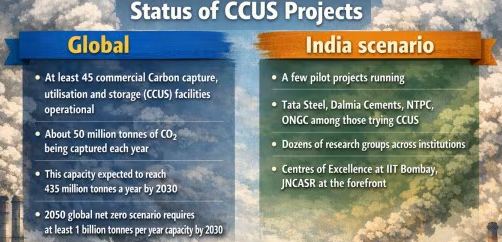
- At present, only about 50 million tonnes of CO₂ are captured annually worldwide, less than 0.5% of the nearly 40 billion tonnes emitted each year.
- The global net-zero targets are unachievable without large-scale CCUS deployment, especially as many countries struggle to sharply cut emissions from heavy industry.
India’s Growing Focus on CCUS
- Emissions are expected to rise in the short to medium term due to infrastructure development and industrial expansion.
- India has intensified efforts to develop indigenous CCUS solutions, since announcing its net-zero 2070 pledge at the Glasgow Climate Summit (2021).
- Key developments include:
- Pilot and demonstration projects in steel, cement and chemical industries;
- Mapping of potential large-scale capture and storage sites;
- Establishment of Centres of Excellence, such as those at IIT Bombay and the Jawaharlal Nehru Centre for Advanced Scientific Research;
- A CCUS R&D roadmap for 2030, released by the Department of Science and Technology (DST), identifying technological, financial and policy gaps;
Why Is the Budget Allocation Crucial?
- A major hurdle for CCUS has been the lack of funding for field-scale testing and deployment. While many technologies have proven effective in laboratories, scaling them up to real-world conditions involves high risks and costs.
- The ₹20,000 crore allocation is aimed at bridging this gap by improving the technology readiness levels of promising solutions.
- The meaningful impact requires technologies capable of capturing or storing 100–500 tonnes of CO₂ per day.
- Multiple CCUS technologies to achieve commercial deployment in India within the next five years.
Economic and Industrial Benefits
- CCUS is especially important for industries like steel and cement, where emissions arise from fuel combustion and core production processes themselves.
- In such cases, switching to renewable electricity alone cannot eliminate CO₂ emissions.
- The budget targets CCUS deployment in power generation, steel, cement, refineries, and chemical industries.
- These sectors are among the largest contributors to India’s emissions.
Boosting Global Competitiveness
- Indian exporters are increasingly exposed to carbon-related trade barriers, such as the EU’s Carbon Border Adjustment Mechanism (CBAM).
- Indian products can remain competitive in key international markets, by lowering their carbon footprint through CCUS.
Looking Ahead
- India could see commercial deployment of CCUS technologies within the next five years with targeted funding, clearer policy direction, and growing industrial interest.
- The push promises technological leadership, industrial resilience, and long-term economic gains, beyond climate mitigation.
- India’s ₹20,000 crore on CCUS signals that achieving net-zero will require renewable energy, and heavy investments in technologies that deal directly with carbon emissions where they are hardest to eliminate.
| Daily Mains Practice Question [Q] Examine the significance of the recent policy push for Carbon Capture Utilisation and Storage (CCUS) technologies in India. Discuss how it can support India’s net-zero commitment and enhance the global competitiveness of Indian industries. |