
Brief Context
In Context The National Critical Mineral Mission (NCMM) was launched in 2025 to establish a robust framework for self-reliance in the critical mineral sector. About Critical minerals are essential for clean energy technologies like solar panels, wind turbines, EVs, and energy storage systems. To secure these resources, India launched the NCMM to ensure their long-term availability and processing.
Source Content
Syllabus: GS3/ S&T
In Context
- The National Critical Mineral Mission (NCMM) was launched in 2025 to establish a robust framework for self-reliance in the critical mineral sector.
About
- Critical minerals are essential for clean energy technologies like solar panels, wind turbines, EVs, and energy storage systems. To secure these resources, India launched the NCMM to ensure their long-term availability and processing.
- The NCMM mission aims to establish a robust framework for self-reliance in the critical mineral sector. Under this mission, the Geological Survey of India (GSI) has been tasked with conducting 1,200 exploration projects from 2024-25 to 2030-31.
- A committee formed by the Ministry of Mines in November 2022 identified 30 critical minerals, with 24 included in Part D of Schedule I of Mines and Minerals Development and Regulation Act, 1957 (MMDR Act, 1957).
- The Union Government now has the exclusive authority to auction mining leases and composite licenses for these specific minerals.
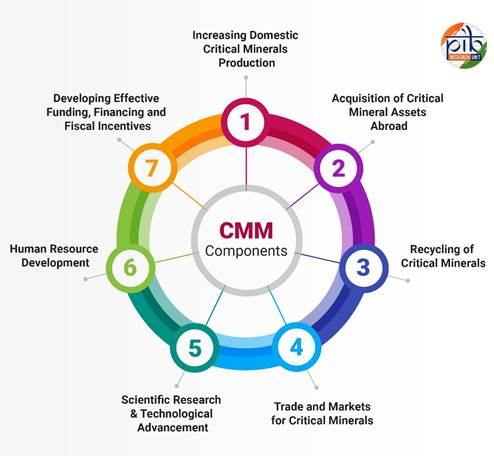
What are Critical minerals?
- Critical minerals are essential for a country’s economic development and national security, and their lack of availability or concentration in a few geographical locations can lead to supply chain vulnerabilities.
Uses of Critical Minerals
- Energy Security & Clean Transition: Lithium, cobalt, nickel, and REEs are crucial for renewable energy systems (e.g. solar panels, wind turbines).
- Support India’s targets: 50% electric power from non-fossil sources by 2030
- Net-zero emissions by 2070
- Increases wind energy capacity from 42 GW to 140 GW by 2030
- Support India’s targets: 50% electric power from non-fossil sources by 2030
- Boost to Electric Vehicles (EVs) and Storage: Essential for manufacturing lithium-ion batteries, the backbone of EVs and energy storage systems.
- Reduce India’s dependency on imported oil.
- Aligns with the National Electric Mobility Mission Plan (NEMMP) and FAME scheme.
- Economic Development & Job Creation: Mining, processing, and R&D in critical minerals can:
- Attract domestic and foreign investment.
- Create jobs in exploration, engineering, refining, and technology sectors.
- Strengthen MSMEs and startups in the clean-tech value chain.
- National Security: Critical minerals like rare earths, titanium, and tungsten are used in:
- Defense (missile systems, stealth aircraft, radar)
- Electronics (telecom, semiconductors, satellites)
- Reduces strategic vulnerabilities by minimizing import dependence.
- Infrastructure & Digital Economy Backbone: Minerals like silicon, gallium, indium are essential for:
- Semiconductors
- 5G/6G tech
- Smart grids, smart cities, and digital India initiatives
IREL (India) Limited
- It is a key public sector enterprise under the Department of Atomic Energy, and plays a vital role in India’s critical minerals value chain.
- With a processing capacity of 6 lakh tonnes per annum, it produces essential beach sand minerals such as ilmenite, rutile, zircon, sillimanite, and garnet.
- The company operates a Rare Earth Extraction Plant in Chatrapur, Odisha, and a Rare Earth Refining Unit in Aluva, Kerala, contributing to the indigenous processing of rare earth elements (REEs).
International Engagements
- KABIL-CAMYEN Agreement (Argentina, 2024): Lithium exploration over 15,703 hectares.
- MoU with Australia’s Critical Minerals Office (2022).
- Talks with Democratic Republic of Congo (DRC) for cobalt and copper.
- Strategic tie-ups with Africa, Latin America, and ASEAN countries for secure sourcing.
Challenges
- Geopolitical Risks: Dependence on imports from China, DRC, and South America.
- Lack of Domestic Processing Capacity: India currently lacks advanced REE separation technologies.
- Low Private Investment: Mining sector faces regulatory and financial entry barriers.
- Environmental Concerns: Mining and refining can damage local ecosystems.
- Recycling Ecosystem: Still nascent and lacks scale.
Way Forward
- Strengthen domestic exploration and incentivize the private sector via PPP.
- Forge long-term strategic partnerships with mineral-rich countries.
- Boost R&D and recycling to close the mineral loop.
- Skilling and capacity-building for critical mineral-specific technologies.
Source: PIB