
Brief Context
Context Citing “technological” and “cross-border fuelling” concerns, the Commission for Air Quality Management (CAQM) deferred the ban on fuel to end-of-life vehicles in Delhi to November 1. About In 2015, the National Green Tribunal (NGT) directed that All diesel vehicles (heavy or light) which are more than 10 years old will not be permitted on the roads of Delhi NCR. Also, Petrol vehicles which are more than 15 years old and diesel vehicles that are more than 10 years old shall not be registe
Source Content
Syllabus: GS2/Governance/GS3/Environment
Context
- Citing “technological” and “cross-border fuelling” concerns, the Commission for Air Quality Management (CAQM) deferred the ban on fuel to end-of-life vehicles in Delhi to November 1.
About
- In 2015, the National Green Tribunal (NGT) directed that All diesel vehicles (heavy or light) which are more than 10 years old will not be permitted on the roads of Delhi NCR.
- Also, Petrol vehicles which are more than 15 years old and diesel vehicles that are more than 10 years old shall not be registered in the NCR, Delhi.
- The NGT’s directive was upheld and reinforced by the Supreme Court in 2018. It said that vehicles violating the order should be impounded.
- Most recently, the Environment Protection (End-of-Life Vehicles) Rules, 2025, effective April 1, made scrapping mandatory within 180 days of the expiry of the vehicle’s registration.
- The enforcement relies on Automatic Number Plate Recognition (ANPR) systems installed at fuel stations. These cameras scan number plates and cross-check with the VAHAN database to identify ELVs. If detected, fuel will be denied, and vehicles may be subject to impoundment or scrapping unless exempted.
Issue with Older Vehicles
- Pre-BS-VI (Bharat Stage VI) vehicles are disproportionately responsible for vehicular emissions.
- BS-IV vehicles, for instance, emit 4.5 to 5.5 times more particulate matter than BS-VI vehicles.
- Transport emissions account for 28% of PM2.5, 41% of sulphur dioxide (SO2), and 78% of nitrogen oxide (NOx) emissions in the NCR.
- Although legal mandates have existed since 2015, official enforcement was delayed due to the absence of necessary technological infrastructure.
| Commission for Air Quality Management (CAQM) – Formalized through the Commission for Air Quality Management in National Capital Region and Adjoining Areas Act, 2021. – Jurisdiction: Covers Delhi, Punjab, Haryana, Rajasthan, and Uttar Pradesh — especially areas contributing to air pollution in the NCR. – CAQM is meant to provide an integrated and permanent mechanism for: 1. Coordinated response to air pollution. 2. Ensuring synergy across different ministries and states. 3. Replacing the fragmented approach that involved multiple agencies with overlapping responsibilities. |
Bharat Stage Norms
- Bharat Stage Norms (BS Norms) are emission standards instituted by the Government to regulate the output of air pollutants from internal combustion engines and spark-ignition engines, including motor vehicles.
- These are European emission standards (Euro norms).
- They apply to all vehicles: 2-wheelers, 3-wheelers, cars, trucks, buses, etc.
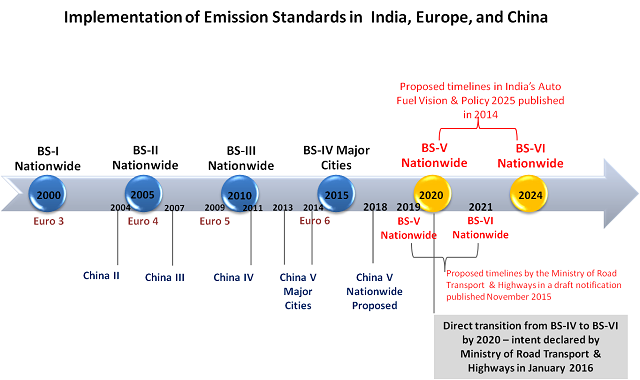
Challenges in the Implementation of Bharat Stage Norms in India
- Automobile Industry Readiness: Sudden transitions, like from BS-IV to BS-VI (skipping BS-V), forced automobile manufacturers to overhaul engines and emission systems in a short time.
- Fuel Availability: Refineries had to upgrade to produce cleaner fuels (e.g., BS-VI compliant fuel), which required huge investments and coordination across the country.
- Testing Facilities: Lack of adequate testing and certification infrastructure for emission standards compliance, especially for real driving emission (RDE) tests.
- For Consumers: BS-VI vehicles are more expensive, discouraging buyers from adopting newer models.
- Weak Enforcement: Limited enforcement capacity to check on-road compliance, especially in smaller towns and rural areas.
- Large Number of Older Vehicles: Older BS-II or BS-III vehicles still ply on roads, emitting significantly more pollutants.
- Resistance to Scrappage: Vehicle owners are reluctant to scrap old vehicles due to sentimental value, poor enforcement of scrappage policy, and lack of economic incentives.
- Low Awareness: Many consumers are unaware of BS norms and their environmental benefits.
Way Ahead
- The CAQM’s directive is a bold enforcement step aiming to remove highly polluting vehicles from roads in a phased manner.
- While legally backed and environmentally justified, its success hinges on technological robustness, cross-state cooperation and public support.
- The solution lies in coordinated planning and action on multiple fronts, involving a wide range of stakeholders.
Source: IE