
Brief Context
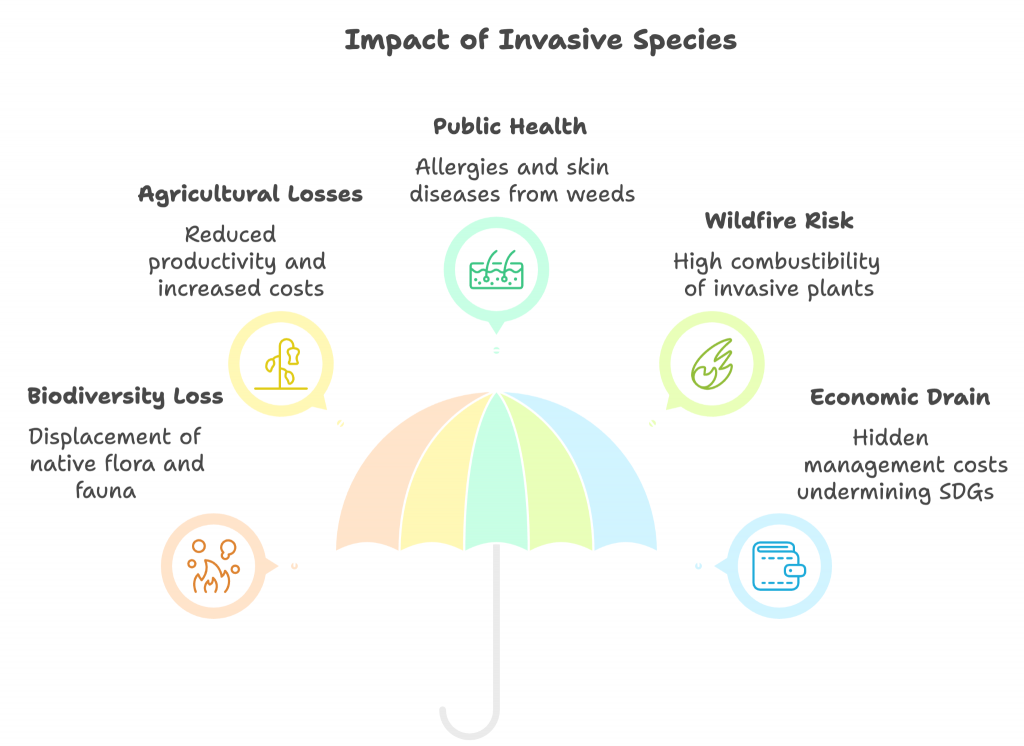
Context According to a recent study published in Nature Ecology Evolution, invasive non-native plants and animals have inflicted more than $2.2 trillion in damages worldwide since 1960, and found that the true costs may be 16 times higher than previously estimated. Common invasive species in India Among the most costly to manage are Japanese knotweed (Reynoutria japonica) and common lantana (Lantana camara). In India, the MoEFCC recognizes over 154 invasive faunal species, spanning terrestrial,
Source Content
Syllabus: GS3/Environment & Biodiversity
Context
- According to a recent study published in Nature Ecology & Evolution, invasive non-native plants and animals have inflicted more than $2.2 trillion in damages worldwide since 1960, and found that the true costs may be 16 times higher than previously estimated.
Invasive Alien Species (IAS)
- Invasive Species are non-native flora and fauna that disrupt local ecosystems, including the environment, economy, or human health.
- Globally, plants were the most damaging invasive group, causing $926.38 billion in costs, followed by:
- Arthropods: $830.29 billion
- Mammals: $263.35 billion
- Researchers emphasize that trade and travel are the main vectors for their spread.
Common invasive species in India
- Among the most costly to manage are Japanese knotweed (Reynoutria japonica) and common lantana (Lantana camara).
- In India, the MoEFCC recognizes over 154 invasive faunal species, spanning terrestrial, freshwater, and marine ecosystems.
- Invasive plants like Lantana camara and Senna spectabilis have colonized vast swathes of the Western Ghats, including critical tiger and elephant habitats.
- Lantana alone has invaded over 40% of India’s tiger habitats, threatening prey availability and altering forest dynamics.
Why the Underreporting?
- Study points to several systemic issues:
- Lack of centralized data systems;
- Limited inter-agency coordination;
- Language barriers in global databases;
- Competing conservation priorities.
Global Policy Responses
- Several international agreements aim to curb biological invasions:
- Ballast Water Management Convention: Prevents aquatic species spread via ships.
- Convention on Biological Diversity: Obligates countries to prevent, control, or eradicate alien species threatening ecosystems.
- These frameworks highlight a growing recognition of invasive species as a global ecological and economic threat.
India’s Efforts to Curb Biological Invasions
- National Biodiversity Strategy and Action Plan (NBSAP): It aligns with the Kunming-Montreal Global Biodiversity Framework and includes invasive species management as a key priority. It adopts a ‘Whole-of-Government and Whole-of-Society’ approach, involving multiple union ministries and stakeholders. It emphasizes:
- Restoration of degraded ecosystems;
- Protection of terrestrial and marine areas;
- Pollution control and invasive species mitigation;
- Community participation in biodiversity governance.
- Scientific Research and Documentation: The Indian Council of Forestry Research and Education (ICFRE) published a comprehensive Handbook on Invasive Species.
What Needs to Change?
- To address this growing threat, India needs to:
- Develop a national database for invasive species costs and management;
- Invest in early detection and rapid response systems;
- Promote interdisciplinary research and community engagement;
- Integrate invasive species control into climate and biodiversity policies.