
Brief Context
Context The year 2025 marked a transformative milestone for India’s agricultural sector, showcasing the cumulative impact of policy continuity, institutional reforms, and strategic investments made over the past decade. Key Highlights For India’s Agricultural Sector (2025) Agriculture and allied activities remained the backbone of the rural economy, contributing nearly 16% to India’s GDP and supporting livelihoods for over 46% of the population. Union Budget 2025–26 allocated ₹1.52 lakh crore to
Source Content
Syllabus: GS3/Agriculture
Context
- The year 2025 marked a transformative milestone for India’s agricultural sector, showcasing the cumulative impact of policy continuity, institutional reforms, and strategic investments made over the past decade.
Key Highlights For India’s Agricultural Sector (2025)
- Agriculture and allied activities remained the backbone of the rural economy, contributing nearly 16% to India’s GDP and supporting livelihoods for over 46% of the population.
- Union Budget 2025–26 allocated ₹1.52 lakh crore to agriculture and allied sectors, with a focus on research, infrastructure, and farmer welfare.
Record Production and Food Security
- India achieved its highest-ever foodgrain production of 357.73 million tonnes in 2024–25, an 8% rise over the previous year and 106 million tonnes higher than in 2015–16.
- Rice: 150.184 million tonnes;
- Wheat: 117.945 million tonnes;
- Pulses and Oilseeds: Significant gains supported by targeted missions and procurement assurances;
- Millets (Shree Anna): Steady rise reaffirming India’s leadership in climate-resilient cereals;
Strengthening Farmer Incomes
- MSP Policy: It continued as a pillar of income assurance, guaranteeing at least 50% return over cost of production.
- Since 2014, procurement operations have transferred over ₹20 lakh crore in MSP payments, ₹14.16 lakh crore for paddy and ₹6.04 lakh crore for wheat, directly benefiting millions of farmers.
- Direct Income Transfers and Credit Expansion: Under PM-Kisan Samman Nidhi, over ₹3.90 lakh crore was directly credited to 11 crore farmers through 20 installments by August 2025.
- The Kisan Credit Card scheme further expanded access to institutional finance, with ₹10 lakh crore disbursed to 7.71 crore farmers, including those in livestock and fisheries.
Risk Management and Irrigation Expansion
- Crop Insurance and Risk Coverage: The Pradhan Mantri Fasal Bima Yojana (PMFBY) continued to mitigate risks, disbursing claims worth ₹1.83 lakh crore since 2016.
- Increasing participation from non-loanee farmers reflected greater trust and transparency.
- Water Efficiency and Irrigation: The Pradhan Mantri Krishi Sinchai Yojana (PMKSY) accelerated completion of irrigation projects and promoted micro-irrigation, enabling shifts to high-value crops and improved water-use efficiency.
Infrastructure and Market Ecosystem
- Investment in Agricultural Infrastructure: More than 1 lakh projects were sanctioned through the Agriculture Infrastructure Fund, including Custom Hiring Centres, warehouses, and cold storage units, reducing post-harvest losses and creating rural jobs.
- The PM Kisan Samriddhi Kendras strengthened village-level access to quality inputs and advisory services, bridging last-mile delivery gaps.
- Market Reforms and Farmer Institutions: The e-NAM platform expanded nationwide, promoting price discovery and transparency.
- The establishment of 10,000 FPOs enabled collective marketing, input procurement, and value addition, empowering women farmers and smallholders.
Growth in Allied Sectors
- Dairy: 239.30 million tonnes in 2023–24, aided by the Rashtriya Gokul Mission and dairy development programmes;
- Fisheries: 195 lakh tonnes in 2024–25, led by rapid inland fisheries growth;
- Horticulture: Record expansion in fruits and vegetables;
- Food Processing: Exports crossed USD 49.4 billion by July 2025, reflecting rising value addition.
Sustainability and Climate Resilience
- Natural and organic farming gained momentum under national missions.
- The Soil Health Card (SHC) Scheme advanced balanced nutrient use through extensive testing and farmer training.
- The Ethanol Blending Programme reached 19.05% by July 2025, reducing crude oil imports and providing additional income for sugarcane farmers.
- Under PM-KUSUM, solar pump installations expanded, fostering renewable energy adoption and decentralized solar power generation.
Human Capital and Skill Development
- Krishi Vigyan Kendras (KVKs) trained millions through hands-on demonstrations and vocational programs.
- Schemes like ATMA, STRY, and PMKVY built a robust rural skilling ecosystem, empowering farmers, women, and youth to embrace modern farming and agri-entrepreneurship.
- Skill integration across horticulture, livestock, mechanization, and processing enhanced employability and innovation across the agri-value chain.
Inclusive Growth and Local Impact
- Convergence of income support, irrigation, infrastructure, and training translated into higher rural incomes, reduced migration, and improved living standards.
- Women farmers, FPOs, and rural entrepreneurs became pivotal agents of change in local agri-economies.
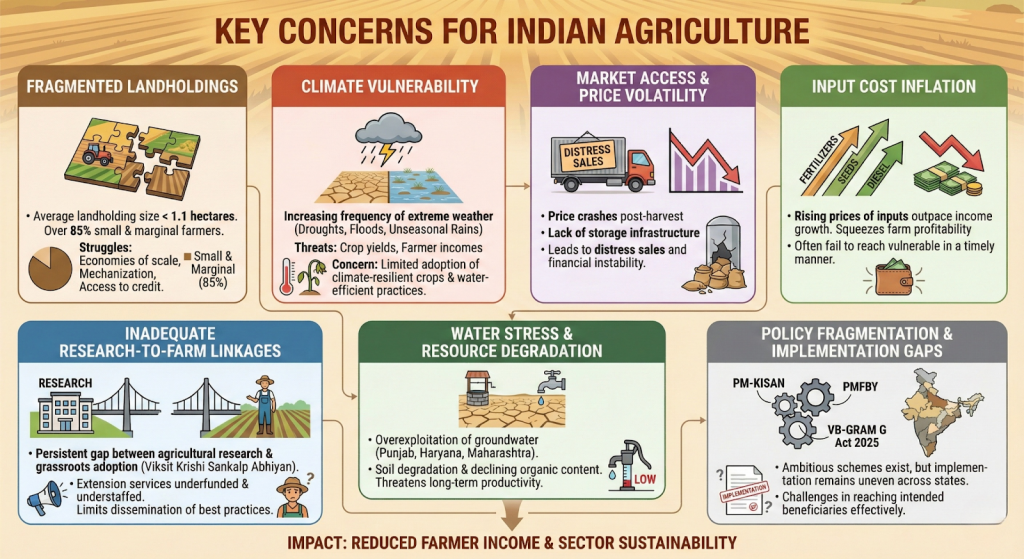
Related Efforts & Initiatives
- Modified Interest Subvention Scheme (MISS): Available to farmers availing short term crop loans up to Rs.3.00 lakh at an interest rate of 7% per annum for one year.
- Agriculture Infrastructure Fund (AIF): To mobilize a medium – long term debt financing facility for investment in viable projects for post-harvest management.
- All loans under this financing facility have interest subvention of 3% per annum up to a limit of ₹ 2 crore.
- National Bee Keeping and Honey Mission (NBHM): Launched as a part of the Atma Nirbhar Bharat Abhiyan; Goal of ‘Sweet Revolution’.
- Namo Drone Didi: To provide drones to 15000 selected Women SHGs; application of fertilizers and pesticides.
- National Mission on Natural Farming (NMNF): To develop 15,000 clusters covering 7.5 lakh Ha area and establish 10,000 need based Bio-Input Resource Centres (BRCs).
- Pradhan Mantri Annadata Aay Sanrakshan Abhiyan (PM-AASHA): To provide price support for pulses, oilseeds, and copra;
- Agri Fund for Start-ups & Rural Enterprises (AgriSURE): To boost innovation and entrepreneurship in the agricultural and rural ecosystem.
- Per Drop More Crop (PDMC): To increase water use efficiency at the farm level through Micro Irrigation technologies namely Drip and Sprinkler Irrigation systems.
- Paramparagat Krishi Vikas Yojana (PKVY): For promotion of organic farming in the country.
- Soil Health & Fertility (SH&F): To promote balanced and integrated nutrient management through the Soil Health Card (SHC) initiative.
- Special initiatives include establishment of school mini soil labs (1,020 functional, expanding to 5,000 PM SHRI schools) and capacity building through demonstrations, campaigns, and farmer training.
- Rainfed Area Development (RAD): A component under National Mission for Sustainable Agriculture (NMSA), focuses on Integrated Farming System (IFS).
- Sub-Mission on Agroforestry: Under National Mission for Sustainable Agriculture (NMSA) with the motto of ‘Har Medh Par Ped’.
- Crop Diversification Programme (CDP): To shift farmers from water-intensive crops like paddy to more sustainable and profitable alternatives such as pulses, oilseeds, and coarse cereals.
- Sub-Mission on Agriculture Extension (SMAE): Making the extension system farmer driven and farmer accountable by disseminating technology to farmers through new institutional arrangements viz. Agricultural Technology Management Agency (ATMA) at district level.
- National Mission on Edible Oils (NMEO)-Oil Palm: To promote oil palm cultivation with special focus on North-Eastern States and A&N Islands.
- Digital Agriculture Mission: To improve the existing National e-Governance Plan in Agriculture (NeGPA) by developing a digital public infrastructure for agriculture.
- National Bamboo Mission: Implemented through the State Bamboo Missions (SBM)/ State Bamboo Development Agency (SBDA).