
Brief Context
Context India’s pesticide market is undergoing a structural transformation, driven by shifting pest dynamics, labour shortages, and changing cropping practices. Background Pesticides, or crop protection chemicals, include substances used to kill or deter pests that harm crops. These include:Insecticides: For insect pests (e.g., white-backed plant hopper in paddy).
Source Content
Syllabus: GS3/ Economy and agriculture
Context
- India’s pesticide market is undergoing a structural transformation, driven by shifting pest dynamics, labour shortages, and changing cropping practices.
Background
- Pesticides, or crop protection chemicals, include substances used to kill or deter pests that harm crops. These include:
- Insecticides: For insect pests (e.g., white-backed plant hopper in paddy).
- Fungicides: For fungal diseases (e.g., blast, sheath blight).
- Herbicides: For weed control.
- Historically, pesticide use in India was low in the mid-20th century, but has grown with the Green Revolution.
- In recent decades, regulatory changes (banning DDT, endosulfan etc.) and rising labour costs have boosted herbicide and biopesticide adoption.
Composition of India’s Crop Protection Market
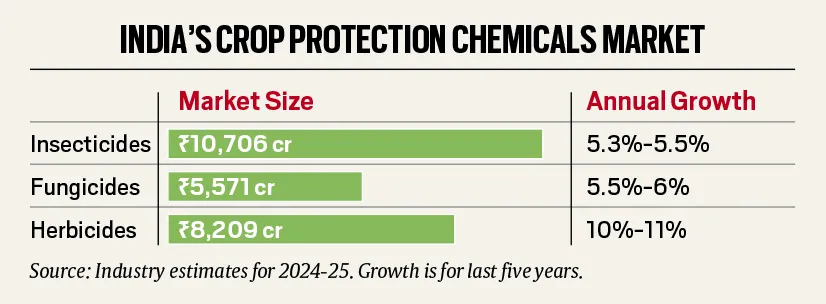
- India’s organised domestic crop protection chemicals market is valued at roughly Rs 24,500 crore.
- The largest segment within that is insecticides (Rs 10,700 crore), followed by herbicides (Rs 8,200 crore) and fungicides (Rs 5,600 crore).
- Herbicides are growing at >10% annually, highest among all sub-segments.
- Global scenario:
- As per Food and Agriculture Organization (FAO), over 3.7 million tonnes of pesticides were used globally in 2022, doubling since 1990.
- Asia leads in production and consumption, with China and India at the forefront.
Driving Factor for the Growth of Herbicides
- Manual weeding requires 8–10 hours per acre, while the average daily wage for plant protection workers rose to ₹447.6 in Dec 2024 (from ₹326.2 in 2019) according to the Labour Bureau’s data.
- Due to migration and rising opportunity costs, labour availability is erratic, especially during peak agricultural operations.
- Herbicides now act as labour substitutes, like tractors or mechanised harvesters.
Regulatory Framework
- Insecticides Act, 1968: Governs import, registration, manufacture, sale, transport, and use of pesticides.
- Banned/Restricted Pesticides: India has banned 46 pesticides; others like Paraquat and Glyphosate remain under scrutiny.
- CIB&RC (Central Insecticide Board & Registration Committee): Approves new pesticides and ensures safety compliance.
- Anupam Verma Committee: It was constituted by the Department of Agriculture & Farmers Welfare to review 66 pesticides which are banned/restricted in other countries but continued to be registered for use in India.
Schemes Promoting Sustainable Use of Pesticides
- National Mission on Sustainable Agriculture (NMSA): Encourages Integrated Pest Management (IPM) and climate-resilient farming.
- Paramparagat Krishi Vikas Yojana (PKVY): Promotes organic farming, including biopesticide usage.
- Kisan Drone Scheme (2022): Provides subsidies for agricultural drones, enabling precision spraying and reducing health risks.
- Kisan Kavach Protective Kit: Developed byDepartment of Biotechnology, it offers safety gear to pesticide applicators.
What are the Concerns?
- Environmental and Health Risks: Excessive or improper pesticide use leads to soil and water contamination, resistance buildup, and human health hazards.
- Regulatory Oversight: India lacks a robust regulatory framework like the EPA (USA) or EFSA (EU) for approving or banning hazardous chemicals.
- R&D and Indigenous Capacity: India is dependent on MNCs for active ingredients and formulations. It needs more investment in domestic R&D and public-private innovation platforms.
Way Ahead
- Promote Bio-pesticides: Streamline approval and incentivize production of eco-friendly alternatives.
- Strengthen Regulatory Enforcement: Improve state-level monitoring to curb the sale of spurious and substandard pesticides.
- Farmer Awareness & Training: Expand extension services to educate farmers on judicious, need-based pesticide use.
- Digital Traceability Systems: Implement QR-based tracking from manufacturer to farmer to ensure quality and transparency.
- Increase R&D Funding: Support innovation in green chemistry, nano-pesticides, and Integrated Pest Management (IPM).
- Ban Hazardous Chemicals: Phase out Class I pesticides (highly hazardous) in alignment with FAO-WHO guidelines.
Concluding Remarks
- India’s pesticide sector is at a crossroads—while it plays a crucial role in ensuring crop protection and food security, it simultaneously raises environmental and health concerns.
- A judicious blend of regulation, innovation, and farmer awareness is essential to transition toward safer, more sustainable agriculture.
Source: IE