
Brief Context
Context The Prime Minister inaugurated and laid the foundation stone for multiple development projects in Imphal, Manipur. What are the Key Unresolved Issues in Manipur? Rehabilitation of Displaced Families: There are more than 280 relief camps in Manipur, sheltering about 57,000 people, many displaced for over two years.
Source Content
Syllabus: GS2/ Polity and Governance
Context
- The Prime Minister inaugurated and laid the foundation stone for multiple development projects in Imphal, Manipur.
Key Highlights of Development Projects
- Infrastructure and Connectivity:
- Launch of the Manipur Urban Roads Project with an investment of over ₹3,600 crore to boost road connectivity and improve urban infrastructure in Imphal.
- The Jiribam-Imphal railway line, worth ₹22,000 crore, will soon connect Imphal to the national rail network.
- Imphal Airport has been expanded with ₹400 crore investment, and helicopter services inaugurated to enhance air connectivity.
- Civil Secretariat building (worth ₹538 crore) and Police Headquarters (₹101 crore) inaugurated to improve governance.
- Digital and IT Initiatives:
- Manipur Infotech Development Project aiming to boost IT and startup ecosystem in the state.
- Women Empowerment:
- Inauguration of four new Ima Markets (women-only markets) reinforcing Manipur’s women-led economy tradition.
- Construction of working women’s hostels at nine locations to empower women and support education and employment.
- Sports and Culture:
- Support for National Sports University and Khelo India initiatives.
- Promotion of polo through the Marjing Polo Complex, which includes the world’s tallest polo statue.
Background
- An ethnic conflict broke out in May 2023, between the Meitei people who dominate the Imphal valley and the Kuki-Zo people who dominate the surrounding hills.
- The violence has claimed above 250 lives and displaced over 60,000 people.
- The conflict originated from the Meitei demand for Scheduled Tribe (ST) status, which the Kukis opposed. By getting ST status, the Meiteis wants to;
- Access to constitutional safeguards such as reservations in jobs, education, and political representation.
- Rights to purchase land in the hill areas, which are currently reserved for tribal communities (mainly Kuki-Zo and Naga groups).
- A political crisis erupted in the State after the resignation of the Chief Minister and the subsequent imposition of President’s Rule.
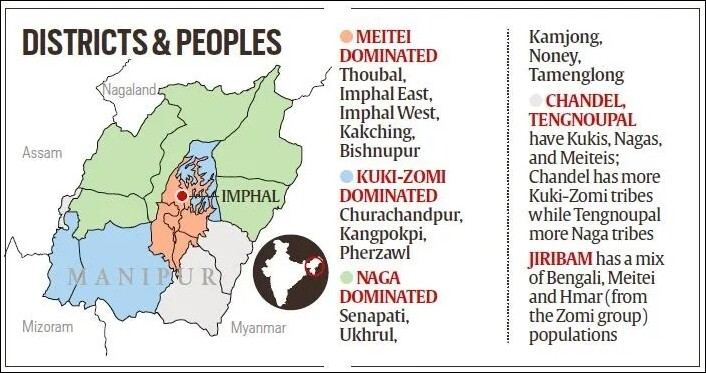
What are the Key Unresolved Issues in Manipur?
- Rehabilitation of Displaced Families: There are more than 280 relief camps in Manipur, sheltering about 57,000 people, many displaced for over two years.
- Restrictions on Movement: During the conflict, “buffer zones” were set up as militarised boundaries separating the valley and hill districts.
- These zones restricted free movement, with Meiteis in the valley cut off from certain services and Kuki-Zo groups unable to access Imphal and other valley-based facilities.
- Border Concerns: The porous international border with Myanmar is an issue. Meitei leaders allege that unchecked migration of Chin people (ethnically related to Kuki-Zo) is worsening tensions.
- The Government scrapped the Free Movement Regime, which allowed border tribes to travel up to 16 km into either country without visa, and plans to fence the border.
- These measures have met opposition from Kuki-Zo and Naga communities, who have cultural, economic ties across the border.
- Political Vacuum: There is a need to ensure good governance and justice in Manipur, creating conditions for stability and development in the State.
- Dialogue Still Missing: Though large-scale violence has reduced since late 2024, there is no sustained dialogue between Meitei and Kuki-Zo communities.
Demand for Separate Administration
- The Kuki-Zo Council has demanded for their hill areas of Manipur to be carved out administratively from the rest of the state, specifically, as a Union Territory (UT) with a legislature under Article 239A of the Indian Constitution.
- Article 239A of the Indian Constitution grants the Parliament the power to create a local legislature or a Council of Ministers, or both, for certain Union Territories.
- This provision was inserted into the constitution by the 14th Amendment Act of 1962.
- However, Meitei organisations like COCOMI strongly oppose the proposal, viewing it as a threat to Manipur’s territorial integrity and a step toward “ethnic partition.”
Need for Development
- Infrastructure and connectivity improvements are critical for trade, mobility, and access to healthcare and education.
- Digital and IT sector growth can provide employment, entrepreneurship opportunities, and integration with the broader economy.
- Women-centric initiatives like Ima Markets help preserve cultural identity while boosting local economies.
- Peace-building efforts and targeted relief for displaced groups are crucial for social cohesion and long-term stability.
- Regional integration through infrastructure aligns with the Act East Policy and fosters economic collaboration with Southeast Asia.
Way Ahead
- A sustainable peace in Manipur requires inclusive dialogue between Meitei and Kuki-Zo groups, backed by neutral mediation.
- The government must prioritise rehabilitation of displaced families with dignity and livelihood support. At the same time, balanced border management and strengthening of local governance institutions can reduce alienation.
- In the long run, a political settlement that safeguards tribal rights while preserving Manipur’s territorial integrity is essential.
Source: TH
Sources and further reading
- THthehindu.com