
Brief Context
Context World Health Day, observed annually on 7 April, highlights pressing global health issues and mobilises action to improve public health outcomes. About It was founded by WHO in 1950. The idea for World Health Day originated from the first World Health Assembly, held in Geneva, Switzerland, in 1948.
Source Content
Syllabus: GS2/Health
Context
- World Health Day, observed annually on 7 April, highlights pressing global health issues and mobilises action to improve public health outcomes.
About
- It was founded by WHO in 1950.
- The idea for World Health Day originated from the first World Health Assembly, held in Geneva, Switzerland, in 1948.
- It is aimed at uniting governments, institutions, and communities to address global health priorities.
- 2025 Theme: “Healthy Beginnings, Hopeful Futures” focuses on maternal and newborn health, urging countries to reduce preventable deaths and prioritize women’s long-term well-being.
- India’s Commitment: The Ministry of Health and Family Welfare, strengthens efforts for equitable, accessible, and quality healthcare.
- According to WHO, close to 300,000 women lose their life due to pregnancy or childbirth each year, while over 2 million babies die in their first month of life and around 2 million more are stillborn.
- Based on current trends, 4 out of 5 countries are off track to meet targets for improving maternal survival by 2030.
India’s Maternal Mortality and Child Mortality
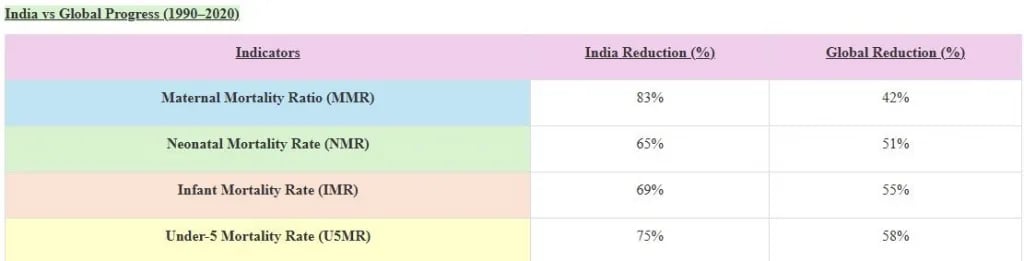
- MMR (Maternal Mortality Ratio) in India dropped from 130 (2014-16) to 97 (2018-20) per 1,00,000 live births – a decline of 33 points.
- Infant & Child Mortality: IMR (Infant Mortality Rate) dropped from 39 (2014) to 28 (2020) per 1,000 live births.
- NMR (Neonatal Mortality Rate) reduced from 26 (2014) to 20 (2020) per 1,000 live births.
Challenges in India’s Healthcare
- Limited Access to Healthcare: Rural and remote areas often lack sufficient healthcare facilities and trained professionals.
- Poor Infrastructure: Inadequate medical infrastructure, including hospitals, equipment, and sanitation, especially in underserved regions.
- High Disease Burden: India faces a heavy burden of both infectious and non-communicable diseases, requiring diverse healthcare solutions.
- Financial Barriers: High out-of-pocket expenses for healthcare, leading to financial strain on low-income families.
- Inequality in Healthcare Access: Disparities in healthcare access based on geography and socioeconomic status.
- Shortage of Skilled Workforce: Insufficient number of healthcare workers, including doctors, nurses, and specialists.
- Fragmented Health System: Lack of integration and coordination between public and private health sectors.
Government Initiatives
- Maternal Death Surveillance and Response (MDSR): Conducted at facility and community levels to identify causes of maternal deaths and implement corrective actions for improving obstetric care.
- Reproductive and Child Health (RCH) Portal: A name-based digital platform to track pregnant women and newborns, ensuring timely antenatal, delivery, and postnatal care.
- Anaemia Mukt Bharat (AMB): Part of POSHAN Abhiyan; focuses on testing, treatment, and prevention of anaemia in adolescents and pregnant women.
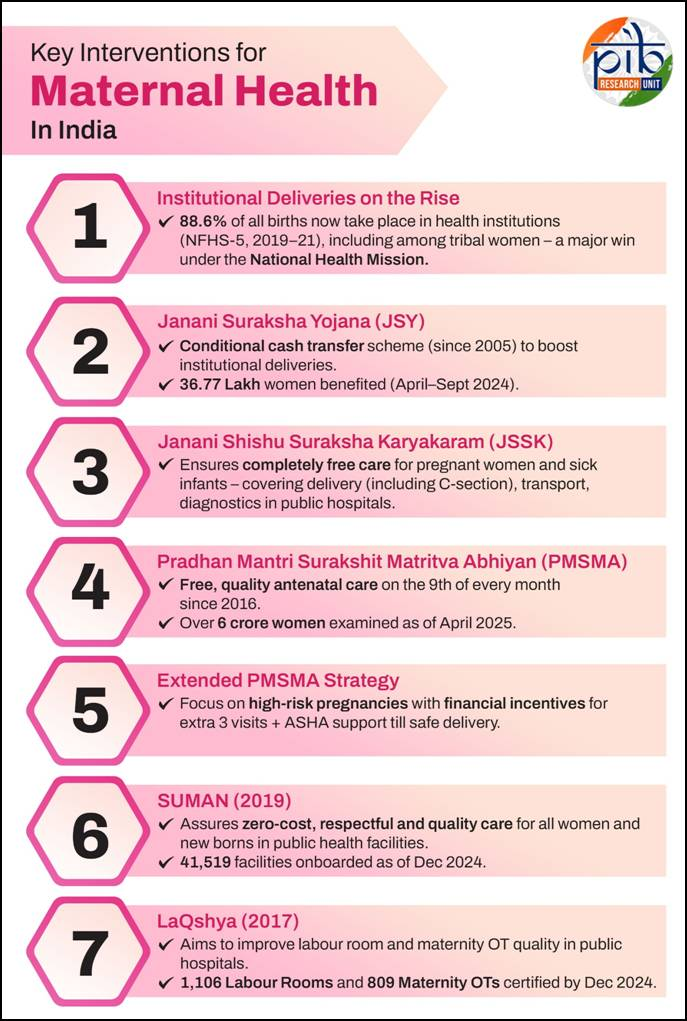
- National Health Mission (NHM): Focused on improving maternal and child health, expanding digital health access, and enhancing infrastructure and services.
- The Ayushman Bharat Digital Mission (ABDM) is a unified digital health ecosystem to securely connect patients, healthcare providers, and systems through an interoperable digital infrastructure.
- Disease Elimination & Control: India’s major strides in malaria elimination, with a 69% drop in cases and 68% reduction in deaths between 2017 and 2023.
- India has eliminated Trachoma as a public health problem in 2024.
- Under the National Tuberculosis Elimination Programme (NTEP), TB incidence fell by 17.7% between 2015 and 2023.
- India has successfully achieved Kala-azar elimination as of 2024.
Conclusion
- Maternal and newborn health is crucial for several reasons, as it directly impacts the well-being of mothers, infants, families and communities.
- Prioritizing regular health check-ups throughout pregnancy can help with early detection and management of potential complications.
- India’s advancements in public health, especially in maternal and child care, reflect a strong commitment to equitable and inclusive healthcare.
Source: PIB