
Brief Context
In News Allahabad High Court categorically held that live-in relationships are not illegal and that consenting adults have the constitutional right to live together with dignity and safety, irrespective of marital status. Key Observations of the Allahabad High Court Live-in relationship is not an offence: Living together without marriage does not violate any law in India if both partners are adults and give free consent. Right to life and personal liberty: The Court emphasized that Article 21 of
Source Content
Syllabus: GS1/ Social Issue
In News
- Allahabad High Court categorically held that live-in relationships are not illegal and that consenting adults have the constitutional right to live together with dignity and safety, irrespective of marital status.
Key Observations of the Allahabad High Court
- Live-in relationship is not an offence: Living together without marriage does not violate any law in India if both partners are adults and give free consent.
- Right to life and personal liberty: The Court emphasized that Article 21 of the Constitution guarantees the right to life, dignity, and personal freedom to all individuals, including those in live-in relationships.
- State’s duty to protect: Once adults choose to live together, the State is duty-bound to ensure their safety, even against threats from family or society.
- Social Morality vs Constitutional Morality: The Court clearly prioritised constitutional morality over social morality.
- Evidentiary Presumption of Marriage: The Court referred to Section 114 of the Indian Evidence Act, 1872, and Section 119(1) of the Bharatiya Sakshya Adhiniyam, 2023.
- These provisions state that if a man and woman cohabit for a significant period in the nature of husband and wife, the law may presume them to be married.
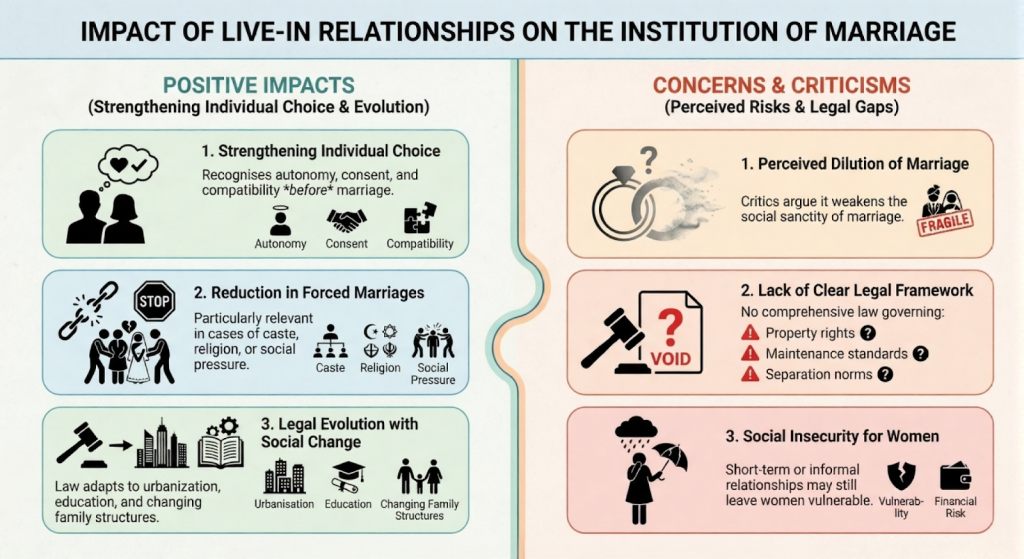
Key Supreme Court Judgments on Live-in Relationships
- Tulsa v. Durghatiya (2008): Children born from prolonged live-in relationships cannot be treated as illegitimate.
- Ensures inheritance and dignity of children.
- D. Velusamy v. D. Patchaiammal (2010): The Court clarified the concept of “relationship in the nature of marriage” under the Domestic Violence Act.
- Conditions laid down like a couple must hold themselves out as husband and wife, must be of legal age & must be otherwise qualified to marry.
- Indra Sarma v. V.K.V. Sarma (2013): Recognised that live-in relationships may be morally debated, but courts must deal with social realities.
- Shafin Jahan v. Asokan K.M. (2018): The Court held that the right to marry a person of one’s choice is an integral part of Article 21.
Source: TOI