
Brief Context
In News The Ministry of Statistics and Programme Implementation (MoSPI) released the draft Indian Statistical Institute Bill, 2025 for public consultation. The Bill proposes a major restructuring of the governance and functioning of the Indian Statistical Institute (ISI). Draft Indian Statistical Institute Bill, 2025: Key Provisions Transformation into a Statutory Body: Replaces the ISI Act, 1959, and dissolves the existing society-based structure.
Source Content
Syllabus: GS2/Governance/GS3/Economy
In News
- The Ministry of Statistics and Programme Implementation (MoSPI) released the draft Indian Statistical Institute Bill, 2025 for public consultation.
- The Bill proposes a major restructuring of the governance and functioning of the Indian Statistical Institute (ISI).
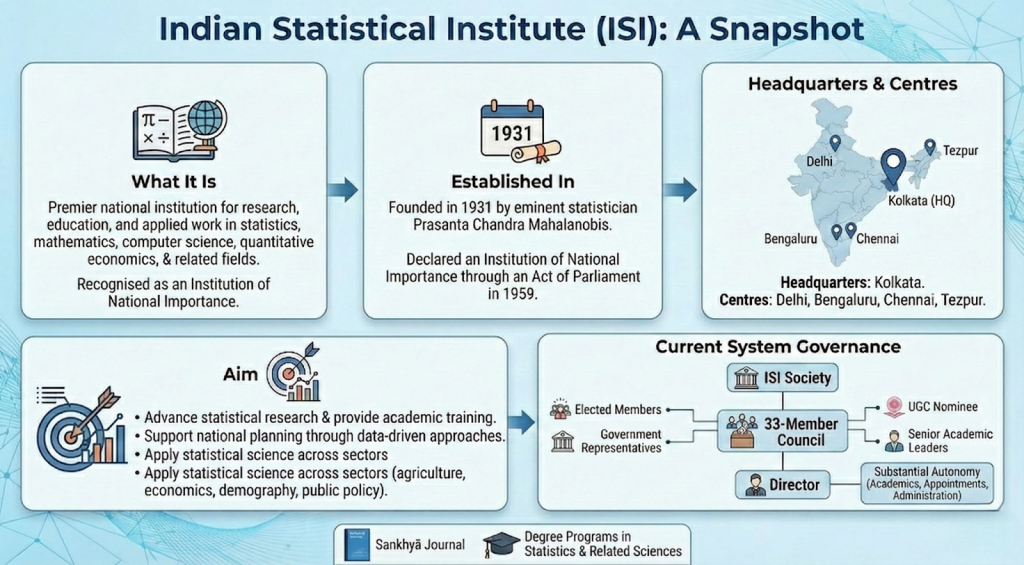
Draft Indian Statistical Institute Bill, 2025: Key Provisions
- Transformation into a Statutory Body: Replaces the ISI Act, 1959, and dissolves the existing society-based structure. ISI becomes a centrally supervised statutory institution, created directly by Parliament.
- Changes in Governance Structure: Board of Governance will wield most institutional powers. Majority of Board members are Central Government nominees; internal academic representation is reduced to only three seats.
- The Academic Council becomes recommendatory rather than decision-making.
- Administrative and Academic Controls: The Board of Governors (BoG) gains powers to establish, merge, close, or relocate centers domestically or abroad, with no statutory protection for Kolkata headquarters, allowing potential shifts for operational efficiency. Central Government directly appoints, reviews performance, and removes the Director, centralizing leadership control previously shared.
- Financial Reforms: Section 29 mandates pursuit of self-sufficiency through revenue streams like increased student fees, consultancy services, sponsored research projects, intellectual property commercialization, patents, collaborations, and investments. Annual audited accounts follow CAG standards, with BoG empowered to manage funds, grants, and endowments independently.
Criticisms and Concerns
- Fear of Government Overreach: Academicians argue the Bill undermines the autonomy ensured by the 1959 Act.
- The new governance structure heavily dominated by government nominees limits faculty participation and undermines academic independence.
- Threat to Cooperative Federalism: Replacing a society registered under a State Act without consultation is viewed as bypassing federal principles.
- Impact on Long-term Research: Critics fear pressures to raise revenue may shift focus from fundamental research to commercially viable projects.
- Financial Burden on Students and Faculty: Emphasis on revenue generation could increase fees and intensify dependence on sponsored research.
Government’s Stand
- The Government argues that the reforms aim to modernise ISI and make it a “world-class scientific institution” by its centenary in 2031.
- A 2020 Review Committee, chaired by Dr. R.A. Mashelkar, recommended restructuring ISI to improve:
- Governance efficiency
- Academic expansion
- International competitiveness.
Source: TH