
Brief Context
Context A recent study highlights that the 2022 increase in Earths energy imbalance was largely driven by a shift from a triple-dip La Niña to a warm El Niño, combined with long-term climate change. Earths Energy Imbalance Study Earth’s Energy Imbalance (EEI) refers to the difference between incoming solar radiation and outgoing heat energy. When more heat is trapped than emitted, global temperatures rise.
Source Content
Syllabus: GS1/Geography
Context
- A recent study highlights that the 2022 increase in Earth’s energy imbalance was largely driven by a shift from a “triple-dip” La Niña to a warm El Niño, combined with long-term climate change.
Earth’s Energy Imbalance Study
- Earth’s Energy Imbalance (EEI) refers to the difference between incoming solar radiation and outgoing heat energy. When more heat is trapped than emitted, global temperatures rise.
- The 2022 increase in EEI explains the sharp global temperature spike since early 2023.
- The “Triple Dip” Impact: During a La Niña, warm water remains deeper in the ocean, resulting in a cooler surface that emits less energy back into space.
- This unusual three-year cooling cycle acted like a “lid” that, once removed during the transition to El Niño, allowed trapped heat to surge upward.
- During 2020 to 2023, the world experienced three consecutive La Niña years without an intervening El Niño.
What is ENSO? (El Niño–Southern Oscillation)
- ENSO is a periodic fluctuation in sea surface temperatures and atmospheric pressure in the equatorial Pacific Ocean. It has two opposite phases: El Niño and La Niña.
- ENSO influences Indian Monsoon, cyclone patterns, droughts and floods and global temperature variability.
What is El Nino?
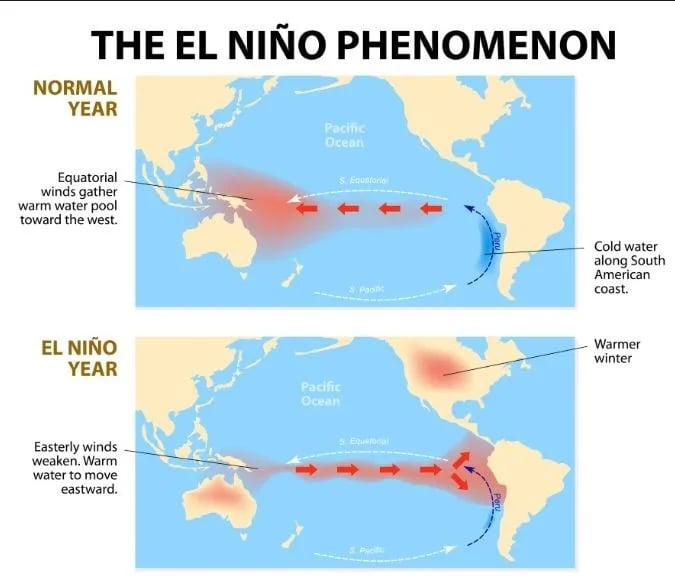
- El Niño is the warming of seawater in the central-east Equatorial Pacific that occurs every few years.
- During El Niño, surface temperatures in the equatorial Pacific rise, and trade winds, east-west winds that blow near the Equator, weaken.
- Impact: El Niño causes dry, warm winters in the Northern U.S. and Canada and increases the risk of flooding in the U.S. gulf coast and southeastern U.S.
- It also brings drought to Indonesia and Australia.
What is La Nina?
- La Niña is the opposite of El Niño. La Niña witnesses cooler than average sea surface temperature (SST) in the equatorial Pacific region.
- Trade winds are stronger than usual, pushing warmer water towards Asia.
- Impact: This leads to drier conditions in the Southern U.S., and heavy rainfall in Canada. It has also been associated with heavy floods in Australia.
How does it affect the Indian Monsoon?
- In El Niño years, India faces warmer temperatures and less rainfall, causing droughts in some regions.
- This affects agriculture, water resources, and ecosystems.
- The El Nino phenomenon led to 1.4% decrease in food grain production for the 2023-24 (July-June) crop year.
- La Niña brings cooler sea surface temperatures, leading to increased rainfall in certain parts of India.
Source: TH
Sources and further reading
- THthehindu.com