
Brief Context
Context As per NITI Aayog India’s electricity mix could shift decisively from coal-heavy to renewable-led by 2070. Major Highlights of the Study Coal remains the backbone of India’s electricity landscape, accounting for nearly 74% of generation and providing dependable, low-cost base-load power. Under the Current Policy Scenario (CPS) renewable energy’s share in electricity generation could rise from around 20% in 2024-25 to more than 80% by 2070.
Source Content
Syllabus: GS3/Environment/Energy
Context
- As per NITI Aayog India’s electricity mix could shift decisively from coal-heavy to renewable-led by 2070.
Major Highlights of the Study
- Coal remains the backbone of India’s electricity landscape, accounting for nearly 74% of generation and providing dependable, low-cost base-load power.
- Under the Current Policy Scenario (CPS) renewable energy’s share in electricity generation could rise from around 20% in 2024-25 to more than 80% by 2070.
- In the same scenario, coal’s share in electricity generation could decline sharply to 6-10 per cent by 2070.
- As coal’s role shrinks, nuclear power is expected to expand gradually, increasing its share from about 3% at present to 5-8% by 2070.
India’s Energy Share
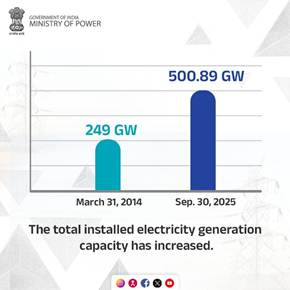
- As of 2025, the country’s total installed electricity capacity has crossed 500 GW, reaching 500.89 GW.
- Non-fossil fuel sources (renewable energy, hydro, and nuclear): 256.09 GW – over 51 % of the total.
- Fossil-fuel-based sources: 244.80 GW, about 49 % of the total, making coal a source of up to almost half the energy needs. Also, coal contributes about 74% of total electricity production in India.
- Within renewables:
- Solar power: 127.33 GW.
- Wind power: 53.12 GW.
- During FY 2025–26 India added 28 GW of non-fossil capacity and 5.1 GW of fossil-fuel capacity.
Challenges in Transition
- Limited Share in Actual Generation: Despite rapid capacity addition, RE’s share in electricity generation rose only from 19.6% (2013-14) to 22% (2024-25) due to structural issues.
- Intermittency Challenge: Solar and wind are variable in nature, making round-the-clock supply difficult. Hence, coal remains essential for grid stability and meeting peak demand.
- Limited energy storage: Large-scale energy storage (like battery systems) remains underdeveloped, restricting the grid’s ability to use RE during peak demand or low generation periods.
- Import dependence: India relies heavily on imported critical minerals (like lithium, cobalt, rare earth elements) for batteries, solar, and wind technologies, exposing it to global supply risks.
- Financial & Policy Hurdles: High upfront costs for solar, wind, and storage systems.
- There are delays in policy implementation and regulatory approvals.
- Land & Resource Constraints: Limited availability of land for large-scale solar/wind projects.
- Environmental and social conflicts in land acquisition.
- Technological & Skill Gaps: Need for advanced technologies in storage, smart grids, and hybrid systems.
- Shortage of skilled workforce in RE installation and maintenance.
Government Initiatives
- National Solar Mission (NSM): It was launched in 2010, it has set ambitious targets for solar capacity installation, including grid-connected and off-grid solar power projects.
- National Clean Energy Fund (NCEF): It was established to support research and innovation in clean energy technologies and projects that help in reducing greenhouse gas emissions.
- National Wind Energy Mission: Focuses on the development and expansion of wind energy in India. The target for wind energy capacity is set at 140 GW by 2030.
- Financial Support & Incentives: Viability Gap Funding (VGF) for large-scale solar and hybrid projects.
- Production Linked Incentive (PLI) scheme for solar PV manufacturing.
- Subsidies for rooftop solar and off-grid systems.
- Renewable Energy Certificates (RECs) to promote green power trading.
- Infrastructure Development: Green Energy Corridor to improve RE grid integration.
- PM-KUSUM Scheme for solarizing agricultural pumps.
- Revamped Distribution Sector Scheme (RDSS) to strengthen DISCOMs.
- Emerging Technologies & Projects: Support for Battery Storage, hybrid systems, and RTC power.
- Promotion of offshore wind and floating solar projects.
- Focus on Hydrogen Mission for green hydrogen development.
- International Partnerships: ISA (International Solar Alliance) launched by India to promote global solar cooperation.
- Collaboration with countries & global funds for clean energy investment and technology.
Way Ahead
- Nuclear Power as Strategic Pillar: Nuclear capacity is projected to increase from 8.18 GW (2025) to 90–135 GW by 2070.
- This provides firm low-carbon power, supports green hydrogen, and ensures 24×7 supply.
- Coal’s Continued Role: Coal capacity may peak at 450–470 GW in 2050, and some coal plants are likely to operate as reserve/low-utilisation capacity.
- Core Constraint: Transition depends on cost reduction, land availability, grid expansion, storage scalability, and faster nuclear deployment.
Source: IE
Sources and further reading
- IEindianexpress.com