
Brief Context
Context Government e Marketplace (GeM), India’s national public procurement portal, marked its 8th Incorporation Day. Government e-Marketplace GeM is a one stop portal to facilitate online procurement of common use Goods Services required by various Government Departments / Organizations / PSUs. It was launched in 2016, and is operated by the GeM SPV (Special Purpose Vehicle), a 100% government-owned company under the Ministry of Commerce and Industry.
Source Content
Syllabus: GS2/Governance
Context
- Government e Marketplace (GeM), India’s national public procurement portal, marked its 8th Incorporation Day.
Government e-Marketplace
- GeM is a one stop portal to facilitate online procurement of common use Goods & Services required by various Government Departments / Organizations / PSUs.
- It was launched in 2016, and is operated by the GeM SPV (Special Purpose Vehicle), a 100% government-owned company under the Ministry of Commerce and Industry.
- Aim: To enhance transparency, efficiency and speed in public procurement.
- The purchases through GeM by Government users have been authorized and made mandatory by the Ministry of Finance in 2017.
Core Principles of GeM
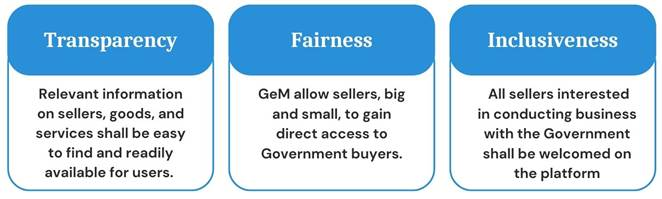
GeM: Transforming Public Procurement in India
- GeM’s user base has seen a threefold increase in recent years, with over 1.64 lakh primary buyers and 4.2 lakh active sellers now onboard.
- The platform offers more than 10,000 product categories and over 330 services.
- Over 10 lakh Micro and Small Enterprises (MSEs), 1.3 lakh artisans and weavers, 1.84 lakh women entrepreneurs, and 31,000 startups are now part of the GeM ecosystem.
- Expansion of Role: GeM’s role in advancing national priorities was underscored by key transactions, including ₹5,000 crore worth of equipment for the Akash Missile System and ₹5,085 crore in vaccine procurement.
- The platform is also enabling complex services such as drone-as-a-service for AIIMS, GIS and insurance for over 1.3 crore lives, and wet leasing of chartered flights and CT scanners.
- Nationwide Adoption: GeM has now been adopted across all 36 States and Union Territories, with Uttar Pradesh leading the way.
- Eight states—including Maharashtra, Manipur, Gujarat, Himachal Pradesh, Assam, Uttarakhand, and Chhattisgarh—have mandated GeM usage.
Significance
- Transparent and Efficient Procurement: GeM aims to reduce human intervention in government purchases, ensuring transparency, efficiency, and speed. It minimizes corruption and delays in procurement.
- Cost Savings: Competitive pricing has resulted in lower procurement costs for the government.
- Boost to MSMEs & Startups: Significant amount of the orders on GeM are from MSMEs, promoting small businesses.
- Digital Process: The entire process, from vendor registration to payment, is done online.
- Security and Audit Trails: Built-in mechanisms for data security, digital signatures, and audit trails to ensure accountability.
Challenges
- Limited Awareness and Adoption: Many government officials and potential vendors, especially in rural areas and among MSMEs, are unaware or lack training on how to use the platform effectively.
- There is a resistance to change from traditional procurement methods.
- Quality Control and Standardization: Ensuring consistent quality of products and services is difficult, especially when a large number of vendors are involved.
- Lack of standardized specifications for some products and services.
- Delays in Payments: Although the platform supports timely payments, in practice, delays by government departments in processing payments discourage sellers.
- Logistics and Delivery Challenges: Vendors often face logistical difficulties in delivering goods across vast geographies.
- Technical Issues and Platform Stability: Users sometimes face issues such as system crashes, slow interface, or bugs, especially during high-traffic periods.
- Regulatory and Policy Bottlenecks: Inconsistent application of procurement rules across departments leads to inefficiency.
Government Initiatives to Improve GeM
- SWAYATT (Startups, Women & Youth Advantage Through e-Transactions): The portal committed to enhance ease of doing business and establish direct market linkages to annual public procurement for startups, women entrepreneurs, Micro & Small Enterprises (MSEs), Self Help Groups (SHGs) and youth.
- Startup Runway 2.0: It is an opportunity for Startups to showcase their innovative products and services to Government buyers and engage in public procurement.
- GeM has created a dedicated marketplace category for all Startups to list their products and services, irrespective of their DPIIT-certification.
- Womaniya initiative: To showcase products made by women entrepreneurs and women self-help groups [WSHGs].
- GeM is collaborating with various stakeholders from the Micro, Small and Medium Enterprises [MSME] ecosystem with special focus on entrepreneurs from the Scheduled Caste/ Schedule Tribes [SC/ ST].
- The SARAS Collection: It is a pristine handcrafted collection of handicrafts, handloom textiles, office décor, furnishings, accessories, event souvenirs, personal hygiene and care products from top of the line SHGs in India.
Conclusion
- The platform’s strategic initiatives have significantly contributed to the ease of doing business and enhanced participation in government procurement.
- As GeM continues to evolve, it remains committed to its vision of creating a sustainable, open, and competitive marketplace, driving India’s progress towards inclusive and transparent public procurement practices.
Source: PIB