
Brief Context
Context The U.S. and China agreed to suspend most tariffs on each other’s goods. Why were Tariffs Levied?
Source Content
Syllabus: GS3/Economy/Trade
Context
- The U.S. and China agreed to suspend most tariffs on each other’s goods.
Background
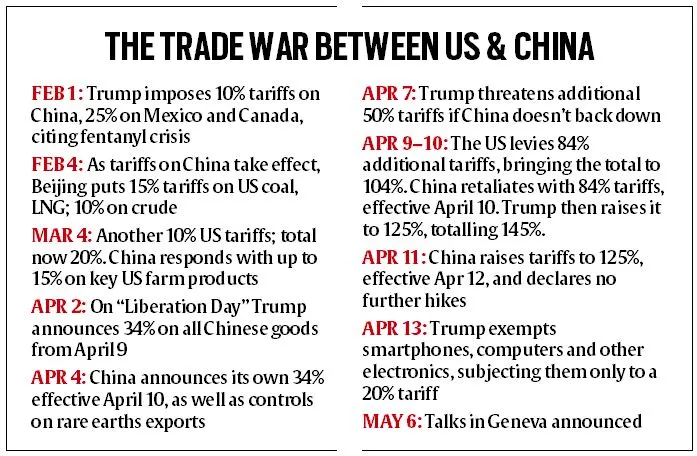
Why were Tariffs Levied?
- Trade Imbalance: The U.S. Trade Representative pointed to a $1.2 trillion trade deficit with the rest of the world as justification for tariffs.
- The Trump administration viewed this as the U.S. being “ripped off” by trading partners who protected and subsidized their own industries while benefiting from open U.S. markets.
- Strategic Protectionism: The administration believed that talking had not helped change global trade behavior, so high tariffs were seen as a tool to force other countries to open their markets.
Revised Tariffs After Geneva Talks
- Both have reached an agreement on a 90-day pause and substantially move down the tariff levels.
- The deal means “reciprocal” tariffs between both countries will be cut from 125% to 10%.
- The U.S.′ 20% duties on Chinese imports relating to fentanyl will remain in place, meaning total tariffs on China stand at 30%.
Why Was There a Truce?
- China’s Retaliation: Unlike other countries, China responded with its own counter-tariffs and non-tariff barriers escalating the trade conflict.
- Economic Concerns in the U.S.: At peak levels (U.S.: 145%, China: 125%), tariffs became prohibitively expensive for consumers and businesses.
- Example: A $100 Chinese product became $245 in the U.S.
- The U.S. economy began contracting in Q1 2025 — even before the full impact of the tariffs had hit.
- Economists predicted a recession and possibly stagflation (a rare combo of economic stagnation and inflation).
- Consumer Pressure: U.S. consumers faced rising prices and shrinking product availability, especially at major retailers like Walmart.
- Public and political pressure mounted as economic conditions worsened.
- China’s Economic Resilience: While China’s exports to the U.S. dropped 21%, its overall exports rose 8%, and GDP grew 5.4% in the same quarter.
- China’s global trade surplus increased, indicating that it had managed to diversify and offset the U.S. losses.
Way Ahead
- The current agreement is a truce, not a full trade deal.
- Market reactions have been positive — stocks and the dollar rose, while gold and bonds fell, indicating reduced risk perception.
- However, the talks that follow will be complex, and no guarantees exist for a comprehensive trade deal.
Source: IE
Sources and further reading
- IEindianexpress.com