
Brief Context
Context Prime Minister Narendra Modi and Chinese President Xi Jinping met on the sidelines of the SCO summit in Tianjin. Key Outcomes of SCO Summit High-level Engagements: Both leaders met and welcomed the positive momentum in their ties. Reaffirmed they are development partners, not rivals; differences must not turn into disputes.
Source Content
Syllabus: GS2/IR
Context
- Prime Minister Narendra Modi and Chinese President Xi Jinping met on the sidelines of the SCO summit in Tianjin.
Key Outcomes of SCO Summit
- High-level Engagements: Both leaders met and welcomed the positive momentum in their ties.
- Reaffirmed they are development partners, not rivals; differences must not turn into disputes.
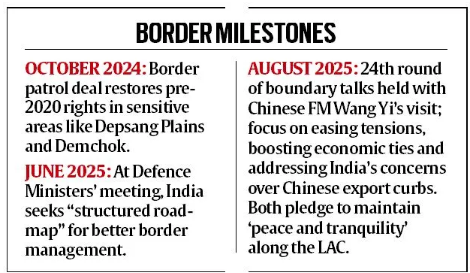
- Border Issues: Leaders noted successful border disengagement in 2024 and maintenance of peace since then.
- People-to-People Ties: Agreed to expand exchanges through direct flights, visa facilitation.
- Building on the Kailash Manasarovar Yatra resumption and tourist visas.
- Economic & Trade Cooperation: Recognized their economies’ role in stabilizing world trade.
- Multilateral Engagements: PM supported China’s SCO Presidency and Tianjin Summit.
- Invited President Xi to India’s BRICS Summit 2026.
| Shanghai Cooperation Organisation (SCO) – The Shanghai Five emerged in 1996 from a series of border demarcation and demilitarization talks between 4 former USSR republics and China. – Kazakhstan, China, Kyrgyzstan, Russia, and Tajikistan were members of the Shanghai Five. – With the accession of Uzbekistan to the group in 2001, the Shanghai Five was renamed the SCO. – Objective: To enhance regional cooperation for efforts to curb terrorism, separatism, and extremism in the Central Asian region. – Members (10): China, Russia, India, Pakistan, Iran, Belarus, and the four Central Asian countries of Kazakhstan, Kyrgyzstan, Tajikistan, and Uzbekistan. – India became a full member in 2017 and assumed the rotating chairmanship in 2023. – Member countries contribute around 30 per cent of the global GDP and about 40 percent of the world’s population. – Observer status: Afghanistan and Mongolia. – Language: The SCO’s official languages are Russian and Chinese. – Structure: The supreme decision-making body of the SCO is the Council of Heads of States (CHS), which meets once a year. – The Organization has 2 standing bodies — the Secretariat in Beijing and the Executive Committee of the Regional Anti-Terrorist Structure (RATS) in Tashkent. |
India-China Relations
- 2025 marks 75 Years of India-China diplomatic ties.
- Historical Tensions:
- Strained since the 1962 Sino-Indian war, deepened by recent clashes and mistrust.
- 2020: Post Galwan Valley clashes, India restricted Chinese investments, banned Chinese apps (e.g., TikTok), and halted flights to China.
- Trade Relations: China was India’s second-largest trading partner in FY2024–25. Out of total bilateral trade worth US$131.84 billion, India’s trade deficit increased to US$99.2bn.
- Ongoing Mechanisms: Despite tensions, mechanisms like the Special Representatives (SR) and Working Mechanism for Consultation and Coordination (WMCC) have been in place to address the boundary issue.
- Recent Developments:
- 2024 Disengagement: India and China announced successful disengagement in eastern Ladakh.
- 2024 BRICS Meeting: PM Modi and President Xi Jinping emphasized “mutual trust, mutual respect, and mutual sensitivity.”
Areas of Concern
- Ongoing Border Tensions:
- The unresolved border dispute spans over 2,000 miles, marked by frequent clashes.
- Incidents in Doklam (2017), Galwan Valley (2020), and northeastern states (Sikkim, Arunachal Pradesh).
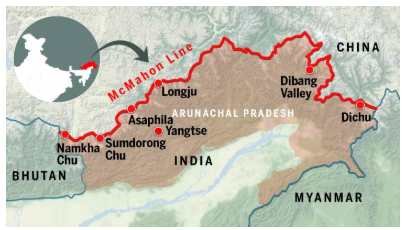
- Military Infrastructure: Both countries have heavily fortified their border with roads, railways, and airstrips for rapid troop mobilization.
- Belt and Road Initiative (BRI): India has expressed reservations about China’s Belt and Road Initiative, especially regarding the China-Pakistan Economic Corridor (CPEC), which passes through the territory of India.
- Trade imbalance: While politically desirable, reducing trade dependence is complicated by China’s economic influence and India’s need for foreign investment.
- China’s growing presence in the Neighbouring Region:
- Sri Lanka: China’s presence at Hambantota Port and investments in an oil refinery raise concerns in India.
- Nepal: China’s investments in infrastructure (e.g., Pokhara airport) challenge India’s strategic position.
- Bangladesh: China’s growing influence, including loan agreements, threatens India’s regional influence.
- Myanmar: China’s deepening ties with Myanmar, including the China-Myanmar Economic Corridor, strengthen its presence in India’s backyard.
Way Ahead
- The Tianjin meeting reflects measured progress in restoring stability along the LAC since the 2020 Galwan clash.
- As India and China look to build mutual trust, sustained dialogue will be essential to better align India’s and China’s intentions vis-à-vis the Asian security order.
Source: PIB