
Brief Context
Context Justice Bhushan Ramkrishna Gavai was sworn in by President Droupadi Murmu as the 52nd Chief Justice of India. What is the Convention? The outgoing CJI recommends his successor a practice, which is strictly based on seniority.
Source Content
Syllabus: GS2/ Polity and Governance
Context
- Justice Bhushan Ramkrishna Gavai was sworn in by President Droupadi Murmu as the 52nd Chief Justice of India.
Constitutional Provisions
- The Constitution of India does not mention any procedure for appointing the CJI.
- Article 124 (1) of the Constitution merely says, “There shall be a Supreme Court of India consisting of a Chief Justice of India.”
- Clause (2) of Article 124 of the Constitution says that every Judge of the Supreme Court shall be appointed by the President.
- Thus, in the absence of a constitutional provision, the procedure to appoint CJI relies on convention.
What is the Convention?
- The outgoing CJI recommends his successor a practice, which is strictly based on seniority.
- Seniority, however, is not defined by age, but by the number of years a judge has been serving in the top court of the country.
Eligibility
- Apart from being an Indian citizen, the person must;
- Have been for at least five years a Judge of a High Court or of two or more such Courts in succession or,
- Have been for at least ten years an advocate of a High Court or of two or more such Courts in succession, or
- Be, in the opinion of the President, a distinguished jurist.
Tenure and Retirement
- The Constitution does not fix a tenure for the Chief Justice.
- The retirement age for Supreme Court judges, including the CJI, is 65 years.
Removal of CJI
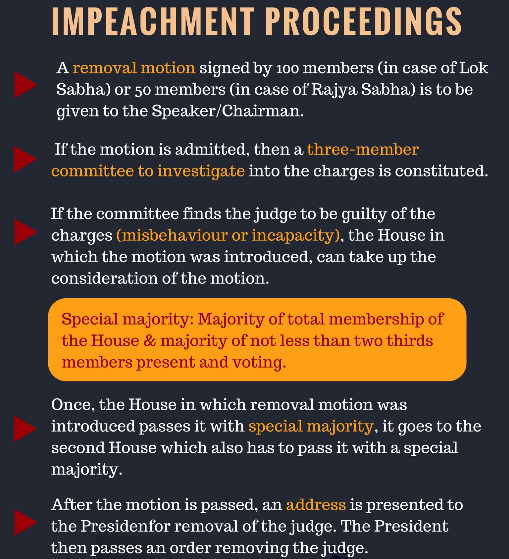
- The constitution provides that a judge can be removed only by an order of the president, based on a motion passed by both houses of parliament.
- The procedure for removal of judges is elaborated in the Judges Inquiry Act, 1968. The Act sets out the following steps for removal from office:
Source: TH