
Brief Context
Context Recently, the United Nations Convention to Combat Desertification (UNCCD) released a policy brief detailing the severe health impacts of land degradation and drought. Health Risks of Land Degradation and Drought Rise in Communicable and Non-Communicable Diseases: The policy brief highlights the wide-ranging health consequences associated with environmental stress: Mental Health Consequences: Droughts often result in displacement, resource scarcity, and financial hardship, leading to incr
Source Content
Syllabus: GS3/Environment;
Context
- Recently, the United Nations Convention to Combat Desertification (UNCCD) released a policy brief detailing the severe health impacts of land degradation and drought.
Health Risks of Land Degradation and Drought
- Rise in Communicable and Non-Communicable Diseases: The policy brief highlights the wide-ranging health consequences associated with environmental stress:
- Waterborne diseases: Cholera, trachoma, scabies, conjunctivitis.
- Vector-borne diseases: Malaria and other mosquito-borne infections.
- Respiratory diseases: Triggered by dust storms and wildfires.
- Cardiovascular ailments: Hypertension, heart attacks, stroke.
- Nutritional disorders: Malnutrition and stunting due to food insecurity.
- Mental Health Consequences: Droughts often result in displacement, resource scarcity, and financial hardship, leading to increased mental health disorders such as anxiety and depression.
- Prolonged drought in Australia estimating mental health-related costs to reach $198 billion by 2050.
Case Studies: India, Africa, and Beyond
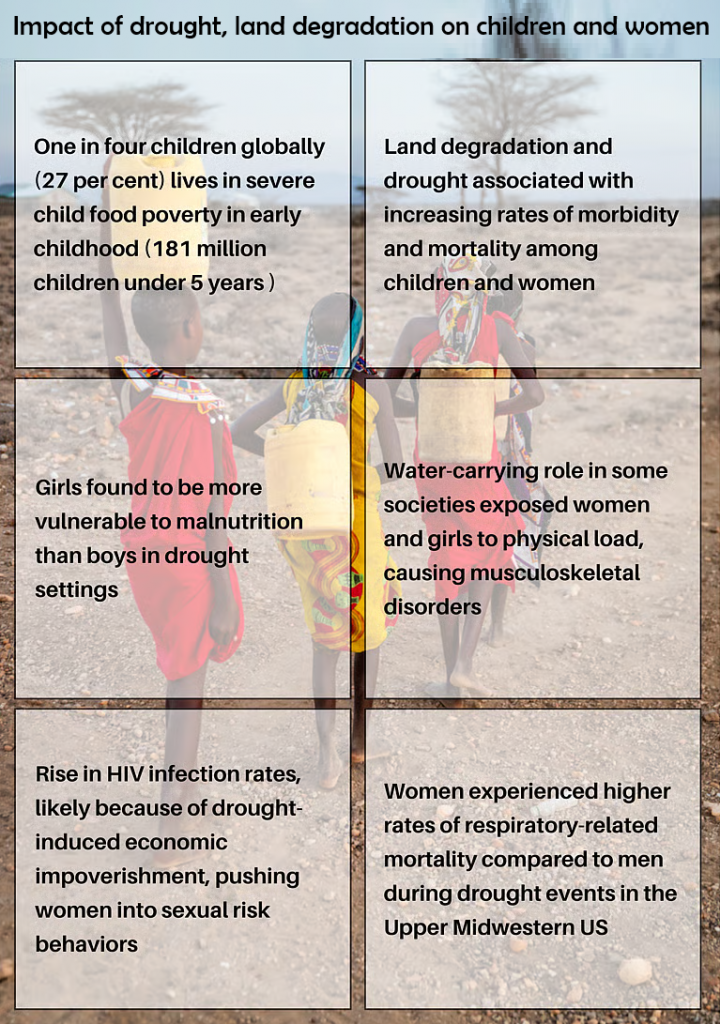
- India and Sub-Saharan Africa: The policy brief compares spatial data on Aridity Index (1991–2020) with malnutrition rates among children under five (2016–2018), showing clear overlap in regions facing both drought and child stunting.
- In Zambia, a drought-induced spike in maize prices led to inadequate maternal nutrition, causing stunting in infants between 6 to 16 weeks old.
India’s Vulnerability
- India lost over 30 million hectares of healthy land between 2015 and 2019.
- Nearly 854 million Indians were exposed to drought during this period.
- The spatial overlap between drought intensity and child stunting highlights the direct link between land degradation and public health.
Environmental Drivers of Disease
- Deterioration of soil health can lead to outbreaks of anthrax and other soil-transmitted diseases.
- Biodiversity loss and land use change raise the risk of zoonotic diseases like Ebola and Covid-19.
- Changing habitats of disease vectors (e.g., mosquitoes) increase the spread of vector-borne illnesses.
Policy Innovation: India’s Farmers’ Distress Index (FDI)
- India has introduced a Farmers’ Distress Index (FDI), aimed at early identification and intervention. The tool is expected to provide three-month advance alerts to stakeholders. The FDI evaluates indicators such as:
- Exposure to extreme weather;
- Financial strain;
- Mental health indicators like loneliness and depression;
UN Recommendations and the ‘One Health’ Approach
- The policy brief promotes the One Health Approach, emphasizing the interdependence of ecosystem health, animal health, and human health, as recognized by the UN Convention to Combat Desertification (UNCCD). It includes:
- Integrated Policy and Planning: Harmonize efforts across environmental and health sectors.
- Promote gender equity and community resilience.
- Research and Capacity Building: Expand research on the health impact of land degradation.
- Strengthen local capacities for mitigation and adaptation.
- Financial Mechanisms: Mobilize targeted funding for land and health system restoration.
- Support innovative financial tools to promote healthy land use.
- Sustainable Solutions: Invest in land restoration, sustainable agriculture, early warning systems, and water management.
- Integrated Policy and Planning: Harmonize efforts across environmental and health sectors.
Further Reading: