
Jharkhand History is the history of an ancient plateau society shaped by forests, minerals, tribal communities, regional kingdoms, resistance movements and struggles over land and political autonomy. The region that now forms Jharkhand was historically part of the wider Chotanagpur Plateau and Santhal Pargana, but it never developed as a single unified political state during the ancient or medieval period. Instead, different areas were ruled by local dynasties, tribal chiefs and regional kingdoms such as the Nagvanshis of Chotanagpur, Cheros of Palamu, Singh rulers of Porahat and Dhalbhum, Ramgarh Raj and several smaller estates.
Jharkhand’s historical development was also fundamentally different from that of the neighbouring Gangetic plains. Dense forests, difficult plateau terrain and strong community institutions limited outside political control for long periods. When Mughal and later British authority expanded into the region, resistance repeatedly emerged over land revenue, forest rights, customary institutions and political autonomy. This produced some of the most significant tribal and peasant uprisings in Indian history, including the Kol Rebellion, Santhal Hul, Birsa Munda’s Ulgulan and Tana Bhagat Movement.
Get all JPSC Notes https://learnpro.in/jpsc-notes/

Jharkhand History at a Glance
| Period | Major Developments |
|---|---|
| Prehistoric Period | Early human occupation, stone tools and rock-art evidence |
| Ancient Period | Tribal settlements, regional interaction, limited imperial control |
| Early Medieval Period | Rise of local chiefdoms and Nagvanshi power |
| Medieval Period | Nagvanshi, Chero, Singh and other regional states |
| Mughal Period | Tributary relations, military expeditions and limited direct control |
| 18th Century | Expansion of East India Company authority |
| 19th Century | Tribal revolts, revenue conflicts and colonial administrative restructuring |
| 1855–56 | Santhal Hul |
| 1857–59 | Revolt in Chotanagpur, Palamu and Singhbhum |
| 1899–1900 | Birsa Munda’s Ulgulan |
| 20th Century | Tana Bhagat Movement, freedom struggle and Jharkhand regional movement |
| 15 November 2000 | Formation of Jharkhand state |
Geographical Background of Jharkhand History
The historical development of Jharkhand cannot be understood without its geography. Much of the region lies on the Chotanagpur Plateau, characterised by hills, forests, river valleys and mineral-bearing rocks.
For centuries, this terrain created several effects:
- relative isolation from large imperial centres;
- survival of local political institutions;
- strong village and clan organisation;
- dependence on forests and communal land;
- difficulty in establishing regular revenue administration.
Unlike the plains of Bihar and Bengal, where large states could more easily establish direct control, Jharkhand’s rugged terrain favoured local autonomy.
This explains why outside rulers often preferred tributary arrangements rather than direct administration.
Prehistoric Jharkhand
Archaeological evidence indicates human occupation in Jharkhand from prehistoric times. Stone tools have been discovered in several parts of the Chotanagpur Plateau, indicating the presence of early hunter-gatherer communities.
The region provided:
- forests;
- stone for tool-making;
- rivers and streams;
- wildlife;
- edible forest products.
These resources made the plateau suitable for early human settlement.
Prehistoric evidence has been reported from areas associated with present-day Hazaribagh, Ranchi, Singhbhum and adjoining plateau regions.
Stone Age Evidence
Jharkhand has yielded evidence belonging broadly to:
- Palaeolithic traditions;
- Mesolithic traditions;
- Neolithic and later prehistoric cultures.
Stone tools included:
- hand axes;
- cleavers;
- scrapers;
- blades;
- microliths.
The distribution of such tools suggests that prehistoric populations moved through river valleys and forested plateau zones.
Rock Art and Early Cultural Evidence
Rock paintings and other early cultural remains found in parts of the plateau indicate that prehistoric communities did more than simply hunt and gather.
Such evidence can provide information about:
- animals;
- human activities;
- hunting;
- ritual behaviour;
- social interaction.
However, rock-art interpretation must be approached carefully because precise dating is often difficult.
Ancient Jharkhand
The ancient history of Jharkhand is less clearly documented than that of the Gangetic plain. Much of the region remained outside the core zones of early imperial administration.
The plateau was inhabited by communities whose political structures were often organised around:
- clans;
- villages;
- local chiefs;
- customary institutions.
The region nevertheless interacted with neighbouring political and cultural centres.
For more detailed coverage, see Ancient Period in Jharkhand.
Jharkhand and the Mahajanapada Period
During the period of the Mahajanapadas, the northern margins of present-day Jharkhand were connected with the political developments of Magadha.
However, the deeper forested plateau was probably not under the same level of direct control as the core Gangetic territories.
The relationship was likely based on:
- frontier interaction;
- forest products;
- trade routes;
- local tribute;
- occasional political influence.
Thus, ancient Jharkhand should not simply be described as a fully administered province of Magadha.
Mauryan Influence
The Mauryan Empire expanded across much of the Indian subcontinent, and regions around Jharkhand probably came under varying degrees of Mauryan influence.
Forested areas were valuable for:
- elephants;
- timber;
- minerals;
- forest produce.
Mauryan administration distinguished between settled agricultural regions and forest zones inhabited by communities often referred to broadly as Atavikas or forest peoples.
Direct imperial control over remote plateau regions, however, was probably limited.
Jharkhand in the Early Historic Period
The region continued to interact with neighbouring political centres during the post-Mauryan and Gupta periods.
Trade routes connecting:
- the Ganga valley;
- Bengal;
- Odisha;
- central India
passed around or through sections of the plateau.
Such connections facilitated the movement of:
- goods;
- religious ideas;
- political influence;
- technologies.
The region therefore remained connected to wider Indian history even when direct political control was weak.
Tribal Communities and Early Settlement
The historical identity of Jharkhand is closely connected with indigenous communities such as the:
- Munda;
- Oraon;
- Ho;
- Santhal;
- Bhumij;
- Kharia;
- Asur;
- Birhor;
- Paharia.
These communities did not all settle in the region at the same time or follow identical political systems.
Their economies historically combined:
- agriculture;
- forest gathering;
- hunting;
- livestock;
- shifting cultivation in some areas.
Their village and clan institutions later played a major role in resistance to outside revenue systems.
For broader social history, see Tribes of Jharkhand.
Early Village Institutions
Many communities developed decentralised political institutions.
Among the Mundas, important offices included:
- Munda — village head;
- Pahan — ritual or religious head.
Among the Ho, the Munda-Manki system became important.
Among the Oraons, village organisation was linked with broader Parha institutions.
These systems varied regionally, but they demonstrate that political organisation existed long before colonial administration.
Rise of Regional Kingdoms
By the early medieval period, several local states and ruling houses emerged across the plateau.
The most important included:
- Nagvanshi dynasty;
- Chero dynasty;
- Singh dynasty of Porahat;
- Dhalbhum Raj;
- Ramgarh Raj;
- Kharagdiha Raj;
- Panchkot and adjoining estates.
These states exercised varying levels of authority over agricultural settlements, forests and local chiefs.
For a broader overview, see Regional Dynasties of Jharkhand.
Nagvanshi Dynasty
The Nagvanshi dynasty was one of the longest-lasting ruling houses of the Chotanagpur region. Traditional genealogies trace its origin to Phani Mukut Rai, traditionally dated to around the first century CE, although the earliest chronology remains partly legendary.
The Nagvanshis ruled large parts of the Chotanagpur region and shifted their capital several times as political conditions changed.
A broad capital sequence is:
Sutiambe
↓
Chutia
↓
Khukhragarh
↓
Doisa/Navratangarh
↓
Palkot
↓
Ratu
The movement of capitals reflects changes in defence, administration and regional political power.
Phani Mukut Rai
Traditional accounts identify Phani Mukut Rai as the founder of the Nagvanshi dynasty.
The foundation date is traditionally placed around 64 CE, but historians treat this early chronology cautiously because the evidence derives largely from later genealogies and traditions.
The importance of Phani Mukut Rai lies primarily in dynastic memory rather than securely documented political history.
Sutiambe
Sutiambe, near present-day Ranchi, is traditionally regarded as the earliest Nagvanshi political centre.
Its importance demonstrates the early concentration of Nagvanshi authority around the central Ranchi plateau.
As political power expanded, later rulers moved the capital to other fortified locations.
Chutia
The Nagvanshi capital was later associated with Chutia, near modern Ranchi.
Chutia occupied a geographically favourable location on the plateau and became an important political and settlement centre.
The region retains archaeological and cultural associations with the early Nagvanshi period.
Khukhragarh
The Nagvanshi political centre later shifted to Khukhragarh or Khukhra, traditionally associated with the reign of Bhim Karn.
Khukhragarh became a major medieval centre of the dynasty.
The term Kokrah, Khokhra or Khukhra, used in several Persian sources, was later applied to the Nagvanshi-controlled region.
For a broader treatment, see Medieval Period in Jharkhand.
Bhim Karn
Bhim Karn is traditionally associated with the strengthening of the Nagvanshi kingdom and the establishment of Khukhragarh as an important capital.
His reign marks an important stage in the transition from earlier Nagvanshi centres to a more consolidated medieval kingdom.
However, exact dates in the early Nagvanshi genealogy must be treated cautiously.
Nagvanshi Administration
Nagvanshi rule was not organised like a highly centralised imperial bureaucracy.
Authority was exercised through a combination of:
- royal power;
- local chiefs;
- village heads;
- landlords;
- customary institutions.
The rulers collected tribute and agricultural revenue while local society retained considerable autonomy in many areas.
This layered structure remained characteristic of Jharkhand politics for centuries.
Mughal Expansion into Chotanagpur
Mughal influence over Jharkhand developed gradually. The difficult forests and plateau terrain limited direct imperial administration.
The Mughal state was interested in the region because of:
- diamonds;
- elephants;
- forest products;
- strategic routes;
- tribute.
The Mughal approach generally combined military expeditions with tributary arrangements.
Akbar and Chotanagpur
During the reign of Akbar, Mughal forces expanded into the Kokrah region.
An important expedition is associated with Shahbaz Khan Kamboh in the late sixteenth century.
The main Mughal objective was not necessarily permanent direct administration but acknowledgement of imperial authority and payment of tribute.
Nagvanshi rulers largely continued to govern locally.
Jahangir and Durjan Shah
One of the best-known Mughal-Nagvanshi episodes occurred during the reign of Jahangir.
Nagvanshi ruler Durjan Shah, also known in traditions as Durjan Sal, resisted Mughal demands.
A Mughal expedition under Ibrahim Khan, the governor of Bihar, invaded Chotanagpur around 1615–16.
Durjan Shah was captured and imprisoned at Gwalior Fort.
The Diamond Tradition
Later traditions associate Durjan Shah with expertise in recognising diamonds.
According to the story, his knowledge impressed the Mughal court and contributed to his release.
The broad episode is historically important, although legendary details surrounding the diamond-testing story should be distinguished from firmly documented evidence.
After his release, Durjan Shah returned to Chotanagpur.
Navratangarh
After returning from Mughal captivity, Durjan Shah developed Doisa or Navratangarh as an important Nagvanshi political centre.
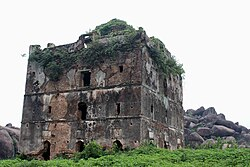
The remains of Navratangarh demonstrate a significant phase of palace and fort architecture in Jharkhand.
Its location provided:
- defensibility;
- access to the plateau;
- political centrality.
Navratangarh represents one of the most important archaeological sites of medieval Jharkhand.
Chero Dynasty of Palamu
The Chero dynasty emerged as the dominant political power in the Palamu region.
Important Chero rulers traditionally include:
- Bhagwat Rai;
- Anant Rai;
- Sahbal Rai;
- Pratap Rai;
- Bhupal Rai;
- Medini Rai.
Chero authority developed around the forested and strategically important Palamu region.
Palamu Forts
The Cheros are closely associated with the famous Palamu Forts, located in present-day Latehar district within the historical Palamu region.
There are two principal fort complexes generally described as:
- Old Palamu Fort;
- New Palamu Fort.
These forts reflect the military importance of the region and the political strength of Chero rulers.
Medini Rai
Medini Rai was one of the most famous Chero rulers of Palamu and ruled during the seventeenth century.
His reign is remembered as a period of political strength and prosperity.
Traditions portray him as an effective ruler who expanded Chero influence and strengthened Palamu.
His name remains strongly associated with the historical identity of the region.
Mughal-Chero Conflict
Palamu attracted repeated Mughal attention.
An earlier Mughal campaign was associated with Raja Man Singh around 1589, while more intensive intervention occurred later.
In 1660, Mughal forces under Daud Khan, governor of Bihar, invaded Palamu.
The conflict demonstrated both:
- Mughal determination to impose authority;
- the difficulty of controlling the forested Palamu region.
Political Structure of Palamu
Chero rulers governed through local chiefs and landholding intermediaries.
Their political system combined:
- royal authority;
- fort-based military control;
- agricultural revenue;
- tribal and local networks.
This was typical of many regional states in Jharkhand, where political authority had to accommodate powerful local communities.
Singh Dynasty and Porahat Kingdom
The Singh dynasty of Porahat ruled parts of Singhbhum.
The kingdom developed in a region characterised by:
- forested hills;
- iron-rich terrain;
- Ho settlements;
- difficult communications.
The ruling family exercised authority around Porahat, while large portions of Kolhan remained strongly influenced by Ho political institutions.
Ho Society and Munda-Manki System
The Ho communities maintained a decentralised political system based on village and inter-village institutions.
Important offices included:
- Munda — village head;
- Manki — head of a group of villages.
This Munda-Manki structure provided an important mechanism of local governance.
It later became relevant to British attempts to administer Kolhan.
Porahat and Mughal Authority
Mughal control over Singhbhum remained comparatively weak.
The rugged terrain and strong local political institutions prevented sustained direct administration.
Regional rulers sometimes acknowledged outside authority strategically while retaining substantial local autonomy.
This pattern continued into the early colonial period.
Dhalbhum Raj
Dhalbhum Raj developed in the eastern Singhbhum region, especially around Ghatsila and Dhalbhumgarh.
The ruling line is generally associated with the Dhal or Dhabal Deo rulers and had strong connections with the broader Bhumij cultural region.
Dhalbhum occupied a strategic location connecting:
- Singhbhum;
- Bengal;
- Odisha.
This gave it considerable political and commercial importance.
Jagannath Dhal and British Expansion
British authority entered the Dhalbhum region during the eighteenth century.
Jagannath Dhal resisted East India Company control in the 1760s.
The Company initially attempted to replace him, but continued resistance made stable administration difficult.
Jagannath Dhal was eventually restored under a political arrangement with the Company.
This episode illustrates a broader British strategy:
military conquest
followed by
indirect rule through cooperative local rulers
where direct administration proved difficult.
Ramgarh Raj
Ramgarh Raj became an important regional state in northern Chotanagpur.
Traditional accounts associate its foundation with Bagdeo Singh, often dated to around the fourteenth century.
The capital shifted several times as the ruling house expanded.
A broad traditional sequence includes:
Sira
↓
Urda
↓
Badam
↓
Ramgarh
↓
Padma
These shifts reflected changing military and administrative requirements.
Mukund Singh
During the eighteenth century, Mukund Singh became involved in resistance to expanding East India Company authority.
The Company attempted to secure political control over Ramgarh because the region occupied an important route between Bengal, Bihar and central India.
The eventual transition to Company-supported rulers strengthened British influence in North Chotanagpur.
Kharagdiha Raj
The Kharagdiha estate developed in the northern Chotanagpur region around present-day Giridih and adjoining areas.
It became increasingly integrated into the colonial revenue system after the East India Company obtained the Diwani of Bengal, Bihar and Odisha in 1765.
The Permanent Settlement of 1793 further transformed landholding relationships.
This shift from older political authority to colonial zamindari arrangements profoundly altered rural society.
Permanent Settlement and Jharkhand
The Permanent Settlement introduced by the East India Company in 1793 aimed to create fixed land-revenue obligations through zamindars.
However, Jharkhand’s land systems were very different from the zamindari structures of Bengal.
Many tribal communities recognised:
- communal ownership;
- clan-based rights;
- customary cultivation rights;
- village authority.
Colonial attempts to impose revenue intermediaries therefore created severe conflict.
East India Company Expansion into Jharkhand
The Company’s acquisition of the Diwani in 1765 transformed the political situation of eastern India.
British expansion into Jharkhand was gradual because of:
- difficult geography;
- weak administrative penetration;
- local resistance;
- powerful chiefs and tribal institutions.
The Company first sought control over:
- revenue;
- strategic routes;
- regional rulers.
Direct administration expanded later.
Palamu and the Company
Palamu became one of the earliest important targets of Company expansion.
The Company supported Gopal Rai against rival claimants and sent military forces under Captain Jacob Camac.
The Palamu Fort surrendered to Company forces on 21 March 1771.
This marked a major expansion of Company power into western Jharkhand.
Tribal Resistance in Colonial Jharkhand
Colonial rule produced repeated uprisings in Jharkhand.
The major causes were remarkably consistent:
- land alienation;
- excessive revenue demands;
- moneylender exploitation;
- forest restrictions;
- police oppression;
- interference with traditional institutions.
Jharkhand therefore became one of the most important centres of anti-colonial tribal resistance.
Early Resistance
Resistance began well before the major nineteenth-century uprisings.
Local chiefs, zamindars and tribal communities opposed:
- revenue collection;
- British-appointed rulers;
- police intrusion;
- loss of customary authority.
Some struggles remained local, while others expanded into large regional rebellions.
Chuar and Bhumij Resistance
The western Bengal-Jharkhand frontier witnessed repeated uprisings involving Bhumij and other forest communities, often described in colonial records as Chuar rebellions.
These movements were closely connected with:
- increased revenue;
- dispossession of local chiefs;
- economic hardship.
The label “Chuar” was itself a colonial term and should be used cautiously when discussing these communities.
Kol Rebellion, 1831–32
The Kol Rebellion of 1831–32 was one of the largest early tribal uprisings in Chotanagpur.
The rebellion involved communities including:
- Munda;
- Ho;
- Oraon;
- other local groups.
The primary causes were:
- land alienation;
- entry of outsiders;
- exploitation by moneylenders and revenue farmers;
- interference with traditional chiefs.
The revolt spread across large parts of Chotanagpur.
Meaning of Diku
The term Diku became important in Jharkhand’s history.
It generally referred to outsiders who were perceived as exploiting tribal communities, particularly:
- moneylenders;
- landlords;
- traders;
- revenue intermediaries.
The meaning could vary with context, but the term became strongly associated with colonial-era social conflict.
Consequences of the Kol Rebellion
The revolt convinced the British that ordinary Bengal administrative arrangements were unsuitable for Chotanagpur.
This eventually contributed to special administrative measures in tribal regions.
One important development was the establishment of the South-West Frontier Agency in the 1830s.
The British increasingly attempted to govern through modified local structures rather than completely replacing them.
Ganga Narayan Singh and Bhumij Rebellion
The Bhumij Rebellion of 1832–33, associated with Ganga Narayan Singh, developed in the Barabhum-Manbhum region.
The movement emerged from conflicts involving:
- succession;
- revenue demands;
- colonial administration;
- zamindari exploitation.
Ganga Narayan became a major symbol of resistance in the region.
The movement also demonstrated how tribal resistance and local political disputes often overlapped.
Santhal Hul, 1855–56
The Santhal Hul of 1855–56 was one of the most important tribal uprisings in Indian history.
It began in the Damin-i-Koh region of present-day Santhal Pargana.
The principal leaders included:
- Sidhu Murmu
- Kanhu Murmu
- Chand Murmu
- Bhairav Murmu
Women such as Phulo and Jhano are also remembered in the resistance tradition.
Causes of the Santhal Hul
Santhal grievances centred around exploitation by:
- moneylenders;
- landlords;
- traders;
- police;
- revenue officials.
Many Santhals had originally been encouraged by the British to settle and cultivate land in Damin-i-Koh.
Over time, indebtedness and land alienation became severe.
The rebellion therefore grew from the collapse of the colonial settlement arrangement itself.
Beginning of the Hul
The uprising began after a major gathering at Bhognadih on 30 June 1855.
Sidhu and Kanhu called upon Santhals to resist colonial rule and exploitative intermediaries.
The movement quickly spread across a large area.
The word Hul broadly conveyed the idea of rebellion or movement for liberation.
Suppression and Consequences
The British suppressed the movement through large-scale military force.
Thousands of Santhals were killed.
However, the rebellion forced administrative change.
One major result was the creation of Santhal Pargana as a separate administrative region, intended to provide a special system of governance.
The rebellion remains central to Jharkhand’s political memory.
Revolt of 1857 in Jharkhand
The Revolt of 1857 also affected large parts of Jharkhand.
Important centres included:
- Ranchi;
- Hazaribagh;
- Palamu;
- Singhbhum.
Local rulers, soldiers, zamindars and tribal communities participated to varying degrees.
The rebellion in Jharkhand had distinctive local leadership and causes.
Thakur Vishwanath Shahdeo
Thakur Vishwanath Shahdeo of Barkagarh became one of the most important leaders of the 1857 uprising in the Ranchi region.
He opposed British authority and supported rebel forces.
His estate became an important centre of resistance.
He was eventually captured and executed by the British.
Pandey Ganpat Rai
Pandey Ganpat Rai was another major leader of the uprising in Chotanagpur.
He worked closely with other anti-British leaders and became involved in organising resistance.
He too was captured and executed.
Together, Vishwanath Shahdeo and Ganpat Rai became major symbols of Jharkhand’s participation in the Revolt of 1857.
Sheikh Bhikhari and Tikait Umrao Singh
Sheikh Bhikhari and Tikait Umrao Singh played important roles in resistance around the Ranchi region.
They attempted to obstruct British movement by controlling important routes and passes.
Both were captured and executed.
Their participation demonstrates that the uprising in Jharkhand cut across religious and social boundaries.
Nilamber and Pitamber
The brothers Nilamber and Pitamber led resistance in the Palamu region during 1857–58.
They mobilised local communities against British authority.
Palamu’s forests and hills provided favourable conditions for guerrilla-style resistance.
British forces eventually suppressed the uprising.
Raja Arjun Singh of Porahat
Raja Arjun Singh of Porahat became one of the major anti-British figures in Singhbhum during the 1857 uprising.
He received support from sections of the Ho population.
British forces faced prolonged resistance in the forested Singhbhum terrain.
Arjun Singh eventually surrendered after sustained military pressure.
Birsa Munda and Ulgulan
The Birsa Munda movement of 1899–1900, known as Ulgulan or the Great Tumult, became one of the defining events in Jharkhand history.
Birsa Munda emerged from the Munda society of the Chotanagpur region at a time when tribal land systems were under severe pressure.
The movement combined:
- religious reform;
- political resistance;
- land rights;
- anti-colonial mobilisation.
Background of the Munda Land Problem
Traditional Munda society recognised Khuntkatti, a system of hereditary clan-based rights over village land.
Colonial revenue arrangements gradually enabled:
- landlords;
- contractors;
- moneylenders;
- outsiders
to gain control over land.
Many Mundas lost their customary rights.
This transformed a land dispute into a wider political and social crisis.
Birsa Munda
Birsa was born in 1875 in the Chotanagpur region.
He developed a large following among Munda communities and became known as Dharti Aba, meaning Father of the Earth.
His teachings combined:
- religious reform;
- rejection of exploitative practices;
- restoration of Munda political rights;
- resistance to colonial rule.
Ulgulan, 1899–1900
The movement intensified in 1899.
Birsa’s followers attacked symbols of colonial and landlord authority.
The British responded with military repression.
Birsa was captured in 1900 and died in Ranchi jail on 9 June 1900.
Although the uprising was suppressed, it had long-term consequences.
Chotanagpur Tenancy Act
The land struggles of the nineteenth century contributed to the eventual enactment of the Chotanagpur Tenancy Act, 1908.
The law sought to protect tribal land rights by restricting transfers of land in Chotanagpur.
The legislation became one of the most important legal protections associated with Jharkhand’s land system.
Its roots can therefore be traced to decades of resistance, including the Munda struggle.
Tana Bhagat Movement
The Tana Bhagat Movement began among the Oraons in the early twentieth century.
It is generally associated with Jatra Oraon, also known as Jatra Bhagat.
The movement initially had a religious and social reform character.
Its followers emphasised:
- non-violence;
- purification;
- rejection of certain traditional practices;
- opposition to oppressive taxes.
Over time, the movement became connected with the wider Indian national movement.
Tana Bhagats and Gandhi
Tana Bhagats strongly identified with Mahatma Gandhi’s principles of non-violence and civil disobedience.
They participated in:
- non-cooperation;
- boycott;
- nationalist mobilisation.
They adopted symbols such as:
- khadi;
- national flag;
- Gandhian discipline.
The movement represents one of the strongest connections between tribal resistance in Jharkhand and the wider Indian freedom struggle.
Jharkhand and the National Movement
Jharkhand participated in several phases of the Indian freedom struggle.
Nationalist activity developed through:
- Non-Cooperation Movement;
- Civil Disobedience;
- Quit India Movement.
Urban centres such as:
- Ranchi;
- Hazaribagh;
- Jamshedpur
became important centres of political activity.
The industrial working class also contributed to the development of modern political consciousness.
Hazaribagh and the Freedom Movement
Hazaribagh became particularly important during the nationalist period.
The Hazaribagh Central Jail held several prominent national leaders.
During the Quit India Movement, Jayaprakash Narayan and other leaders escaped from Hazaribagh Jail in November 1942, one of the most famous episodes associated with the region.
The event linked Jharkhand directly with the underground phase of the Quit India Movement.
Industrialisation and Modern Jharkhand
Modern Jharkhand was transformed by industrialisation.
The establishment and expansion of mining and heavy industry created major urban centres such as:
- Jamshedpur;
- Dhanbad;
- Bokaro.
Coal, iron ore and other minerals made the Chotanagpur Plateau one of India’s most important industrial regions.
Industrialisation also brought:
- migration;
- labour movements;
- urbanisation;
- demographic change.
These changes contributed to the emergence of modern regional political identity.
Jamshedpur and Tata Iron and Steel Company
The establishment of Tata Iron and Steel Company at Jamshedpur in the early twentieth century transformed Singhbhum.
The location was favourable because of proximity to:
- iron ore;
- coal;
- water;
- rail transport.
Jamshedpur developed into one of India’s first major planned industrial cities.
Its rise represents a major transition in Jharkhand history from primarily agrarian-forest economies to industrial modernity.
Jharkhand Movement
The demand for a separate Jharkhand state developed gradually during the twentieth century.
The movement was based on several arguments:
- distinctive tribal identity;
- regional culture;
- economic exploitation;
- mineral wealth;
- land rights;
- administrative neglect.
The idea of Jharkhand increasingly united different communities of the Chotanagpur and Santhal Pargana regions.
Chotanagpur Unnati Samaj
The Chotanagpur Unnati Samaj, founded in the early twentieth century, represented one of the early organised attempts to articulate the interests of the tribal population of Chotanagpur.
Its concerns included:
- education;
- social advancement;
- political representation.
Such organisations laid the foundation for the later Jharkhand movement.
Adivasi Mahasabha
Under the leadership of Jaipal Singh Munda, the Adivasi Mahasabha became a major political organisation demanding greater autonomy for the region.
Jaipal Singh brought together questions of:
- tribal identity;
- political representation;
- regional autonomy.
He later became one of the most important political leaders of the Jharkhand movement.
Jharkhand Party
The Adivasi Mahasabha later evolved into the Jharkhand Party.
The party demanded a separate state comprising tribal-majority areas of eastern and central India.
It achieved significant political success in the first decades after Independence.
However, the proposed Jharkhand state faced opposition because of:
- linguistic diversity;
- changing demographic composition;
- economic and administrative concerns.
Jaipal Singh Munda
Jaipal Singh Munda was among the most influential leaders in modern Jharkhand history.
He was:
- an Oxford-educated intellectual;
- captain of India’s 1928 Olympic hockey team;
- tribal political leader;
- member of the Constituent Assembly.
In the Constituent Assembly, he strongly articulated the historical experiences and political concerns of India’s tribal communities.
Jharkhand Mukti Morcha
The Jharkhand movement gained renewed momentum during the 1970s with the rise of the Jharkhand Mukti Morcha (JMM).
Important leaders included:
- Shibu Soren;
- Binod Bihari Mahato;
- A.K. Roy in the wider regional movement.
The movement increasingly connected:
- tribal rights;
- labour issues;
- land;
- mining;
- regional development.
This widened the political base of the statehood demand.
Formation of Jharkhand
After decades of political mobilisation, the Indian Parliament passed legislation to create a separate Jharkhand state from southern Bihar.
Jharkhand formally came into existence on 15 November 2000.
The date was chosen to coincide with the birth anniversary of Birsa Munda.
Ranchi became the state capital.
Bihar Reorganisation Act, 2000
The state was created under the Bihar Reorganisation Act, 2000.
Eighteen districts of southern Bihar initially formed the new state.
Administrative reorganisation later increased the number of districts to 24.
The formation of Jharkhand represented the culmination of a regional movement lasting several decades.
Major Tribal Movements of Jharkhand
| Movement | Period | Major Leaders | Main Region | Core Issue |
|---|---|---|---|---|
| Kol Rebellion | 1831–32 | Local Munda, Ho and Oraon leaders | Chotanagpur | Land alienation and outsider exploitation |
| Bhumij Rebellion | 1832–33 | Ganga Narayan Singh | Manbhum-Barabhum | Revenue and political grievances |
| Santhal Hul | 1855–56 | Sidhu, Kanhu, Chand, Bhairav | Santhal Pargana | Moneylenders, landlords, colonial administration |
| 1857 Resistance | 1857–59 | Vishwanath Shahdeo, Ganpat Rai, Nilamber-Pitamber, Arjun Singh and others | Various regions | Anti-British rebellion |
| Birsa Ulgulan | 1899–1900 | Birsa Munda | Chotanagpur | Land rights, religion, colonial oppression |
| Tana Bhagat Movement | From 1914 | Jatra Bhagat | Oraon region | Social reform, taxes and later nationalism |
Why Land Was Central to Jharkhand’s History
Land in many Jharkhand communities was not merely private property.
It represented:
- ancestry;
- clan identity;
- livelihood;
- ritual connection;
- political authority.
Colonial laws transformed land into a revenue-generating commodity.
This created a clash between:
customary collective rights
and
colonial individual/zamindari property systems
Much of nineteenth-century Jharkhand history can be understood through this single conflict.
Khuntkatti System
The Khuntkatti system was associated particularly with Munda society.
It recognised hereditary rights of founding lineages over village land.
The term broadly reflects:
- original clearance of land;
- clan-based rights;
- collective claims.
The erosion of these rights under colonial rule contributed directly to the Birsa movement.
Bhuinhari Rights
Bhuinhari rights also referred to older hereditary land claims associated with original settlers or land clearers.
British administrators gradually recognised that ignoring these customary rights created serious unrest.
This eventually encouraged special tenancy legislation.
Chotanagpur Tenancy Act, 1908
The Chotanagpur Tenancy Act, 1908 became one of the most important land laws in the region.
It restricted the transfer of tribal land to outsiders and recognised several customary tenancy categories.
The Act emerged from a long history of conflict over land.
Its significance continues into contemporary Jharkhand politics.
Santhal Parganas Tenancy Framework
Santhal Pargana also developed a separate land-administration system designed partly to prevent unrestricted land alienation.
This reflected the lessons of the Santhal Hul.
Thus, two major tribal regions of Jharkhand developed distinct legal protections:
Chotanagpur → CNT framework
Santhal Pargana → special tenancy framework
These laws became central to Jharkhand’s political identity.
Forests and Colonial Rule
Forests were another major source of conflict.
Tribal communities traditionally used forests for:
- grazing;
- hunting;
- fuel;
- shifting cultivation;
- timber;
- food;
- medicinal plants.
Colonial forest policies gradually restricted many of these customary uses.
Forest became increasingly treated as a state-controlled economic resource.
This altered the relationship between communities and their environment.
Mining and Colonial Transformation
The discovery and exploitation of minerals produced another major transformation.
Jharkhand possessed major deposits of:
- coal;
- iron ore;
- mica;
- copper.
Colonial mining expanded particularly in:
- Jharia;
- Giridih;
- Singhbhum.
Railways were built to transport minerals to industrial and port centres.
Mining therefore integrated Jharkhand more directly into the colonial economy.
Jharia Coalfield
The development of the Jharia Coalfield transformed Dhanbad into one of India’s major coal regions.
Mining encouraged:
- migration;
- urbanisation;
- railway construction;
- industrial labour.
Traditional rural landscapes were converted into mining settlements.
This created a new working-class dimension to Jharkhand society.
Singhbhum Iron Ore
Iron ore mining expanded in Singhbhum during the modern period.
Its availability was a major factor in the development of the Jamshedpur steel industry.
The economic relationship was:
Singhbhum iron ore
Jharia coal
Subarnarekha and regional water
Railway connectivity
↓
Heavy industrialisation
This transformed the political economy of the region.
Labour Movements
Industrial development brought large numbers of workers into Jharkhand.
Labour movements developed around:
- wages;
- working conditions;
- housing;
- job security.
Industrial politics became particularly important in:
- Jamshedpur;
- Dhanbad;
- Bokaro.
The modern Jharkhand movement therefore developed not only from tribal politics but also from industrial and working-class concerns.
Cultural Identity of Jharkhand
Jharkhand’s historical identity developed from interaction among tribal and non-tribal communities.
Important cultural elements include:
- Sarhul;
- Karma;
- Sohrai;
- tribal dance and music;
- village festivals;
- oral traditions;
- customary institutions.
The historical importance of these traditions lies in their connection with:
- agriculture;
- forests;
- seasons;
- clan identity.
They preserve important information about the social history of the region.
Sadan Communities
The term Sadan is commonly used for long-established non-tribal communities of Jharkhand.
They developed close cultural and economic relationships with tribal communities over centuries.
Jharkhand society therefore cannot be understood simply as a division between “tribal” and “outsider”.
Long-term interaction produced a distinctive regional culture involving:
- languages;
- festivals;
- occupations;
- agricultural traditions.
Languages and Historical Identity
Jharkhand contains considerable linguistic diversity.
Major languages include:
- Hindi;
- Nagpuri/Sadri;
- Khortha;
- Kurmali;
- Panchpargania;
- Santhali;
- Mundari;
- Ho;
- Kurukh.
Languages preserve oral traditions and collective memory.
Songs, legends and genealogies often provide historical information about:
- migrations;
- rulers;
- conflicts;
- sacred places.
Such sources must be interpreted carefully but are extremely valuable for reconstructing local history.
Sources of Jharkhand History
The history of Jharkhand is reconstructed from several different kinds of evidence.
These include:
Archaeological Sources
- stone tools;
- pottery;
- fort ruins;
- temple remains;
- inscriptions.
Literary Sources
- Sanskrit texts;
- Persian chronicles;
- colonial records;
- missionary accounts.
Oral Traditions
- tribal myths;
- genealogies;
- songs;
- legends.
Administrative Records
- revenue settlements;
- district gazetteers;
- court records;
- tenancy surveys.
No single category is sufficient by itself.
A reliable history requires comparison between different sources.
Importance of Oral Tradition
Jharkhand’s tribal societies preserved much of their history orally.
Oral traditions may preserve memories of:
- migration;
- settlement;
- conflict;
- political authority;
- sacred places.
They are particularly important where written records are absent.
However, oral traditions may change over time and therefore need to be compared with archaeological and documentary evidence.
Important Historical Places of Jharkhand
| Place | Historical Importance |
|---|---|
| Sutiambe | Traditional early Nagvanshi centre |
| Chutia | Nagvanshi political centre |
| Khukhragarh | Major medieval Nagvanshi capital |
| Navratangarh | Capital associated with Durjan Shah |
| Palamu Forts | Chero political and military centre |
| Porahat | Singh dynasty centre |
| Dhalbhumgarh/Ghatsila | Dhalbhum Raj |
| Bhognadih | Centre of Santhal Hul |
| Ulihatu | Birthplace associated with Birsa Munda |
| Ranchi | Major political centre and modern capital |
| Hazaribagh | Important centre of national movement |
| Jamshedpur | Industrial transformation of Jharkhand |
Chronology of Jharkhand History
| Date/Period | Event |
|---|---|
| Prehistoric period | Early human settlement on Chotanagpur Plateau |
| Ancient period | Interaction with Magadha and neighbouring regions |
| Medieval period | Consolidation of regional dynasties |
| Late 16th century | Mughal intervention under Akbar |
| c. 1615–16 | Durjan Shah captured during Mughal expedition |
| 1660 | Daud Khan’s invasion of Palamu |
| 1765 | Company obtains Diwani |
| 1760s–70s | Expansion into Dhalbhum, Ramgarh and Palamu |
| 21 March 1771 | Palamu Fort surrendered to Company forces |
| 1793 | Permanent Settlement |
| 1831–32 | Kol Rebellion |
| 1832–33 | Ganga Narayan/Bhumij Rebellion |
| 1855–56 | Santhal Hul |
| 1857–59 | Revolt across Chotanagpur, Palamu and Singhbhum |
| 1899–1900 | Birsa Munda Ulgulan |
| 1908 | Chotanagpur Tenancy Act |
| 1914 onward | Tana Bhagat Movement |
| 1942 | Quit India Movement; Hazaribagh Jail escape |
| Post-1947 | Jharkhand statehood movement continues |
| 15 November 2000 | Formation of Jharkhand |
Historical Significance of Jharkhand
Jharkhand occupies a distinctive place in Indian history because it demonstrates that anti-colonial resistance developed long before the rise of organised nationalism in the late nineteenth century.
The region witnessed repeated struggles involving:
- tribal communities;
- local rulers;
- peasants;
- workers.
These movements were not identical, but they shared a concern with political autonomy, land, livelihood and dignity.
Jharkhand’s historical development can therefore be understood through four major themes:
Land
Forest
Political autonomy
Resistance
These themes link the medieval kingdoms, colonial revolts and modern statehood movement.
Frequently Asked Questions (FAQs)
1. What are the main periods of Jharkhand history?
Jharkhand history can broadly be divided into prehistoric, ancient, medieval, colonial, freedom movement and post-Independence periods.
2. Why is Jharkhand’s geography important for its history?
The rugged Chotanagpur Plateau and extensive forests helped local communities and regional rulers retain substantial autonomy for long periods.
3. Which was the most important medieval dynasty of Chotanagpur?
The Nagvanshi dynasty was one of the most important and longest-lasting ruling houses.
4. Who is traditionally regarded as the founder of the Nagvanshi dynasty?
Phani Mukut Rai is traditionally regarded as its founder.
5. What was the capital sequence of the Nagvanshis?
The broad sequence was Sutiambe → Chutia → Khukhragarh → Navratangarh → Palkot → Ratu.
6. Who was Durjan Shah?
Durjan Shah was a Nagvanshi ruler captured during a Mughal expedition under Jahangir’s reign.
7. Which Mughal officer captured Durjan Shah?
The expedition is associated with Ibrahim Khan, governor of Bihar.
8. What was Navratangarh?
Navratangarh or Doisa became an important Nagvanshi capital after Durjan Shah’s return from Mughal captivity.
9. Which dynasty ruled Palamu?
The Chero dynasty ruled Palamu.
10. Who was the most famous Chero ruler?
Medini Rai was one of the most celebrated Chero rulers.
11. Which forts are associated with the Cheros?
The Palamu Forts are closely associated with Chero rule.
12. When did Daud Khan invade Palamu?
The major Mughal invasion occurred in 1660.
13. Which dynasty ruled Porahat?
The Singh dynasty ruled Porahat in Singhbhum.
14. What was the Munda-Manki system?
It was a traditional administrative system among the Ho in which a Munda headed a village and a Manki supervised a group of villages.
15. What happened after the Company received the Diwani in 1765?
The East India Company gradually expanded its revenue and political control into Jharkhand.
16. When did Palamu Fort fall to the Company?
The fort surrendered on 21 March 1771 during Company expansion under Captain Jacob Camac.
17. What was the Kol Rebellion?
The Kol Rebellion of 1831–32 was a major tribal uprising against land alienation, outsiders and colonial exploitation.
18. Who led the Bhumij Rebellion?
Ganga Narayan Singh was the principal leader of the Bhumij uprising of 1832–33.
19. What was the Santhal Hul?
The Santhal Hul of 1855–56 was a massive rebellion against colonial rule, moneylenders, landlords and revenue officials.
20. Who were the main leaders of the Santhal Hul?
Sidhu Murmu, Kanhu Murmu, Chand Murmu and Bhairav Murmu were major leaders.
21. Where did the Santhal Hul begin?
It began from Bhognadih in present-day Sahibganj district.
22. Which leaders are associated with the 1857 revolt in Ranchi?
Important leaders included Thakur Vishwanath Shahdeo, Pandey Ganpat Rai, Sheikh Bhikhari and Tikait Umrao Singh.
23. Who led the revolt in Palamu during 1857?
Nilamber and Pitamber were major leaders.
24. Who led resistance in Singhbhum?
Raja Arjun Singh of Porahat became an important anti-British leader.
25. What was Birsa Munda’s movement called?
It was known as Ulgulan, meaning the Great Tumult.
26. When did Birsa’s Ulgulan occur?
The major phase occurred during 1899–1900.
27. What was Khuntkatti?
Khuntkatti was a traditional clan-based system of hereditary land rights among the Mundas.
28. Why was the Chotanagpur Tenancy Act important?
The CNT Act of 1908 provided significant protection against alienation of tribal land in Chotanagpur.
29. Who founded the Tana Bhagat Movement?
It is associated with Jatra Oraon or Jatra Bhagat.
30. How were Tana Bhagats connected with Gandhi?
They adopted non-violence, khadi and nationalist methods and participated in Gandhian movements.
31. Who was Jaipal Singh Munda?
Jaipal Singh Munda was a leading tribal politician, Constituent Assembly member and major leader of the Jharkhand movement.
32. Which organisation did Jaipal Singh lead?
He led the Adivasi Mahasabha and later the Jharkhand Party.
33. What was the main objective of the Jharkhand movement?
The movement demanded a separate state based on the region’s distinctive history, tribal identity, economic conditions and political aspirations.
34. When was Jharkhand created?
Jharkhand was created on 15 November 2000.
35. Why was 15 November chosen as Jharkhand Foundation Day?
The date coincides with the birth anniversary of Birsa Munda.
36. Which law created Jharkhand?
Jharkhand was created through the Bihar Reorganisation Act, 2000.
37. What became the capital of Jharkhand?
Ranchi became the capital.
38. What are the major themes of Jharkhand history?
The major themes are tribal society, regional kingdoms, land rights, forest rights, resistance to outside control, industrialisation and the statehood movement.
39. Why are tribal revolts central to Jharkhand history?
They represented repeated resistance against land alienation, colonial revenue systems, forest restrictions and interference with traditional institutions.
40. What is the defining historical characteristic of Jharkhand?
The defining characteristic of Jharkhand history is the continuing struggle to preserve land, community rights and regional autonomy within a mineral-rich but politically contested plateau region.
What is the meaning of “Jharkhand”?
The term “Jharkhand” literally means “Land of Forests.” It first appeared in 13th-century texts, recognizing the region for its dense forests and tribal communities.
Which ancient texts mention the Jharkhand region?
Ancient texts like the Aitareya Brahmana (referring to it as Pulinda/Pundra), Atharvaveda (as Hiranya), and Mahabharata (as Pundarik/Pashubhumi) allude to the region.
Who were the leaders of the Santhal Rebellion?
The Santhal Rebellion (1855–56) was primarily led by two brothers, Sidhu Murmu and Kanhu Murmu. They organized a mass uprising against exploitative British policies and zamindari oppression.
What was Birsa Munda’s Ulgulan?
Birsa Munda’s Ulgulan, meaning “The Great Rebellion,” was a significant tribal movement (1899–1900) in Jharkhand. Birsa Munda led his people in a fight for autonomy, social reform, and resistance against British exploitation.
Why is Jharkhand History important for the JPSC CCE exam?
Jharkhand History is a core component of the JPSC CCE syllabus. It covers the region’s unique tribal culture, ancient heritage, medieval developments, and crucial role in India’s freedom struggle, making it essential for aspirants.