
PNGRB natural gas pipeline tariff reforms change how transportation charges, excess-volume gains and fuel costs are handled in India’s regulated gas pipeline system. The Second Amendment Regulations, 2025 were notified in the Gazette on 7 July 2025 and amended the 2008 tariff framework.
The reform is not about the market price of natural gas alone. It concerns the regulated charge paid for moving gas through pipelines. That charge affects city gas distributors, fertiliser and power plants, industrial users and, indirectly, households using domestic piped natural gas (PNG) or compressed natural gas (CNG).
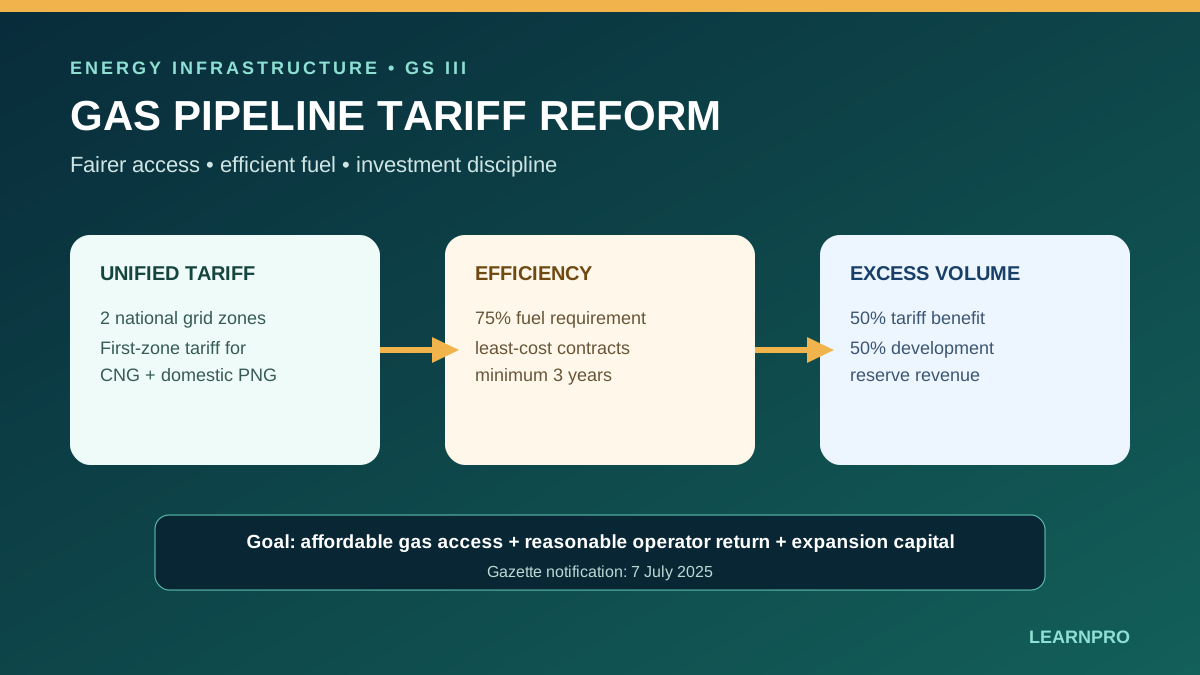
Key changes at a glance
| Reform | What the 2025 amendment does |
|---|---|
| CNG and domestic PNG | Applies the first-zone unified tariff after a revised tariff order |
| Unified zones | Reduces the national gas grid structure to two zones by removing the third zone |
| Isolated pipelines | Creates a defined tariff treatment for listed pipelines outside the national grid and not connected to an LNG terminal |
| Fuel gas procurement | Requires at least 75% of annual fuel requirement to be procured under contracts of at least three years on a least-cost basis |
| Excess volume | Shares 50% of qualifying excess-volume benefit through tariff adjustment |
| Development reserve | Places net revenue from the other 50% in a ring-fenced pipeline development reserve |
What does PNGRB regulate?
The Petroleum and Natural Gas Regulatory Board is a statutory regulator created under the PNGRB Act, 2006. Its functions include authorising pipelines and city gas distribution networks, regulating access and determining transportation tariffs for common-carrier or contract-carrier pipelines.
A pipeline is a natural monopoly: duplicating a long high-pressure network is expensive and often inefficient. The owner therefore needs a reasonable return, but users also need non-discriminatory access at a fair price. Tariff regulation balances these interests.
Gas price versus pipeline tariff
| Component | Meaning | Main driver |
|---|---|---|
| Commodity price | Price of the natural gas itself | Domestic allocation, contract terms or imported LNG market |
| Transportation tariff | Charge for carrying gas through the pipeline | Approved capital cost, operating cost, capacity, volume and regulated return |
| Delivered price | Total cost at the user’s delivery point | Commodity price plus transport, taxes and downstream charges |
A lower transport tariff cannot fully protect a consumer if LNG prices rise sharply. Conversely, inefficient pipeline charges can make even relatively cheap gas uncompetitive at distant locations.
How unified zonal tariff works
India introduced a unified tariff approach to reduce the “distance penalty” faced by consumers far from gas sources. Instead of adding a separate tariff for every pipeline segment, users pay an applicable tariff according to the national grid zone.
The 2025 amendment defines the applicable unified zonal tariff and provides that CNG and domestic PNG use the first-zone tariff after the revised order. It also removes the third zone: the second zone now covers the remaining national gas grid length on either side of the first zone.
This can support regional equity and gas use in areas far from LNG terminals or domestic production. Yet it also creates cross-subsidy questions: some short-distance users may pay more than a purely pipeline-specific tariff so that distant users pay less.
Treatment of isolated natural gas pipelines
The amendment defines an isolated natural gas pipeline as a qualifying pipeline that is neither part of the national gas grid nor connected to a listed LNG terminal. A dedicated line built for one customer and not for resale is excluded from this category in the circumstances specified by the regulation.
For a listed isolated pipeline, tariff is determined under the normal tariff methodology in Regulation 4. If a tariff review mathematically produces a negative tariff, the previous positive tariff continues until the next review. This avoids the impractical result of a transporter paying users to move gas.
Least-cost procurement of system-use gas
Pipelines consume some gas to operate compressors and maintain pressure. This is called system-use gas (SUG). Because fuel cost enters the regulated tariff, inefficient procurement can be passed on to users.
The 2025 rule requires an entity to procure at least 75% of its annual fuel-gas requirement through long-term contracts of at least three years on a least-cost basis, after the existing contracted period. If cheaper surplus gas exists in the entity’s portfolio, that lower-priced gas must be allocated to SUG. Procurement details must be reported to PNGRB.
How excess-volume benefit is shared
Pipeline tariff calculations depend on an assumed or normative volume. When actual throughput exceeds that volume, the fixed cost is spread across more units and the transporter may earn more than expected. The reform divides qualifying excess-volume benefit after prescribed adjustments:
- 50% is shared with users through tariff adjustment; and
- the net revenue from the remaining 50% goes into a Natural Gas Pipeline Development Reserve.
The reserve, including net interest, may be used only for capital expenditure on laying, building, replacing or expanding the entity’s natural gas pipeline infrastructure. It cannot pay dividends or operating expenses. The transporter must provide an annual statement certified by its statutory auditor by 30 June of the following financial year.
Security deposits in tariff calculation
An interest-free security deposit received from a shipper for pipeline services or infrastructure is treated as a cash inflow in the year received and as a cash outflow when refunded. Payment-security deposits for transmission or imbalance-management invoices are excluded. The approach recognises that an interest-free deposit temporarily lowers the operator’s financing need.
Expected benefits
- consumer relief: CNG and domestic PNG obtain the first-zone unified tariff;
- regional access: a simpler two-zone structure can reduce distance-related disadvantage;
- efficiency: long-term least-cost SUG procurement limits avoidable fuel expense;
- gain sharing: users benefit when throughput exceeds the regulatory assumption;
- infrastructure recycling: the reserve channels part of upside into network expansion; and
- auditability: specified reporting and ring-fencing make the reserve easier to monitor.
Risks and policy questions
- Cross-subsidy transparency: unified tariffs should disclose who gains, who contributes and by how much.
- Volume forecasting: optimistic projections can understate tariffs initially and create later true-ups.
- Contract rigidity: long-term fuel contracts reduce price risk but can become expensive if spot prices fall.
- Reserve governance: capital projects financed from the reserve need independent prudence checks.
- Gas transition risk: pipelines are long-lived assets, while climate policy may change future demand.
- Consumer pass-through: lower upstream transport costs must actually reach retail CNG and PNG users.
The reform connects with wider questions of infrastructure pricing and the energy transition. Read LearnPro’s analysis of India’s net-zero transition and the EU 2040 climate target.
UPSC and State PSC relevance
PNGRB natural gas pipeline tariff reforms are relevant to GS Paper III under energy infrastructure, statutory regulation, natural monopolies and inclusive growth. A good answer should explain the trade-off between cost recovery for the operator, affordable access for consumers and long-term investment.
Mains practice question: How can regulated pipeline tariffs balance regional equity, consumer protection and infrastructure investment in India’s natural gas market?
Conclusion
The 2025 tariff amendment is important because it changes incentives, not merely terminology. It rewards efficient fuel procurement, shares part of high-throughput gains and reserves the remainder for network development. Its success will depend on transparent tariff orders, realistic demand forecasts and proof that regulated savings reach consumers. Good regulation must make both the price and the allocation of risk visible.
Frequently asked questions
What is a natural gas pipeline tariff?
It is the regulated charge for transporting natural gas through a pipeline. It is separate from the commodity price of the gas.
What tariff applies to CNG and domestic PNG?
Under the 2025 amendment, the applicable unified zonal tariff for CNG and domestic PNG is the first-zone tariff after the revised tariff order.
How many unified tariff zones remain?
The amendment removes the third zone, leaving a first zone and a second zone covering the remaining national gas grid length.
What is the Natural Gas Pipeline Development Reserve?
It is a ring-fenced reserve funded by net revenue from half of qualifying excess volumes and used only for pipeline capital expenditure.
What is the 75% procurement rule?
Pipeline entities must procure at least 75% of annual fuel-gas requirements under least-cost long-term contracts of at least three years, subject to the regulation’s conditions.