
The India startup ecosystem has entered a new phase. The first decade of Startup India expanded the number and geographical spread of recognised firms; the next challenge is to convert that scale into productive jobs, durable innovation and globally competitive companies.
A June 2025 report commissioned by Meta and prepared by Alvarez & Marsal (A&M) identified six business levers used by 100 high-growth Indian startups. Its findings are useful, but they should not be mistaken for a census of every startup. This article combines that survey with the Government of India’s 2026 Startup India data and explains what the numbers mean for UPSC and State PSC examinations.
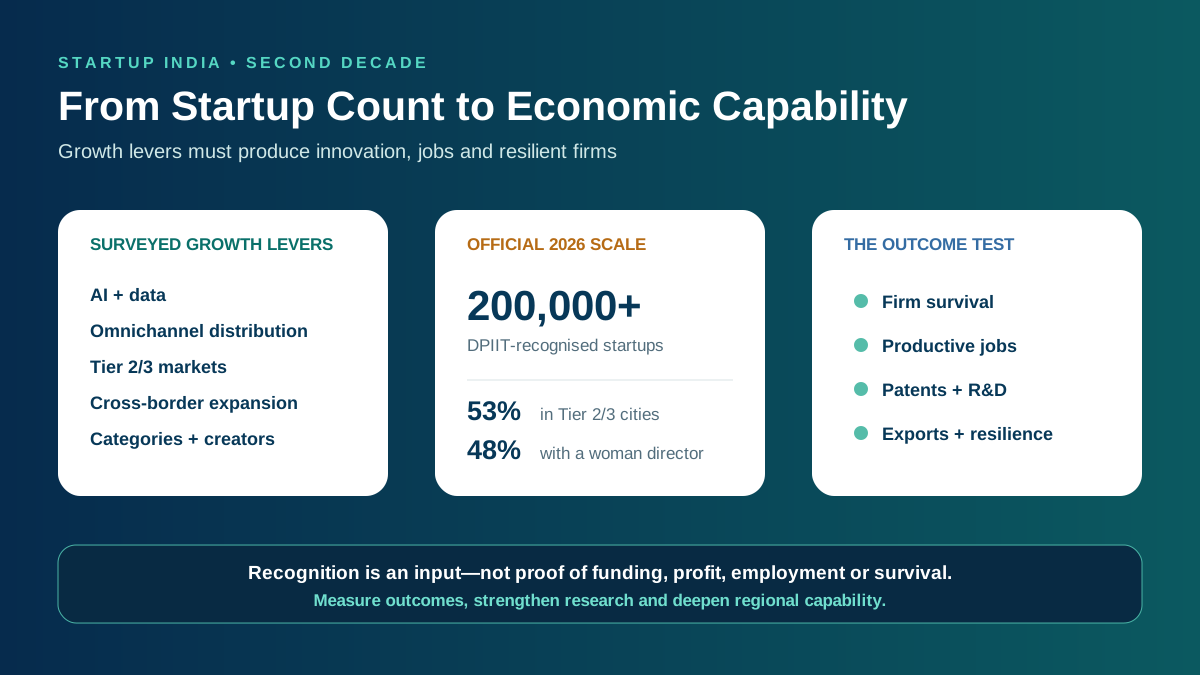
What did the Meta–A&M report study?
The study was based on detailed conversations with 100 high-growth Indian startups. It highlighted six levers: artificial intelligence, cross-border expansion, omnichannel distribution, Tier 2 and Tier 3 expansion, category diversification and creator-led brand building.
| Growth lever | Reported finding | Why it matters |
|---|---|---|
| AI adoption | More than 70% were integrating AI into operations | Automation, personalisation and predictive analysis can reduce costs and improve decisions |
| Omnichannel | 67% had adopted online-plus-offline models | Discovery may occur online even when purchase happens in a physical store |
| Cross-border growth | 52% were expanding internationally | The US, UAE and UK were identified as leading markets for surveyed firms |
| Category expansion | 84% had diversified beyond their core offering | Adjacent products can raise customer value, but also create execution risk |
| Creator partnerships | 88% worked with creators | Creators can build trust and reach niche audiences |
| Non-metro markets | Expansion into Tier 2 and Tier 3 markets was widespread | New demand and supply gaps are shifting entrepreneurship beyond major metros |
Among firms using AI in marketing, 87% reported about a 30% improvement in customer-acquisition cost. This is a survey result reported by participating firms, not proof that AI will produce the same gain in every sector. Business model, data quality, employee skills and measurement methods all affect the outcome.
How large is the India startup ecosystem?
Startup India marked its tenth anniversary in January 2026. Its official National Startup Day page reported:
- 200,000+ DPIIT-recognised startups;
- 53% of startups located in Tier 2 and Tier 3 cities;
- 48% of recognised startups having at least one woman director;
- 32 States and Union Territories with a startup policy;
- ₹27,000+ crore of funding through Startup India initiatives; and
- ₹51,000+ crore worth of orders to startups through the Government e-Marketplace.
These indicators measure different things. A DPIIT recognition is an administrative status, not a guarantee that the firm has raised venture capital, earned profit or survived for many years. Similarly, the number of recognition certificates is not the same as the number of unicorns. Sound analysis must keep recognition, funding, valuation, revenue, employment and survival separate.
What is a DPIIT-recognised startup?
Startup India recognition can provide access to measures such as easier compliance, faster intellectual-property examination, public-procurement relaxations and eligibility for specified tax benefits. Recognition depends on the legal and innovation criteria in the prevailing DPIIT notification.
In February 2026, the government revised the turnover ceiling used for startup recognition from ₹100 crore to ₹200 crore. Candidates should always use the current notification rather than memorising an older threshold. Recognition still does not remove the need to comply with sectoral law, taxation, labour rules, data protection or competition requirements.
Why has India’s startup base expanded?
1. Digital public infrastructure
Digital identity, interoperable payments and paperless verification have reduced transaction costs. They allow young firms to build services over population-scale rails instead of recreating every basic layer.
2. Mobile connectivity and a large consumer market
Affordable data and smartphones widened access to commerce, education, finance and entertainment. Non-metro demand has encouraged firms to design in Indian languages and for different income levels.
3. Policy and institutional support
The Startup India Seed Fund Scheme, Fund of Funds for Startups, Credit Guarantee Scheme for Startups, incubators, Atal Innovation Mission, state policies and procurement through GeM address different stages of the enterprise cycle. Their impact must be evaluated through additional investment, innovation and survival—not only sanctioned amounts.
4. A deeper talent and capital network
Experienced founders, employees and investors increasingly recycle knowledge and capital into new ventures. Universities, accelerators and corporate partnerships have also expanded the pipeline.
Why the six growth levers are strategically important
AI can improve productivity, but adoption must be accompanied by reliable data, cybersecurity, explainability and workforce training. Omnichannel distribution connects digital discovery with local retail and logistics. Tier 2 and Tier 3 expansion makes growth more geographically inclusive, while localisation becomes essential.
Cross-border expansion can diversify revenue and earn foreign exchange. It also exposes startups to standards, customs, tax, intellectual-property and data-transfer rules. The issues overlap with the India–US trade framework and broader BTA, because market access is usable only when firms meet origin, product and documentation requirements.
Category diversification can use an established brand and distribution network, but premature expansion may burn capital. Creator-led marketing can build trust, though paid promotions must remain transparent and comply with consumer-protection and advertising rules.
Structural problems behind the growth headline
- Funding concentration: venture funding favours a small group of firms, cities and sectors; early-stage and deep-tech ventures face long gestation periods.
- Survival and governance: recognition does not ensure product-market fit. Weak financial controls, aggressive valuation and poor boards can destroy trust.
- Employment quality: job counts should be examined with wages, social security, skill formation and stability.
- Research gap: India needs stronger university–industry links, laboratories, patient capital and technology transfer.
- Digital risks: cyberattacks, misuse of personal data, algorithmic bias and platform dependence can harm consumers and firms.
- Market access: small firms face high compliance costs, delayed payments and difficulty competing with network effects.
- Regional capability: locating a firm in a non-metro city is not enough; local finance, mentors, broadband, logistics and skilled workers must also improve.
Policy priorities for the next decade
- Measure outcomes: publish comparable data on active firms, survival, jobs, revenue, exports, patents and public-support outcomes.
- Improve patient finance: expand well-governed seed, credit-guarantee and deep-tech instruments without socialising reckless risk.
- Connect research to markets: strengthen university technology-transfer offices, shared laboratories and procurement of indigenous innovation.
- Pay MSMEs on time: enforce payment discipline and improve cash-flow finance. Read the related analysis of MSMEs, formalisation and enterprise resilience.
- Build responsible AI: encourage innovation alongside privacy, safety, accountability and upskilling.
- Deepen regional ecosystems: link district-level institutions, colleges, incubators and industry clusters instead of merely replicating metropolitan models.
- Enable orderly failure: fast restructuring and exit allow capital and talent to move to more productive uses.
UPSC and State PSC relevance
The India startup ecosystem connects GS Paper II governance with GS Paper III economy, employment, science and technology, intellectual property and inclusive growth. For Prelims, distinguish DPIIT recognition from funding or valuation. For Mains, balance innovation and entrepreneurship with job quality, regional equity, consumer protection and financial discipline.
Mains practice question: India’s startup policy must move from counting recognised firms to measuring productive innovation and durable employment. Discuss with reference to the second decade of Startup India.
Conclusion
The Meta–A&M survey shows how selected high-growth firms are using AI, creators, omnichannel distribution and new markets. Official Startup India data shows that entrepreneurship has also spread widely across geography and ownership. The next policy goal should be more demanding: innovative firms that survive, export, create good jobs and solve Indian problems. Scale is valuable only when it becomes lasting economic capability.
Frequently asked questions
What are the six growth levers identified in the Meta report?
AI adoption, cross-border expansion, omnichannel presence, Tier 2 and Tier 3 market expansion, category diversification and creator-led brand building.
How many startups did the Meta–A&M report study?
It drew on conversations with 100 high-growth Indian startups. Its percentages describe that survey sample and should not be treated as a census of all Indian startups.
How many DPIIT-recognised startups did India report in 2026?
The official National Startup Day 2026 page reported more than 200,000 DPIIT-recognised startups.
Does DPIIT recognition mean a startup is profitable?
No. Recognition is an administrative status based on eligibility criteria. It does not guarantee funding, profitability, employment or survival.
Why are Tier 2 and Tier 3 cities important?
They widen the founder and consumer base and can distribute innovation geographically. However, local finance, infrastructure, mentors and skills must grow with the number of firms.
Official and primary references
- Meta: AI, cross-border and Tier 2/3 expansion transforming India’s startups
- Startup India: National Startup Day 2026 and decade-of-impact data
- Startup India: initiative and policy instruments





Sources and further reading
- Meta: AI, cross-border and Tier 2/3 expansion transforming India’s startupsabout.fb.com
- Startup India: National Startup Day 2026 and decade-of-impact datastartupindia.gov.in
- Startup India: initiative and policy instrumentsstartupindia.gov.in