
Tags: GS Paper 3 – Science and Technology: Energy, Indigenisation of Technology
For Prelims: Nuclear fusion, tokamak, plasma, deuterium–tritium, ITER, Institute for Plasma Research, SST-1, Aditya tokamak, SHANTI Act 2025, fusion vs fission
For Mains: Prospects of fusion energy for clean baseload power, role of private sector in nuclear R&D
Why in News?
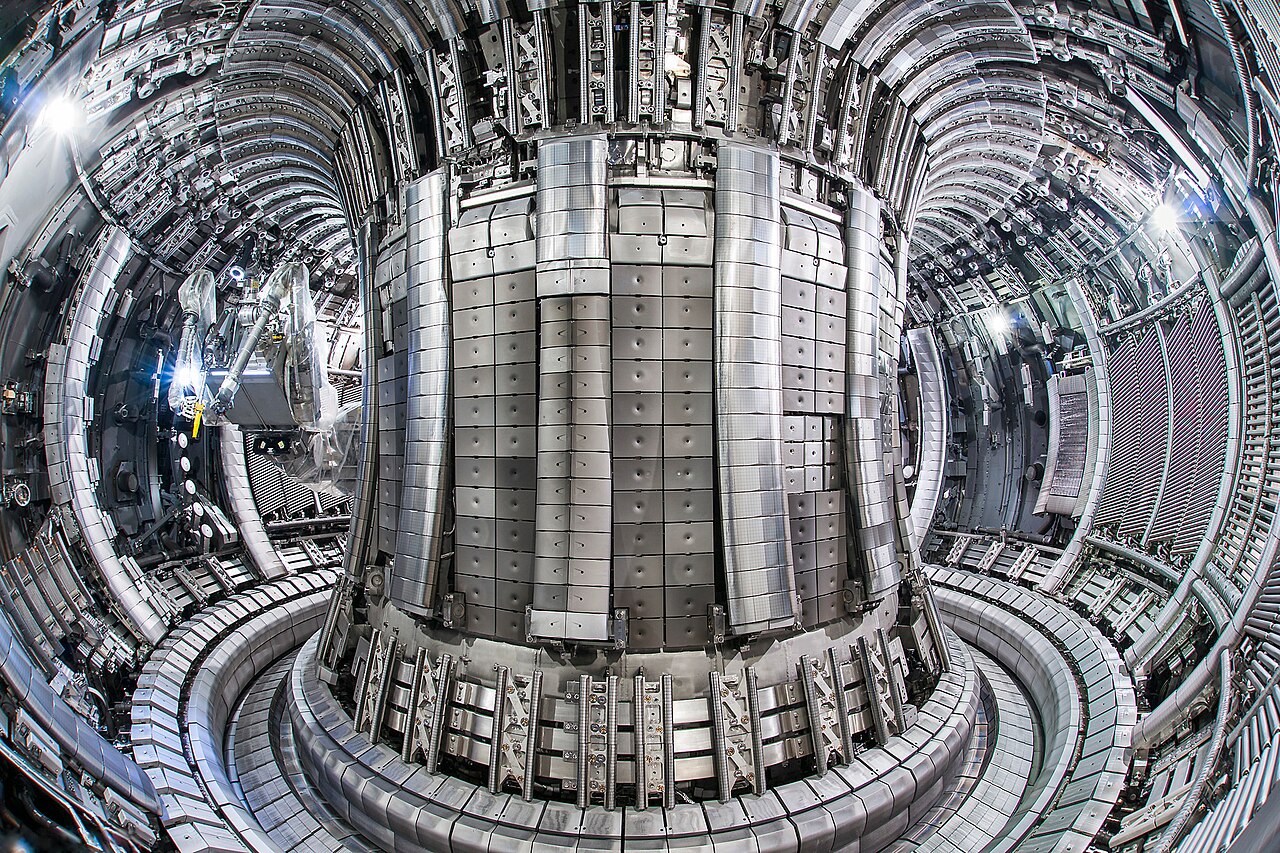
Bengaluru-based start-up Pranos Fusion, described as India’s first private fusion power company, has built PRAGYA, a small doughnut-shaped tokamak for testing plasma control and superconducting magnets. It plans to finalise the design of a larger tokamak, PRANIK, by 2027. Generating electricity from fusion is still further away.
What is Nuclear Fusion?
- Fusion is the joining of light nuclei, such as the hydrogen isotopes deuterium and tritium, into a heavier nucleus such as helium. The small loss of mass is released as a large amount of energy. It is the process that powers the Sun.
- It requires temperatures of over 100 million °C (hotter than the Sun’s core), and the plasma must be held long enough at high enough density.
How Does a Tokamak Work?
- A tokamak (a Russian acronym) is a ring-shaped (toroidal) chamber in which strong magnetic fields confine hot plasma so that it does not touch the walls.
- Plasma is heated by electric current, neutral beams and radio-frequency waves.
- Another approach is inertial confinement, using lasers. The US National Ignition Facility achieved ignition (net energy gain from the target) in 2022.
Fusion vs Fission
| Feature | Fission | Fusion |
|---|---|---|
| Process | Splitting heavy nuclei (uranium, plutonium) | Joining light nuclei (deuterium, tritium) |
| Waste | Long-lived radioactive waste | Little, short-lived waste |
| Risk | Meltdown possible | No chain reaction, so no meltdown |
| Status | Commercial | Experimental |
India’s Fusion Programme
- Institute for Plasma Research (IPR), Gandhinagar, under the Department of Atomic Energy, runs the Aditya tokamak (1989) and SST-1, a steady-state superconducting tokamak.
- India is a member of ITER in Cadarache, France, with the EU, the US, Russia, China, Japan and South Korea. India supplies the cryostat, in-wall shielding and cooling systems.
- The SHANTI Act, 2025 opened the nuclear sector to private participation, which helps start-ups.
Challenges
- Producing more energy from the reaction than is put in, and sustaining the plasma for long periods.
- Materials that can withstand neutron bombardment, and the supply of tritium.
- High costs and long timelines. Commercial fusion is expected only around the 2040s.
Frequently Asked Questions (FAQs)
1. What is a tokamak?
A ring-shaped device that uses magnetic fields to confine plasma for fusion.
2. Where is ITER located?
Cadarache, France.
3. Which Indian institute runs the Aditya and SST-1 tokamaks?
The Institute for Plasma Research, Gandhinagar.
Sources and further reading
- EUROfusioncommons.wikimedia.org