
Tags: GS Paper 1 – World Geography: Biomes; GS Paper 3 – Environment, Climate Change
For Prelims: Amazon rainforest, carbon sink vs carbon source, El Niño, tipping point, Amazon Cooperation Treaty Organization, COP30 Belém, Tropical Forests Forever Facility, India’s forest carbon stock
For Mains: Role of tropical forests in global carbon budget, climate tipping points, deforestation and international climate finance
Why in News?
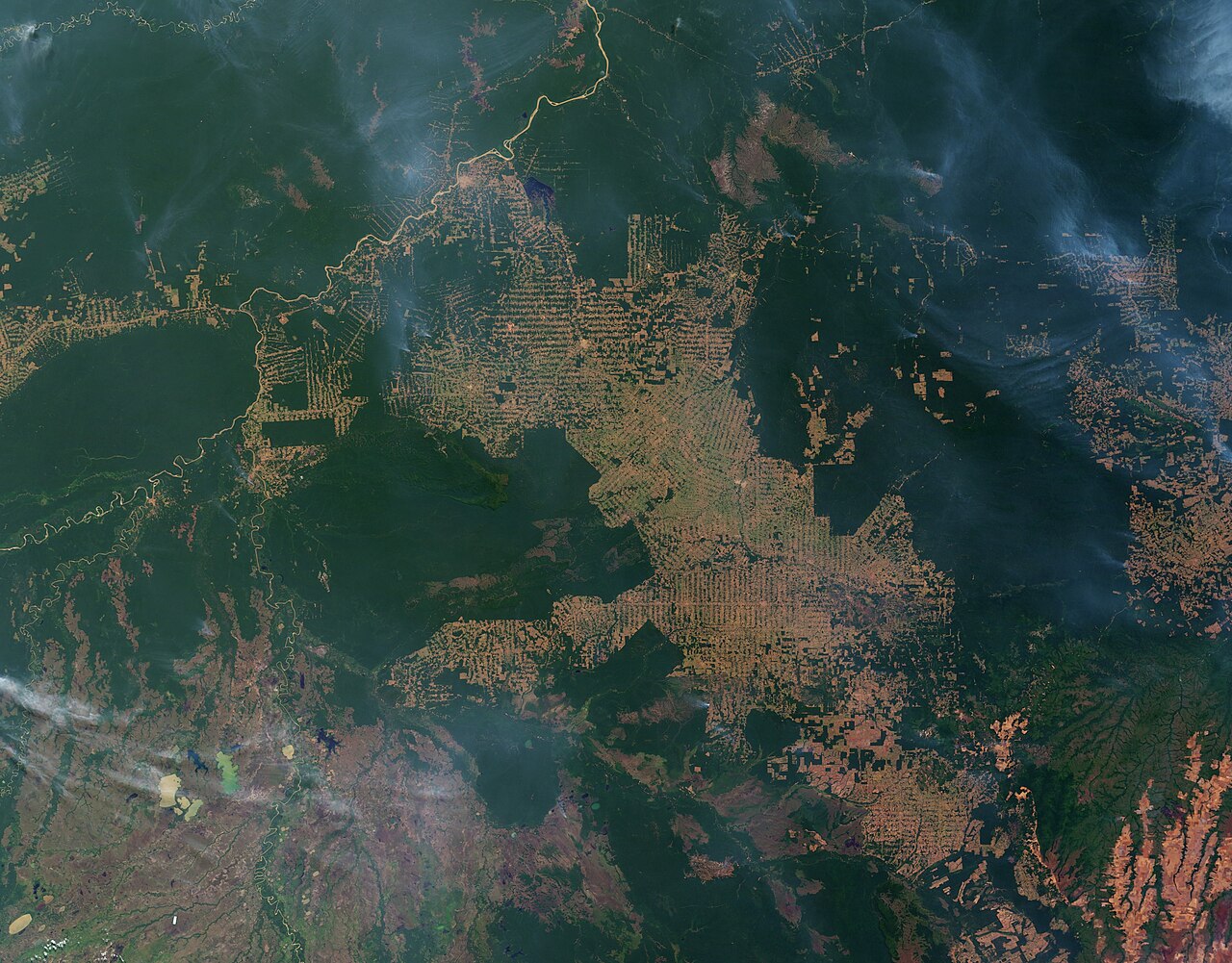
A study published in Nature found that the Amazon rainforest has become a net carbon source. It now releases more CO2 than it absorbs, mainly because of deforestation and forest fires. Scientists used research aircraft to measure CO2 at different altitudes over four Amazon sites between 2010 and 2024.
Summary
- Fires caused the Amazon to emit about 1.17 billion tonnes more carbon than it absorbed over the study period.
- The highest emissions came during the strong El Niño of 2024, the hottest and driest period. That year, up to 38% of deforestation was caused by fire.
- Forest loss reduces rainfall and raises temperatures, which makes the remaining forest more flammable. Most fires are set deliberately.
- The area under mining and pasture has expanded sharply since 2010.
Carbon Sink vs Carbon Source
- Carbon sink: A natural system, such as forests, oceans or soil, that absorbs more carbon than it releases. Land and ocean sinks together absorb about half of human CO2 emissions.
- Carbon source: A system that releases more carbon than it absorbs, for example through burning, decomposition or land-use change.
- The Amazon stores about 100 billion tonnes of carbon in its vegetation and soils. Releasing even part of it would affect the global carbon budget.
About the Amazon
- The world’s largest tropical rainforest, spread across nine countries. About 60% of it is in Brazil.
- It is home to about 10% of known species and around 30 million people, including many Indigenous communities.
- It produces its own rainfall: moisture recycled by trees creates “flying rivers” that bring rain to South America’s farm belt.
- Amazon Cooperation Treaty Organization (ACTO): Formed under the 1978 treaty by eight Amazon countries.
The Tipping Point Concern
- Scientists warn that if around 20–25% of the forest is lost, combined with warming, parts of the Amazon could change permanently into degraded savanna.
- Longer dry seasons and repeated droughts (2015-16, 2023-24) show the forest is already losing resilience.
Global Responses
- COP30 (Belém, Brazil, 2025): Launched the Tropical Forests Forever Facility (TFFF) to pay countries for keeping forests standing.
- Glasgow Leaders’ Declaration (2021): A pledge to halt and reverse forest loss by 2030.
- REDD+: A UNFCCC framework for results-based payments for reducing deforestation.
Lessons for India
- India’s NDC target is an additional carbon sink of 2.5–3 billion tonnes of CO2-equivalent through forest and tree cover by 2030.
- Indian forests face similar threats from forest fires (especially in the Himalayas and central India), fragmentation and invasive species.
- An Indian study suggests forest carbon could nearly double by 2100 with more rainfall and CO2 fertilisation, but this depends on managing fires and degradation.
Conclusion
The Amazon turning into a carbon source shows that natural sinks cannot be relied on as permanent climate buffers. Protecting standing forests through enforcement, Indigenous land rights and finance is now as important as cutting fossil fuel emissions.
Frequently Asked Questions (FAQs)
1. How many countries does the Amazon rainforest span?
Nine.
2. What is a carbon sink?
A system that absorbs more carbon from the atmosphere than it releases.
3. Which COP launched the Tropical Forests Forever Facility?
COP30, held in Belém, Brazil (2025).
Practice Question
Mains: “Natural carbon sinks are turning into sources.” Examine the causes and the global climate implications of this trend, with reference to the Amazon. (250 words)
Sources and further reading
- Jesse Allen and Robert Simmoncommons.wikimedia.org