
Shillong Teer is a traditional archery-based game associated with the Khasi community of Meghalaya. Unlike an ordinary lottery in which numbers are drawn mechanically or electronically, the declared number in Shillong Teer is derived from an actual archery event in which archers shoot arrows at a target and the arrows that successfully hit the target are counted.
The practice combines traditional Khasi archery, organised sport and a State-regulated teer-ticket system. Shillong Teer is therefore significant not only as a popular activity in Meghalaya but also for understanding the State’s culture, customary sporting traditions, regulation of betting, taxation and local economy.
The present legal framework is particularly important. Teer is specifically regulated under the Meghalaya Regulation of the Game of Arrow Shooting and the Sale of Teer Tickets Act, 2018, which extends across Meghalaya and provides for licensing, regulation of arrow shooting, sale of teer tickets, bookmakers, record-keeping and penalties. (Meghalaya Government)
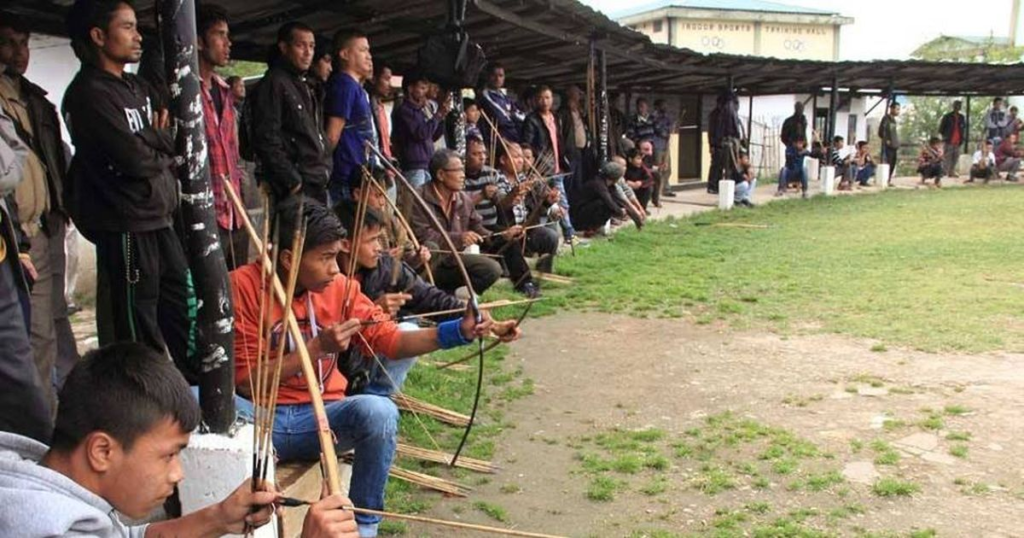
What is Shillong Teer?
Shillong Teer is an organised form of traditional archery in which a group of archers shoot a large number of arrows at a common target. After the shooting is completed, the arrows that have struck the target are counted. The last two digits of the total number of successful arrows form the declared number for that round.
For example, if the total number of arrows striking the target were 1,599, the relevant two-digit result would be 99. The purpose of this example is only to explain how the result is derived; the system is based on the physical outcome of the archery event rather than a computer-generated or mechanically drawn number. (Shillong Teer Ground)
The shooting takes place in two rounds, generally referred to as the First Round and Second Round. Each round produces a separate result after the arrows hitting the target have been counted.
This physical connection between archery and the declared number makes Shillong Teer different from conventional lotteries.
Origin of Shillong Teer
To understand Shillong Teer, it is necessary to understand the importance of archery in Khasi society.
Traditional archery has long formed part of the social and cultural life of the Khasi people. Bows and arrows were historically associated with hunting, defence, sporting competition and community gatherings. Archery eventually developed into organised competitions between groups and villages, while wagering also became associated with some of these competitions.
The modern Teer system developed from this older archery tradition. The sport became increasingly organised, and a numerical result began to be derived from the total number of arrows striking the target.
Shillong, as the political and commercial centre of the Khasi Hills and later the capital of Meghalaya, became the best-known centre for this organised form of Teer.
Archery in Khasi Culture
Archery occupies a distinctive position in Khasi cultural tradition. Traditional Khasi bows are generally made from bamboo, while bamboo is also used for arrows. Archery competitions historically provided opportunities for skill, physical training and community participation.
Traditional terminology associated with Khasi archery includes expressions such as Siat Khnam or forms of traditional archery competition found in Khasi society. Cultural accounts of Shillong also describe archery as one of the important traditional sports of the Khasi community. (World Archery)
The importance of archery therefore goes beyond Shillong Teer itself. Teer represents one modern manifestation of a much older sporting and cultural tradition.
How Does Shillong Teer Work?
The basic mechanism of Shillong Teer is comparatively simple.
A group of archers assembles at the shooting ground and fires arrows at a common target. The target is traditionally made from material capable of holding a large number of arrows, commonly straw or a similar tightly packed material.
The event is held in two rounds. After each round is completed, officials count the number of arrows that have successfully struck the target. The final two digits of that count form the declared number for the respective round.
The sequence can therefore be understood as:
Archery Round → Arrows Hit Target → Arrows Counted → Last Two Digits Become the Declared Number
This method is the defining feature of Teer.
It is important to note that the numerical outcome does not come from a random-number generator. It is produced from the number of arrows that physically strike the target.
Why Does Shillong Teer Have Two Rounds?
Shillong Teer traditionally consists of two separate rounds of shooting. The arrows are counted separately after each round, which produces two separate numerical outcomes.
The two-round structure has become one of the defining characteristics of the Shillong Teer format. Other Teer events in Meghalaya may follow broadly similar archery-based systems, although their organisers, locations and schedules can differ.
Where is Shillong Teer Held?
Shillong Teer is associated with the Polo area of Shillong, particularly the archery ground at 4th Furlong.
The location has become closely identified with the Shillong Teer tradition and organised Khasi archery. (Shillong Teer)
The Polo area itself has long been an important sporting zone in Shillong, and the presence of organised archery there reflects the continued place of traditional sport within the modern city.
Legal Status of Teer in Meghalaya
The legal position of Shillong Teer requires careful explanation because older articles frequently refer only to the Meghalaya Amusements and Betting Tax legislation of 1982.
The legal framework has subsequently developed further.
The major present legislation specifically governing Teer is:
Meghalaya Regulation of the Game of Arrow Shooting and the Sale of Teer Tickets Act, 2018
The purpose of the Act is to regulate:
- the game of arrow shooting;
- sale of teer tickets;
- licensing of organisers;
- licensing of bookmakers;
- maintenance of accounts and registers;
- conditions and restrictions governing Teer;
- offences and penalties.
The Act defines “Arrow Shooting” as the game of arrow shooting using traditional bows and arrows. It also recognises the sale of teer or thoh team tickets within the regulatory framework. (Meghalaya Government)
The Act applies throughout Meghalaya.
Regulation Through Licences
The Teer system is therefore not an unrestricted activity. The legislation provides for regulatory authorities and requires licences or permits for relevant organisers and bookmakers.
The rules prescribe procedures relating to:
- applications for licences;
- permissions to organise arrow shooting;
- licensed bookmakers;
- prescribed forms;
- records and accounts;
- conditions attached to licences.
This regulatory structure is important because legality depends upon compliance with the applicable State licensing framework.
Historical Legal Development
The regulation of Teer did not begin in 2018.
An important earlier development came through amendments to Meghalaya’s amusements and betting tax law in the early 1980s. The 1982 amendment expressly recognised arrow shooting and included the game of Teer or “thoh team” within the legal terminology dealing with licensed bookmakers. (Meghalaya Government)
The State later enacted a much more specific law in 2018 dealing directly with arrow shooting and the sale of Teer tickets.
The evolution can therefore broadly be understood as:
Traditional Archery → Organised Teer → Earlier Betting-Tax Regulation → Specific Teer Regulation under the 2018 Act
What About the Meghalaya Regulation of Gaming Act, 2021?
This is an area where confusion frequently arises.
Meghalaya enacted the Meghalaya Regulation of Gaming Act, 2021 to create a broader framework for games of skill and games of chance. However, this legislation was subsequently repealed by the Meghalaya Regulation of Gaming (Repeal) Act, 2023. (India Code)
The separate 2018 law specifically regulating arrow shooting and Teer tickets remains the important legislation for studying Teer.
Shillong Teer and the Local Economy
Shillong Teer also has an economic dimension. The activity involves archers, organisers, licensed bookmakers and other persons associated with the conduct and regulation of the event.
For participating traditional archers, organised archery can provide both a platform to continue the sport and a source of income. The survival of an archery-based institution within a modern urban economy illustrates how traditional cultural activities can acquire new economic functions.
At the same time, because money is associated with the Teer-ticket system, regulation is necessary. Licensing, taxation, record-keeping and enforcement become important for protecting the integrity of the regulatory framework.
This creates an unusual intersection between:
Culture + Traditional Sport + Local Economy + Taxation + Regulation
Shillong Teer as Cultural Continuity
The continuing popularity of Teer demonstrates how an indigenous cultural practice can survive while adapting to changing economic and institutional conditions.
The bows and arrows used in Teer connect the modern game to traditional Khasi archery. The physical participation of archers distinguishes the activity from a conventional numerical draw.
Shillong Teer therefore illustrates the broader process through which traditional practices may be:
- preserved;
- commercialised;
- regulated;
- adapted to urban life;
- incorporated into the formal legal system.
This makes it useful for studying the relationship between custom, culture and modern State regulation in Meghalaya.
Teer and Traditional Bows and Arrows
A distinguishing feature of Teer is the continued use of traditional archery equipment.
Khasi bows are traditionally associated with bamboo construction. Arrows are also fashioned from natural materials, although details may vary among individual archers and traditional practices.
The 2018 legislation itself is significant because its definition of arrow shooting refers specifically to the use of traditional bows and arrows. (Meghalaya Government)
Thus, the traditional character of the equipment is not merely a cultural observation; it also appears within the terminology of the regulatory framework.
Shillong Teer, Jowai Teer and Other Teer Traditions
Shillong Teer is the most widely recognised form, but it is not the only archery-based Teer tradition associated with Meghalaya.
Other names commonly encountered include Jowai Teer and archery-based games conducted at other locations.
These should not automatically be treated as one single organisation. Different Teer events may have different organisers and local arrangements, even where they use a broadly similar arrow-counting system.
For examination purposes, the important point is that Teer is closely associated with Meghalaya’s traditional archery culture, while Shillong represents its best-known urban centre.
Shillong Teer and Meghalaya Society
The significance of Shillong Teer can be understood at several levels.
Cultural Significance
It preserves an association with traditional Khasi archery and provides continued visibility to indigenous sporting practices.
Social Significance
The shooting event creates a community space around a traditional sport and connects archers from different areas.
Economic Significance
The system generates economic activity involving archers and licensed participants within the regulatory structure.
Legal Significance
It represents an unusual example of a traditional activity being brought under detailed State legislation.
Administrative Significance
The activity requires licensing, regulation, taxation, record maintenance and enforcement by State authorities.
Important Issues Related to Regulation
The existence of a legal framework does not mean that every Teer-related activity is automatically lawful.
The law distinguishes between authorised organisers, licensed bookmakers and unauthorised activities. Regulatory compliance is therefore crucial.
Audit scrutiny has also raised questions in the past about licensing and the sale of tickets connected with particular organisers. This illustrates why candidates should avoid the simplistic statement that “all Teer activity is legal.”
The more accurate position is:
Meghalaya provides a legal framework for regulated arrow shooting and sale of Teer tickets, subject to licensing and compliance with the applicable law and rules.
That distinction is important both legally and academically. (Comptroller and Auditor General of India)
Why Shillong Teer is Important for MPSC Meghalaya
Shillong Teer can appear in Meghalaya-specific examinations because it connects several parts of the State syllabus.
It can be linked with:
- Khasi culture and traditional institutions
- traditional sports of Meghalaya;
- social and cultural heritage;
- State legislation;
- taxation;
- local economy;
- customary practices;
- government regulation.
A factual question may ask about the nature of Shillong Teer or the legislation regulating it, while a Mains question could examine the relationship between traditional culture and modern regulation.
Shillong Teer: Important Facts
| Topic | Fact |
|---|---|
| Shillong Teer | Traditional archery-based game |
| State | Meghalaya |
| Major Community Association | Khasi |
| Main Centre | Shillong |
| Traditional Equipment | Bows and arrows |
| Number of Shooting Rounds | Two |
| Basis of Result | Last two digits of arrows hitting the target |
| Shillong Venue | Polo / 4th Furlong area |
| Specific Teer Law | Meghalaya Regulation of the Game of Arrow Shooting and the Sale of Teer Tickets Act, 2018 |
| Area of Application | Whole of Meghalaya |
| 2021 General Gaming Act | Repealed in 2023 |
Frequently Asked Questions
1. What is Shillong Teer?
Shillong Teer is a traditional archery-based game of Meghalaya in which the numerical result is determined from the number of arrows that successfully strike a target.
2. Is Shillong Teer associated with Khasi culture?
Yes. Shillong Teer developed around the traditional archery practices of the Khasi community, among whom bow-and-arrow competitions have longstanding cultural significance.
3. How is the Shillong Teer result determined?
After an archery round, the arrows that successfully hit the target are counted. The last two digits of the total count form the declared number for that round.
4. How many rounds are there in Shillong Teer?
Shillong Teer normally consists of two rounds of archery, with a separate arrow count after each round.
5. Where is Shillong Teer held?
It is associated with the Polo/4th Furlong archery ground in Shillong, Meghalaya.
6. Is Teer regulated by law in Meghalaya?
Yes. Meghalaya has a specific legal framework regulating traditional arrow shooting and the sale of Teer tickets. Activities within the system are subject to applicable licensing and regulatory requirements.
7. Which law regulates Teer in Meghalaya?
The principal specific legislation is the Meghalaya Regulation of the Game of Arrow Shooting and the Sale of Teer Tickets Act, 2018.
8. Is the Meghalaya Regulation of Gaming Act, 2021 still in force?
No. The broader Meghalaya Regulation of Gaming Act, 2021 was repealed in 2023. It should not be confused with the separate 2018 legislation governing arrow shooting and Teer tickets.
9. Why is Shillong Teer culturally important?
Shillong Teer keeps traditional Khasi archery visible within contemporary society and represents an unusual combination of indigenous sport, cultural continuity and modern State regulation.
10. Why is Shillong Teer important for MPSC Meghalaya?
It can be studied under Meghalaya culture, traditional sports, State legislation, local economy, taxation and governance, making it relevant for both objective and descriptive examination questions.





Sources and further reading
- Meghalaya Governmentmeghalaya.gov.in
- Shillong Teer Groundshillongteerground.com
- World Archeryworldarchery.sport
- Shillong Teermeghalayateer.com
- Meghalaya Governmentmeghalaya.gov.in