The Chief Minister of Meghalaya, Conrad K. Sangma, presented the Meghalaya Budget 2026-27 on 23 February 2026. The Budget places emphasis on capital expenditure, transport connectivity, health, rural development, agriculture, climate adaptation and entrepreneurship, while also revealing important fiscal challenges relating to dependence on Central transfers, debt and expenditure accountability.
Budget Highlights
- Gross State Domestic Product (GSDP): Meghalaya’s GSDP at current prices is projected at ₹76,320 crore in 2026-27, an increase of about 13% over the previous year.
- Expenditure: Expenditure excluding debt repayment is estimated at ₹29,292 crore, which is 6% higher than the revised estimate for 2025-26. In addition, the State will repay debt of ₹2,731 crore.
- Receipts: Receipts excluding borrowings are estimated at ₹26,621 crore, an increase of around 5% over the revised estimate for 2025-26.
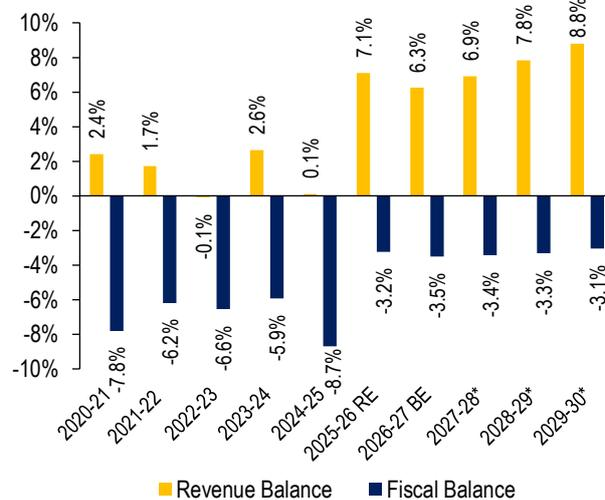
- Revenue Surplus: The State expects a revenue surplus of ₹4,771 crore, equivalent to 6.3% of GSDP. The revised estimate for 2025-26 was higher at 7.1% of GSDP.
- Fiscal Deficit: The fiscal deficit is targeted at ₹2,672 crore or 3.5% of GSDP. The revised estimate for 2025-26 was 3.2% of GSDP.
Policy Highlights
- Entrepreneurship: Six new schemes will be introduced under CM ELEVATE. The areas identified include green taxis, adventure tourism, polyhouses, cold storage and fish ponds. The programme is aimed at encouraging entrepreneurship through financial assistance.
- Health and Nutrition: A 1,000-Day Mission will be launched to address child stunting and malnutrition, with an allocation of ₹127 crore. The Budget also proposes Active Ageing Centres, where senior citizens and children can participate in shared learning and activities.
- Rural Development: The Chief Minister’s Model Village Scheme will develop selected villages as growth hubs in agriculture, floriculture, sericulture, organic farming, aquaculture and livestock management.
- Water Conservation: The State will introduce a rooftop rainwater-harvesting initiative. Private buildings will be eligible for a subsidy of up to 25% for installing rooftop rainwater collection systems.
- Agricultural Education: An Agriculture and Horticulture College will be established at Williamnagar in East Garo Hills.
Meghalaya’s Economy
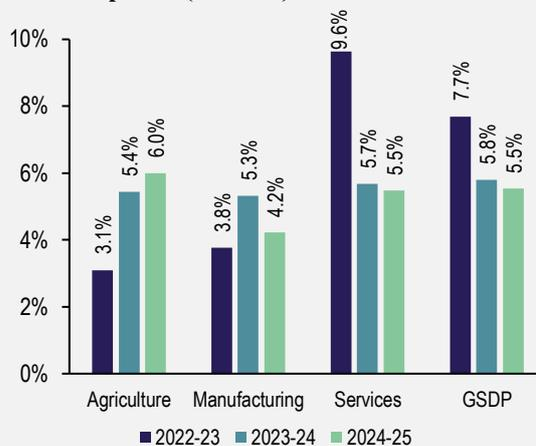
The performance of the State economy provides the larger context within which the 2026-27 Budget has been prepared. In 2024-25, Meghalaya’s GSDP at constant prices was estimated to grow by 5.5%, while India’s GDP was estimated to grow by 6.5% during the same year.
The structure of Meghalaya’s economy continues to be dominated by the service sector. At current prices in 2024-25, services contributed about 57%, agriculture about 26%, and manufacturing about 17% of the State economy.
| Sector | Share in Meghalaya’s Economy, 2024-25 |
|---|---|
| Agriculture | 26% |
| Manufacturing | 17% |
| Services | 57% |
Agriculture therefore continues to occupy a much larger place in Meghalaya’s economy than its share alone might suggest, because a substantial part of the rural population remains connected with agriculture and allied activities. This helps explain the Budget’s continued emphasis on horticulture, livestock, aquaculture, cold storage and rural development.
Meghalaya’s per capita GSDP at current prices was estimated at ₹1,72,929 in 2024-25, representing an increase of about 11% over the previous year. India’s corresponding per capita GDP was estimated at ₹2,34,859.
Budget Estimates for 2026-27
The following table gives the broader fiscal position of Meghalaya across the latest actual, budget and revised estimates.
| Item | 2024-25 Actual | 2025-26 BE | 2025-26 RE | 2026-27 BE |
|---|---|---|---|---|
| Total Expenditure | ₹33,531 cr | ₹30,003 cr | ₹30,003 cr | ₹32,023 cr |
| Debt Repayment | ₹11,171 cr | ₹2,405 cr | ₹2,405 cr | ₹2,731 cr |
| Net Expenditure | ₹22,360 cr | ₹27,598 cr | ₹27,598 cr | ₹29,292 cr |
| Total Receipts | ₹33,039 cr | ₹30,416 cr | ₹30,190 cr | ₹32,000 cr |
| Borrowings | ₹15,864 cr | ₹4,788 cr | ₹4,788 cr | ₹5,379 cr |
| Net Receipts | ₹17,176 cr | ₹25,627 cr | ₹25,401 cr | ₹26,621 cr |
| Fiscal Deficit | ₹5,184 cr | ₹1,970 cr | ₹2,196 cr | ₹2,672 cr |
| Fiscal Deficit as % of GSDP | 8.7% | 3.0% | 3.2% | 3.5% |
| Revenue Surplus | ₹73 cr | ₹5,035 cr | ₹4,809 cr | ₹4,771 cr |
| Revenue Surplus as % of GSDP | 0.1% | 7.6% | 7.1% | 6.3% |
| Primary Deficit | ₹3,953 cr | ₹623 cr | ₹849 cr | ₹1,132 cr |
| Primary Deficit as % of GSDP | 6.6% | 0.9% | 1.3% | 1.5% |
| GSDP | ₹59,626 cr | ₹66,645 cr | ₹67,638 cr | ₹76,320 cr |
The GSDP estimate increases from ₹67,638 crore in the 2025-26 revised estimate to ₹76,320 crore in 2026-27. At the same time, the fiscal deficit increases from ₹2,196 crore to ₹2,672 crore, while the revenue surplus declines slightly from ₹4,809 crore to ₹4,771 crore.
BE means Budget Estimate and RE means Revised Estimate. The distinction is important because the original allocation announced in a Budget may be revised upward or downward during the financial year.
Expenditure in 2026-27
Meghalaya’s revenue expenditure is proposed at ₹21,812 crore, an increase of 6% over the revised estimate for 2025-26. Revenue expenditure includes recurring items such as salaries, pensions, interest payments, grants and subsidies.
The State’s capital outlay is proposed at ₹7,439 crore, also 6% higher than the revised estimate of ₹6,995 crore for 2025-26. Capital outlay represents expenditure that creates assets, such as roads, public buildings and other infrastructure.
| Expenditure | 2024-25 Actual | 2025-26 BE | 2025-26 RE | 2026-27 BE |
|---|---|---|---|---|
| Revenue Expenditure | ₹17,081 cr | ₹20,556 cr | ₹20,556 cr | ₹21,812 cr |
| Capital Outlay | ₹5,246 cr | ₹6,995 cr | ₹6,995 cr | ₹7,439 cr |
| Loans Given by State | ₹33 cr | ₹46 cr | ₹46 cr | ₹41 cr |
| Net Expenditure | ₹22,360 cr | ₹27,598 cr | ₹27,598 cr | ₹29,292 cr |
Capital outlay alone is equivalent to roughly one-fourth of expenditure excluding debt repayment. This gives infrastructure and asset creation an important place in the State’s fiscal strategy.
Climate Action Budget
Meghalaya has allocated ₹5,572 crore for climate action in 2026-27. This represents approximately 19% of total expenditure excluding debt repayment.
About 80% of the climate budget has been allocated towards climate adaptation, while the remaining portion is intended for climate mitigation. The departments receiving the largest shares are Planning, Community and Rural Development, Agriculture and Farmers Welfare, and Public Health Engineering.
| Department | Share of Climate Budget |
|---|---|
| Planning | 21% |
| Community and Rural Development | 20% |
| Agriculture and Farmers Welfare | 12% |
| Public Health Engineering | 8% |
The strong adaptation component is significant for Meghalaya because climate risks directly affect agriculture, hill infrastructure, water supply, rural livelihoods and ecological systems. Rather than treating climate change as a stand-alone environmental issue, the Budget attempts to integrate climate resilience into departmental spending.
Committed Expenditure
Committed expenditure refers to expenditure that a government has limited flexibility to reduce in the short term, particularly salaries, pensions and interest payments.
Meghalaya is estimated to spend ₹8,256 crore on committed expenditure in 2026-27, equivalent to around 31% of its revenue receipts.
| Component | 2024-25 Actual | 2025-26 BE | 2025-26 RE | 2026-27 BE |
|---|---|---|---|---|
| Salaries | ₹4,354 cr | ₹6,836 cr | ₹4,792 cr | ₹4,713 cr |
| Pension | ₹1,907 cr | ₹1,852 cr | ₹1,852 cr | ₹2,003 cr |
| Interest Payments | ₹1,231 cr | ₹1,347 cr | ₹1,347 cr | ₹1,540 cr |
| Total | ₹7,491 cr | ₹10,035 cr | ₹7,991 cr | ₹8,256 cr |
Salaries are the largest component of committed expenditure, followed by pensions and interest payments. A high committed expenditure burden can reduce the State’s flexibility to increase spending on new programmes or capital projects.
Sector-Wise Expenditure
The following sectors account for around 67% of Meghalaya’s total sectoral expenditure in 2026-27.
| Sector | 2024-25 Actual | 2025-26 RE | 2026-27 BE | Change over RE |
|---|---|---|---|---|
| Education, Sports, Arts & Culture | ₹3,369 cr | ₹4,096 cr | ₹4,267 cr | +4% |
| Transport | ₹2,107 cr | ₹2,394 cr | ₹3,020 cr | +26% |
| Health & Family Welfare | ₹1,803 cr | ₹2,176 cr | ₹2,467 cr | +13% |
| Rural Development | ₹1,494 cr | ₹1,901 cr | ₹2,005 cr | +5% |
| Agriculture & Allied Activities | ₹1,065 cr | ₹1,521 cr | ₹1,710 cr | +12% |
| Urban Development | ₹716 cr | ₹1,371 cr | ₹1,532 cr | +12% |
| Police | ₹1,282 cr | ₹1,392 cr | ₹1,404 cr | +1% |
| Energy | ₹1,220 cr | ₹578 cr | ₹1,107 cr | +92% |
| Social Welfare & Nutrition | ₹675 cr | ₹1,066 cr | ₹1,100 cr | +3% |
| Water Supply & Sanitation | ₹1,064 cr | ₹1,342 cr | ₹985 cr | -27% |
Education
Education, Sports, Arts and Culture receives ₹4,267 crore, making it the largest allocation among the major sectors listed. Meghalaya allocates 14.6% of its sectoral expenditure to education, marginally above the average of 14.5% across States.
The comparison suggests that education receives a substantial allocation, although Meghalaya’s spending share is broadly similar to the average State.
Health
Health and Family Welfare receives ₹2,467 crore, an increase of 13% over the previous revised estimate. Meghalaya allocates 8.4% of its expenditure to health, compared with an average of 6.2% across States.
Health therefore receives a noticeably higher share of the Budget in Meghalaya than the average State.
Transport, Roads and Bridges
Transport receives ₹3,020 crore, an increase of 26% over the revised estimate for 2025-26.
The difference becomes even clearer when expenditure shares are compared. Meghalaya allocates 9.6% of expenditure to roads and bridges, while the average among States is only 4.3%.
This is the largest positive difference among the sectors compared. It reflects the importance of road connectivity in a hill State, where transport infrastructure influences agricultural markets, tourism, access to healthcare, education and administrative services.
Rural Development
Rural Development receives ₹2,005 crore. Meghalaya allocates around 6.6% of its expenditure to rural development, compared with an average of 4.9% across States.
The relatively high share is consistent with Meghalaya’s predominantly rural development challenges and the importance of village-based livelihoods.
Agriculture and Allied Activities
Agriculture and allied activities receive ₹1,710 crore, an increase of 12% over the revised estimate.
As a share of expenditure, Meghalaya allocates 5.8% to agriculture, marginally above the average of 5.7% across States.
The agriculture allocation should be read together with the Budget’s new initiatives in polyhouses, cold storage, fish ponds, organic farming, aquaculture and agricultural education.
Energy
Energy receives ₹1,107 crore, compared with the revised estimate of ₹578 crore for 2025-26. This represents an increase of 92% over the revised estimate.
However, the original Budget Estimate for 2025-26 was ₹1,510 crore. The sharp percentage increase therefore partly reflects the unusually low revised estimate rather than an equally large increase over the original allocation.
Water Supply and Sanitation
Water Supply and Sanitation receives ₹985 crore, down from the revised estimate of ₹1,342 crore. This represents a decline of 27%.
The reduction is significant when viewed alongside the State’s continuing water-management challenges. The separate rooftop rainwater-harvesting initiative appears intended to address at least part of the conservation and storage problem.
Meghalaya Compared with Other States
A comparison with average expenditure by States helps identify the sectors that receive unusually high or low priority in Meghalaya.
| Sector | Meghalaya | Average Across States |
|---|---|---|
| Education | 14.6% | 14.5% |
| Health | 8.4% | 6.2% |
| Rural Development | 6.6% | 4.9% |
| Roads & Bridges | 9.6% | 4.3% |
| Agriculture | 5.8% | 5.7% |
| Energy | 3.8% | 5.3% |
The most striking figure is expenditure on roads and bridges, where Meghalaya’s allocation share is more than twice the State average. Health and rural development also receive clearly higher relative shares, while energy remains below the average.
Receipts in 2026-27
Total revenue receipts are estimated at ₹26,583 crore, an increase of 5% over the revised estimate for 2025-26.
The composition of these receipts is particularly important. Meghalaya expects to raise only ₹5,354 crore or 20% through its own resources, while ₹21,229 crore or 80% will come from the Centre. Central resources consist primarily of the State’s share in Central taxes and grants.
| Source | 2026-27 Estimate |
|---|---|
| State’s Own Tax Revenue | ₹4,720 crore |
| State’s Own Non-Tax Revenue | ₹634 crore |
| Share in Central Taxes | ₹9,631 crore |
| Grants from Centre | ₹11,599 crore |
| Revenue Receipts | ₹26,583 crore |
The 20:80 division between own resources and Central transfers is one of the most important indicators of Meghalaya’s fiscal structure. It shows the relatively limited size of the State’s internal revenue base and the importance of fiscal transfers from the Union government.
Meghalaya’s Own Tax Revenue
The State expects to collect ₹4,720 crore in own tax revenue in 2026-27, representing an increase of 12% over the revised estimate for 2025-26.
State GST remains the largest source of own tax revenue and is expected to contribute approximately half of the total.
| Tax Source | 2024-25 Actual | 2025-26 RE | 2026-27 BE | Change |
|---|---|---|---|---|
| State GST | ₹1,808 cr | ₹2,094 cr | ₹2,351 cr | +12% |
| Sales Tax/VAT | ₹953 cr | ₹1,180 cr | ₹1,290 cr | +9% |
| State Excise | ₹506 cr | ₹682 cr | ₹731 cr | +7% |
| Taxes on Vehicles | ₹146 cr | ₹195 cr | ₹222 cr | +14% |
| Stamp Duty & Registration | ₹36 cr | ₹41 cr | ₹48 cr | +18% |
| Electricity Duties | ₹2 cr | ₹3 cr | ₹43 cr | — |
| Land Revenue | ₹2 cr | ₹7 cr | ₹7 cr | +5% |
State GST alone is estimated at ₹2,351 crore, making it by far the largest source of Meghalaya’s internally generated tax revenue.
Central Tax Devolution and Grants
Meghalaya’s share in Central taxes is estimated at ₹9,631 crore in 2026-27, which is about 10% lower than the revised estimate of ₹10,684 crore for 2025-26.
In contrast, grants from the Centre are projected to increase from ₹9,658 crore to ₹11,599 crore, an increase of around 20%.
This means that while tax devolution is expected to decline, Meghalaya will receive more through grants. The distinction is important because tax devolution generally provides States with greater spending flexibility, while grants may be connected with particular purposes or conditions.
Revenue Surplus, Fiscal Deficit and Primary Deficit
Meghalaya is expected to record a revenue surplus of ₹4,771 crore in 2026-27, equivalent to 6.3% of GSDP.
A revenue surplus occurs when revenue receipts exceed revenue expenditure. Meghalaya’s revenue receipts of ₹26,583 crore are considerably higher than revenue expenditure of ₹21,812 crore.
The State will nevertheless record a fiscal deficit because the fiscal deficit includes capital expenditure and other expenditure outside the revenue account. The fiscal deficit is estimated at ₹2,672 crore or 3.5% of GSDP.
The primary deficit is estimated at ₹1,132 crore or 1.5% of GSDP. Primary deficit represents the fiscal deficit after excluding interest payments and helps indicate how much of current borrowing arises from present expenditure rather than the burden of previous debt.
Outstanding Liabilities
Outstanding liabilities represent the accumulated borrowing obligations of the State government.
At the end of 2026-27, Meghalaya’s outstanding liabilities are estimated at 42% of GSDP. If special Central capital expenditure loans are excluded, outstanding liabilities are estimated at around 35% of GSDP.
This distinction is relevant because the Central government has been providing long-term interest-free loans to States for capital expenditure. Such loans increase reported liabilities but have more favourable repayment conditions than ordinary borrowing.
Outstanding Government Guarantees
State governments also create contingent liabilities by guaranteeing borrowings of State Public Sector Enterprises.
As of 31 March 2025, Meghalaya’s outstanding government guarantees were estimated at ₹2,906 crore, equivalent to about 4.9% of GSDP.
Under Meghalaya’s fiscal responsibility framework, outstanding guarantees at the end of a year should not exceed 10% of GSDP. The State therefore remains below the prescribed ceiling, although guarantees still represent a fiscal risk if the entities whose loans are guaranteed are unable to repay them.
Delay in Submission of Utilisation Certificates
A major financial-governance issue highlighted in the Budget analysis is the increase in pending Utilisation Certificates.
The number of outstanding UCs increased from only 14 in 2012-13 to 733 in 2022-23. As of March 2024, the expenditure associated with outstanding Utilisation Certificates amounted to ₹4,836 crore.
The departments accounting for the largest shares of this amount were:
- Community and Rural Development – 30%
- Health and Family Welfare – 29%
- Education – 26%
Together, these three departments account for around 85% of the total outstanding amount.
A Utilisation Certificate confirms that grants released for a specified purpose have actually been spent for that purpose. A large backlog therefore raises concerns about expenditure verification, financial reporting and accountability.
This is an important distinction in evaluating a Budget: higher allocation does not automatically mean better outcomes. The capacity to utilise, monitor and account for expenditure is equally important.
16th Finance Commission and Meghalaya
The recommendations of the 16th Finance Commission apply from 2026-27 to 2030-31. The Commission has retained the States’ aggregate share in the divisible pool of Central taxes at 41%.
However, Meghalaya’s individual share has declined.
| Finance Commission | Meghalaya’s Share |
|---|---|
| 14th Finance Commission | 0.64% |
| 15th Finance Commission | 0.77% |
| 16th Finance Commission | 0.63% |
Meghalaya’s share therefore falls from 0.77% under the 15th Finance Commission to 0.63% under the 16th Finance Commission. This reduction helps explain the projected fall in the State’s share of Central taxes in 2026-27.
For the 2026-31 period, the 16th Finance Commission has recommended the following grants for Meghalaya:
| Purpose | Amount |
|---|---|
| Rural Local Bodies | ₹1,479 crore |
| Urban Local Bodies | ₹377 crore |
| Disaster Management | ₹437 crore |
The 16th Finance Commission has also discontinued certain categories of grants that existed under the previous Commission, including revenue deficit grants, sector-specific grants and State-specific grants.
What Does Meghalaya Budget 2026-27 Indicate?
The Budget shows that Meghalaya is attempting to increase development expenditure while maintaining a revenue surplus. Capital outlay remains substantial, and particularly strong emphasis is visible in transport, health, rural development and climate adaptation.
The expenditure pattern is also closely related to Meghalaya’s physical geography. Road and bridge expenditure is more than twice the average share across States, reflecting the high cost and importance of connectivity in a mountainous region.
At the same time, Meghalaya’s fiscal structure remains highly dependent on the Centre. Around 80% of revenue receipts come through Central tax devolution and grants. The decline in Meghalaya’s Finance Commission share from 0.77% to 0.63% therefore has greater significance than it would for a State with a much larger own-revenue base.
The Budget also exposes an important distinction between allocation and expenditure quality. The ₹4,836 crore backlog in Utilisation Certificates suggests that improvements in financial monitoring and accounting will be necessary if larger development allocations are to translate into effective outcomes.
Important Facts for MPSC Meghalaya
| Topic | Important Figure |
|---|---|
| Budget presented | 23 February 2026 |
| GSDP 2026-27 | ₹76,320 crore |
| GSDP increase | 13% at current prices |
| Net Expenditure | ₹29,292 crore |
| Revenue Expenditure | ₹21,812 crore |
| Capital Outlay | ₹7,439 crore |
| Revenue Receipts | ₹26,583 crore |
| Revenue Surplus | ₹4,771 crore |
| Revenue Surplus/GSDP | 6.3% |
| Fiscal Deficit | ₹2,672 crore |
| Fiscal Deficit/GSDP | 3.5% |
| Primary Deficit | ₹1,132 crore |
| Climate Action Budget | ₹5,572 crore |
| Climate Action Share | 19% |
| Climate Adaptation Share | Around 80% |
| Own Tax Revenue | ₹4,720 crore |
| SGST Revenue | ₹2,351 crore |
| Central Tax Devolution | ₹9,631 crore |
| Central Grants | ₹11,599 crore |
| Own Resources | 20% of revenue receipts |
| Central Resources | 80% of revenue receipts |
| 16th FC Share | 0.63% |
| Outstanding Liabilities | 42% of GSDP |
| Government Guarantees | ₹2,906 crore |
| Pending Utilisation Certificates | ₹4,836 crore |
Frequently Asked Questions
1. What is the GSDP of Meghalaya for 2026-27?
Meghalaya’s GSDP at current prices is projected at ₹76,320 crore, an increase of approximately 13% over the previous year.
2. What is the fiscal deficit of Meghalaya in 2026-27?
The fiscal deficit is estimated at ₹2,672 crore, equivalent to 3.5% of GSDP.
3. Does Meghalaya have a revenue deficit in 2026-27?
No. The State is expected to record a revenue surplus of ₹4,771 crore, equivalent to 6.3% of GSDP.
4. What is the capital outlay of Meghalaya in 2026-27?
The capital outlay is estimated at ₹7,439 crore, about 6% higher than the revised estimate for 2025-26.
5. What is Meghalaya’s Climate Action Budget for 2026-27?
The State has allocated ₹5,572 crore for climate action, equivalent to around 19% of expenditure excluding debt repayment. Around 80% of this amount is intended for climate adaptation.
6. How much of Meghalaya’s revenue comes from the Centre?
Around 80% of revenue receipts are expected to come from Central transfers, while about 20% will be raised through the State’s own resources.
7. What is Meghalaya’s share under the 16th Finance Commission?
Meghalaya’s share is 0.63%, compared with 0.77% under the 15th Finance Commission.
8. Which sector receives the highest major allocation in Meghalaya Budget 2026-27?
Among the major sectors listed, Education, Sports, Arts and Culture receives ₹4,267 crore, followed by Transport at ₹3,020 crore and Health and Family Welfare at ₹2,467 crore.
9. What are the major new schemes announced in Meghalaya Budget 2026-27?
Important announcements include new schemes under CM ELEVATE, the 1,000-Day Mission against child stunting and malnutrition, the Chief Minister’s Model Village Scheme, a rooftop rainwater-harvesting subsidy and a new Agriculture and Horticulture College at Williamnagar.
10. Why is Meghalaya Budget 2026-27 important for MPSC?
The Budget provides updated data and examples for questions on Meghalaya Economy, fiscal policy, agriculture, rural development, infrastructure, climate action, health, Finance Commission, fiscal federalism and financial governance.