Why in News
A new troglophilic stone loach, Schistura densiclava, was described from a stream inside Krem Mawjymbuin in East Khasi Hills. Unlike obligate cave species, it retains functional eyes and pigmentation, suggesting adaptation to cave use without complete dependence on the underground environment.
What Happened
A new troglophilic stone loach, Schistura densiclava, was described from a stream inside Krem Mawjymbuin in East Khasi Hills. Unlike obligate cave species, it retains functional eyes and pigmentation, suggesting adaptation to cave use without complete dependence on the underground environment. In May 2025, a new species of cave-adapted fish named Schistura densiclava was recently discovered in the Krem Mawjymbuin cave, situated in the East Khasi Hills district of Meghalaya. The discovery was made by a collaborative team of researchers from Gauhati University (Guwahati, Assam), Lady Keane College (Shillong, Meghalaya), and the ICAR–National Bureau of Fish Genetic Resources (ICAR-NBFGR), based in Lucknow, Uttar Pradesh (UP).
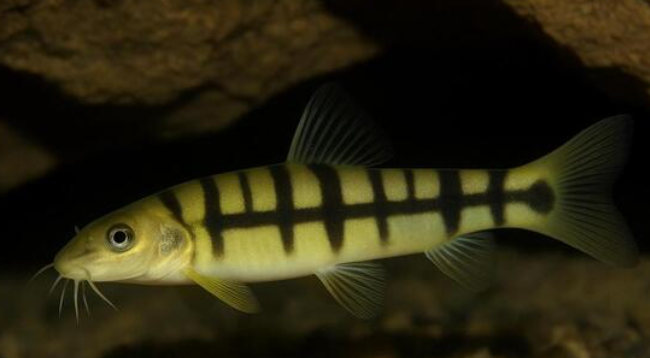
The findings have been published in the Journal of Fish Biology, highlighting the species' unique physical traits and specialized cave habitat. The fish was located in a fast-flowing stream approximately 60 meters inside the cave, where the water temperature is around 18°C and oxygen levels are notably low. Schistura densiclava features a pale yellow-green body adorned with 14–20 greyish-black vertical bars and a distinctive thick dorsal stripe. The name densiclava is derived from Latin, meaning "thick stripe." Unlike obligate cave-dwelling species such as Schistura papulifera, this newly discovered species retains functional eyesight and body pigmentation, enabling it to thrive in multiple environments.
Belonging to the Nemacheilidae family of bottom-dwelling freshwater fishes, the species is equipped with barbels—whisker-like sensory organs—that help detect prey in low-light conditions.
Background
Meghalaya lies within the biologically rich hills of Northeast India, a region linked to the Indo-Burma biodiversity hotspot. High rainfall, limestone caves, subtropical forests, fast-flowing streams and sharp altitudinal variation create many small and isolated habitats. Such habitat diversity promotes endemism, meaning that a species may be restricted to a very small geographical area. Scientific discoveries become meaningful only after formal taxonomic work. Researchers compare morphology, habitat, behaviour and, increasingly, DNA sequences; deposit specimens in recognised collections; and publish the description in a peer-reviewed journal. A new-species report should therefore be distinguished from an unverified sighting or a social-media claim.
Key Features and Important Details
- Date / period – 23 May 2025
- Theme – Environment & Biodiversity
- Core Meghalaya link – Cave-Associated Loach Schistura densiclava Described from Krem Mawjymbuin
- Verification result – Verified from Journal of Fish Biology
Significance for Meghalaya
The development is important for Meghalaya because it reinforces the state's status as a centre of biological diversity and scientific discovery. It also shows why small habitats – a cave stream, an urban forest patch, a hillside shrub zone or a community-managed forest – can have national conservation value. Documentation should lead to habitat assessment, local awareness and carefully designed conservation rather than collection pressure or unregulated tourism.
National and Constitutional Context
Connect the species or ecosystem with taxonomy, endemicity, biodiversity hotspots, conservation methods, protected-area categories and the responsible scientific institution. Learn the scientific name exactly. From an examination perspective, biodiversity news should be connected with habitat protection, the Wildlife (Protection) Act, 1972, ex-situ and in-situ conservation, biodiversity hotspots, community reserves, sacred groves and the role of institutions such as the Zoological Survey of India, Botanical Survey of India and research universities. For preliminary examinations, revise the exact names, date, place, responsible institution and one distinctive feature. For descriptive answers, use the event as an example under the relevant syllabus theme rather than reproducing it as a newspaper summary.
Challenges and Way Forward
The main challenge is to protect habitats while allowing local livelihoods and development. Meghalaya needs stronger field monitoring, community participation, scientific documentation and timely action against habitat loss and pollution.
Important Facts for Prelims
- Date / period – 23 May 2025
- Theme – Environment & Biodiversity
- Core Meghalaya link – Cave-Associated Loach Schistura densiclava Described from Krem Mawjymbuin
- Verification result – Verified from Journal of Fish Biology
Mains Relevance
Connect the species or ecosystem with taxonomy, endemicity, biodiversity hotspots, conservation methods, protected-area categories and the responsible scientific institution. Learn the scientific name exactly. From an examination perspective, biodiversity news should be connected with habitat protection, the Wildlife (Protection) Act, 1972, ex-situ and in-situ conservation, biodiversity hotspots, community reserves, sacred groves and the role of institutions such as the Zoological Survey of India, Botanical Survey of India and research universities. For preliminary examinations, revise the exact names, date, place, responsible institution and one distinctive feature. For descriptive answers, use the event as an example under the relevant syllabus theme rather than reproducing it as a newspaper summary.
Practice Questions
Practice MCQ
Question: With reference to Cave-Associated Loach Schistura densiclava Described from Krem Mawjymbuin, consider the following statements:
- It is directly connected with Meghalaya.
- Its wider relevance can be linked with the category mentioned in this article.
Which of the statements given above is/are correct?
(a) 1 only (b) 2 only (c) Both 1 and 2 (d) Neither 1 nor 2
Answer: (c) Both 1 and 2.
Mains Question
Explain the importance of Cave-Associated Loach Schistura densiclava Described from Krem Mawjymbuin for Meghalaya. Discuss the main implementation challenges and suggest a practical way forward.